Pollinator

Pollinator Garden Design: Layout, Bloom Succession, Habitat

title: "Pollinator Garden Design: Layout, Bloom Succession, Habitat"
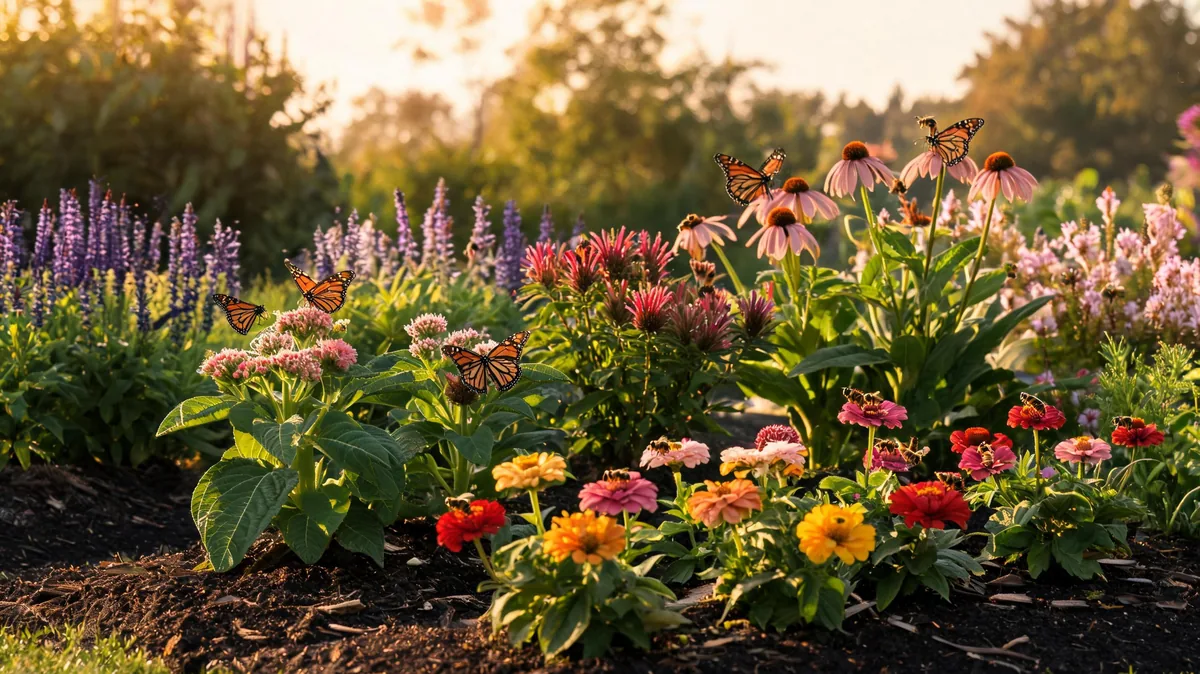
pollinator garden with native wildflowers
Photo: Unsplash on Unsplash

—- title: "Pollinator Garden Design: Layout, Bloom Succession, Habitat" slug: pollinator-garden-design hub: care category: Pollinator description: "How to design a pollinator garden: layout principles, bloom succession from spring to fall, habitat features for nesting, and plant combination strategies backed by Xerces Society research." date: 2026-06-10 updated: 2026-06-10 author: "Thomas A." reading_time: 10 —-

A pollinator garden is not simply a collection of bee-friendly plants. It is a designed system with three functional requirements: food (pollen and nectar from spring through fall), shelter (nesting sites and larval host plants), and protection from pesticides. A garden that provides all three functions year-round for multiple pollinator species requires planning — specifically, planning across time (bloom succession) and space (habitat layering).

This guide covers the design principles behind a functional pollinator garden, based on the framework published by the Xerces Society for Invertebrate Conservation and regional guidance from university Extension programs. The principles apply regardless of garden size — from a 100-square-foot suburban border to a multi-acre restoration.

Design principle 1: bloom succession across the full season

The single most important design decision is ensuring continuous bloom from the earliest spring bee emergence through the latest fall foragers. Most gardens are designed around the summer peak (June—August) and have gaps in April—May and September—October — the two periods when pollinators are most stressed.

The spring gap (March—May)

Per Penn State Extension's pollinator habitat guide, the late-winter through early-spring period is the most critical gap in most landscapes. Native bee queens emerging from overwintering sites in March and April need immediate nectar and pollen. In most suburban landscapes, this need is unmet.

Plants that fill the spring gap:

The summer peak (June—August)

This is where most gardens have adequate coverage. Coneflowers, bee balm, bergamot, catmint, and the tall composites all perform in summer. The design challenge here is not finding plants but avoiding a monoculture of summer composites that all bloom simultaneously and then leave gaps.

Per UMass Extension's native plant guides, staggering the bloom within the summer season — early (June), mid (July), late (August) — ensures continuous resource across the peak season. This is achieved through species selection rather than spacing.

I grow catmint 'Walker's Low' in my Melville border as the June anchor, then coneflower and black-eyed Susan through July and August, then let the switchgrass and Joe Pye weed (nearby) carry into September. The transition is imperfect but there is never more than a few days without something open.

The fall gap (September—October)

Per the Xerces Society, the fall gap is the second most critical seasonal stress point. Bumblebee queens and solitary females need to build fat reserves for overwintering. Migrating monarchs need concentrated nectar sources. Native bees provisioning fall nests need abundant pollen in September.

Native goldenrod (Solidago spp.) and native asters (Symphyotrichum spp.) solve this problem. Both bloom August—October in most of the eastern U.S., overlap with the monarch migration, and are among the top-ranked bee forage plants per the Xerces Society's plant lists. Together they are the most important late-season additions to any eastern pollinator garden.

Design principle 2: plant diversity and structure variety

Diverse pollinator communities require diverse flower structures. Bees with different tongue lengths are physically excluded from flowers that don't match their anatomy.

Per the Xerces Society's Gardening for Bees:

Including plants from multiple flower families — Asteraceae (composites), Lamiaceae (mints and sages), Apiaceae (carrot family), Fabaceae (legumes), and Ranunculaceae (columbine, clematis) — ensures the broadest cross-section of tongue lengths is served.

Design principle 3: scale and massing

Individual plants scattered across a garden provide less pollinator benefit than the same plants grouped in masses. Per Cornell's pollinator research, patch size affects bee visitation rates — larger patches of the same species are more efficiently foraged and attract more individuals per unit of time.

A practical minimum per the Xerces Society is patches of at least 3—5 plants of the same species. In a small garden (under 200 square feet), this means 4—6 species in larger groups rather than 15 species with one plant each.

Design principle 4: habitat features

Flowers are only part of what pollinators need. Nesting habitat, larval host plants, and shelter are the other requirements.

Ground-nesting habitat

Approximately 70% of native bee species nest in the ground, per the Xerces Society's nesting guide. They require:

In practice, this means leaving a patch of bare or lightly mulched soil in a sunny area of the garden. A path edge with compacted-but-not-paved surface, or a south-facing slope with thin mulch, provides adequate conditions.

Stem-nesting habitat

The other 30% of native bees nest in hollow or pithy plant stems (mason bees, leafcutter bees) or holes in wood (orchard mason bees in natural cavities). Per the Xerces Society, supporting these bees requires:

Larval host plants

Adult nectar and pollen plants serve adult pollinators. Larval host plants — milkweed for monarchs, violets for fritillaries, wild cherry and oak for many caterpillar species — serve the next generation. Per Doug Tallamy's research at the University of Delaware, adding native woody plants (oaks, cherries, willows) to a landscape dramatically increases the number of caterpillar species that can complete their life cycle there, which in turn supports bird breeding populations.

Larval host plants are often the most overlooked element of a pollinator garden because they don't look like "pollinator plants" — oaks don't have showy flowers, and caterpillars eating leaves doesn't look like success to most gardeners.

Layout strategies

The island bed

A freestanding island bed surrounded by lawn or paths maximizes solar exposure (critical for most pollinator plants) and allows approach from all sides. Per Penn State Extension, an island bed of 100—200 square feet with 8—12 native species in bloom succession from spring through fall is a realistic target for a suburban yard.

Suggested layout for an island bed, using plant height as a guide:

Integrating natives into existing borders

The alternative to a dedicated native plant garden is integrating native species into existing mixed borders. Per UMass Extension, this approach works well but requires choosing natives compatible with the cultural requirements of existing plants — sun exposure, soil drainage, irrigation frequency.

The most compatible native insertions for typical mixed perennial borders are switchgrass and little bluestem (replacing ornamental miscanthus), coneflower and black-eyed Susan (companion to non-native summer composites), native asters (fall extension of the border), and goldenrod (late-season accent at the back).

Pesticide management

A pollinator garden requires pesticide management appropriate to its purpose. Per the EPA's pollinator protection guidance:

Seasonal maintenance calendar

Per the Xerces Society's pollinator garden management guidance:

SeasonTask
Late winter (Feb–Mar)Cut hollow stems to 12–18 in; leave brush piles for nesting cover
Early spring (Mar–Apr)Remove invasive weed seedlings before they establish
Late spring (Apr–May)Transplant new natives; do not disturb bare soil nest areas
Summer (Jun–Aug)Deadhead selectively (leave seed heads on composites for birds)
Late summer (Aug–Sep)Allow late-season bloom to persist fully; no cutting
Fall (Oct–Nov)Leave standing structure all winter; no fall cleanup of stems
WinterNo intervention; standing stems shelter overwintering insects

The "messy garden" that results from leaving stems and seed heads standing all winter is the correct management approach for a pollinator garden — it is not neglect but deliberate habitat maintenance.

Frequently asked

How big does a pollinator garden need to be?

Per the Xerces Society, there is no minimum size — even a 10-square-foot container planting on a balcony with three species in bloom succession provides measurable forage for urban pollinators. Studies of urban bee diversity find that gardens clustered within a neighborhood provide collectively significant habitat even when individual gardens are small. The practical minimum for supporting a resident population of ground-nesting bees is approximately 100 square feet with a bare-soil patch.

Do I need to water a native pollinator garden?

During establishment (first 2 seasons for most perennials, first 3—4 for native shrubs), regular watering is needed per Penn State Extension. After establishment, most native pollinator gardens require no supplemental irrigation in the East, where summer rainfall generally meets plant needs. In the West, the calculation depends on species selection — California and Great Basin natives are chosen specifically for drought tolerance and should not be irrigated in summer once established.

Can I have a pollinator garden and a deer problem at the same time?

Yes. Per the Rutgers NJAES deer resistance publication, a significant number of high-value pollinator plants are also deer-resistant: goldenrod (B-rated), wild bergamot (B-rated), coneflower (B-rated), switchgrass (A-rated), catmint (A-rated), and most ornamental grasses. The overlap between deer-resistant and pollinator-valuable plants is substantial. See the deer-resistant perennials guide for the full Rutgers-rated list.

How do I deal with invasive plants competing with my native pollinator garden?

Invasive management is the most labor-intensive aspect of native pollinator gardening, particularly in the first 3 years before the native community fills in. Per Cornell Cooperative Extension, pulling or cutting invasives before they set seed is the most effective approach. Herbicide treatment of established invasive woody plants (Oriental bittersweet, multiflora rose, Japanese barberry) is sometimes necessary and appropriate — the ecological cost of persistent invasives outweighs the localized cost of targeted herbicide use.

Recommended gear: Best [clematis cultivars by pruning group](https://outdoorplantcare.com/plants/best-clematis-cultivars/) — our buyer's guide covering picks for every budget, ranked by Extension publication consensus and personal use.

Sources

Sources