Coneflower (Echinacea) care: deadheading and aster yellows disease
Coneflowers live 3 to 5 years. Deadhead for rebloom or leave seed heads for goldfinches. Remove aster yellows-infected plants immediately -- there is no cure.
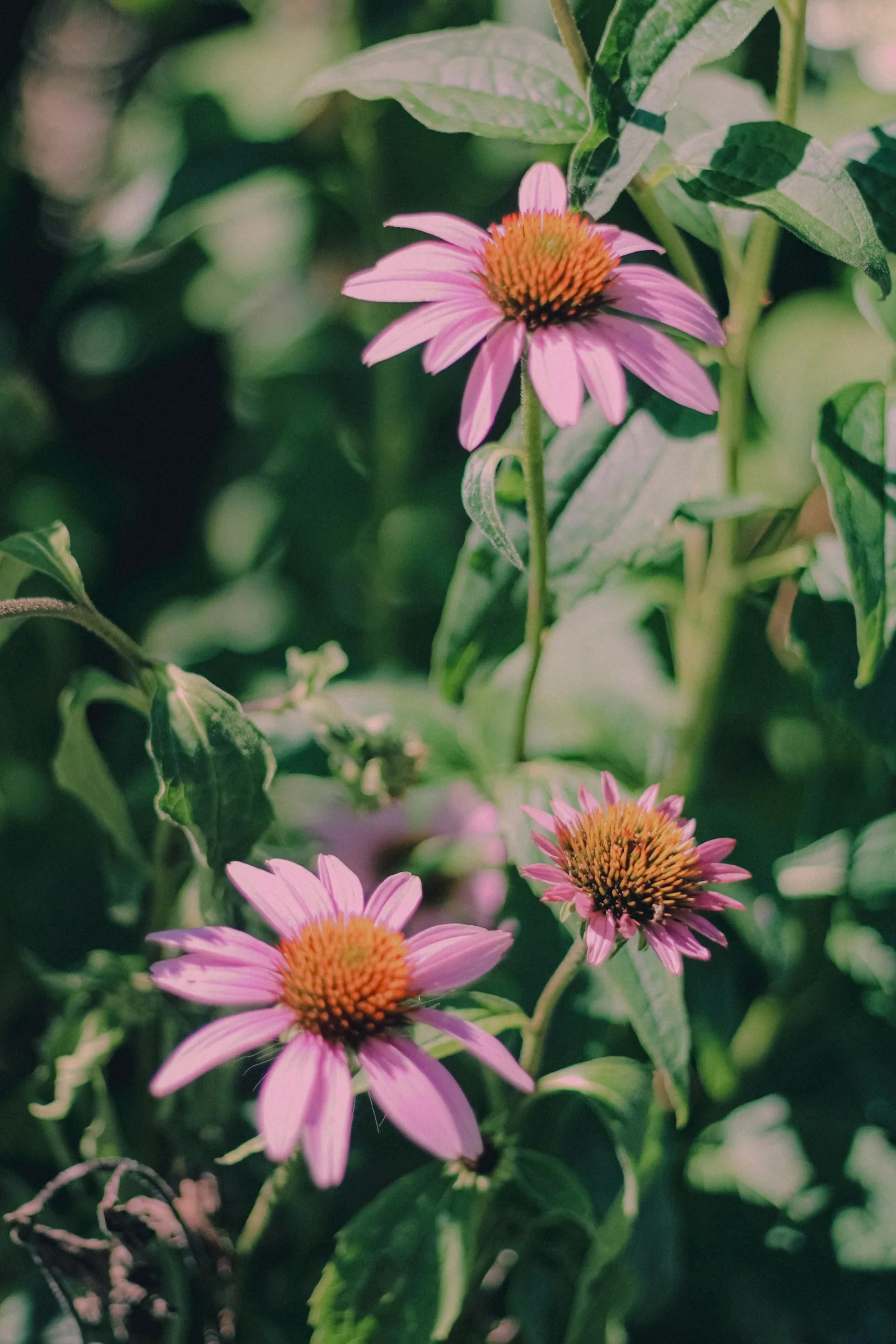
—- title: "Coneflower care" slug: coneflower-care hub: plants category: Species guide description: "I grow Echinacea purpurea in two locations on my Long Island property — a mass planting along a sunny fence line and a smaller group in a mixed border. Both have been there six years. Both are." date: 2026-06-10 updated: 2026-06-10 author: "Thomas A." reading_time: 10 scientific: "Echinacea purpurea" zones_min: 3 zones_max: 9 sun: "full sun" deer_resistant: false native: true pollinator: true bloom: "summer" height_min: 2 height_max: 4 —-
I grow Echinacea purpurea in two locations on my Long Island property — a mass planting along a sunny fence line and a smaller group in a mixed border. Both have been there six years. Both are starting to thin out from the center, which is what Echinacea purpurea does at year five or six as a short-lived perennial. I have been letting the plants self-seed, and the offspring are actually more vigorous than the originals. This is the normal lifecycle of the plant. Understanding it changes how you approach coneflower care.
Which coneflower do you have?
"Coneflower" applies to several genera. In the home garden, it almost always means Echinacea, and within Echinacea, it usually means E. purpurea, the eastern purple coneflower, the most widely sold and most adaptable species.
Echinacea purpurea — eastern purple coneflower
The standard garden coneflower. Per Missouri Botanical Garden Plant Finder, it is "easily grown in average, dry to medium, well-drained soil in full sun to part shade" and is "an adaptable plant that is tolerant of drought, heat, humidity and poor soil." Hardy in zones 3 to 8. Grows 2 to 4 feet tall. Blooms June through August.
Echinacea angustifolia — narrow-leaf coneflower
Native to the Great Plains. Per Clemson HGIC, it reaches 12 to 16 inches tall and is "native to the prairies of Saskatchewan and Minnesota, south to Nebraska and Texas, and is hardy from Zones 2 to 8." More drought-tolerant than E. purpurea but less tolerant of wet soils.
Echinacea pallida — pale coneflower
Per Clemson HGIC, it is native to the prairies of Oklahoma, Kansas, and Missouri and is "hardy from Zones 4 to 8." The flowers have long, narrow, pale petals that droop noticeably from the cone — a different look than the standard purple coneflower.
A note on hybrid cultivars
Breeding has produced coneflowers in orange, yellow, red, coral, and white — the Cheyenne Spirit series, Magnus, Sombrero, PowWow Wild Berry, and many others. These can be beautiful but several caveats apply. First, many hybrid cultivars are shorter-lived than straight E. purpurea. Second, per Missouri Botanical Garden, "freely self-seeds if at least some of the seed heads are left in place" — but hybrid seeds do not breed true. If you want a self-sustaining colony, straight species or species-type cultivars like 'Magnus' and 'White Swan' are better choices.
USDA hardiness zones
Echinacea purpurea: Zones 3 to 8 per Missouri Botanical Garden. NC State Extension Plant Toolbox gives zones 3a through 8b. Clemson HGIC extends this to zones 3 to 9 depending on species.
On Long Island in zone 7a, coneflowers are fully reliable. I have lost plants to extended waterlogging but never to cold.
Light
Per Missouri Botanical Garden, coneflowers grow in "full sun to part shade" but perform best in full sun. Per Clemson HGIC, plants "will perform best in an area with full sun to part shade" with a minimum of 6 to 8 hours of direct sunlight.
Partial shade is tolerable — the plants will grow — but flowering is reduced and stems tend to get lax. In zones 8 and warmer, per NC State, some afternoon shade is beneficial to prevent bleaching of flowers. In zones 3 through 7, full sun is always better.
Watering
Per Missouri Botanical Garden, coneflowers are "tolerant of drought" once established. Per NC State Extension, they are "drought tolerant once established."
In the first growing season, water new transplants weekly during dry spells. After establishment, I water my coneflower plantings only during genuine droughts — stretches of 3 or more weeks without rain in mid-summer. The plants tolerate this without complaint. What they do not tolerate is wet feet. Poor drainage is a far more common killer than drought.
Per Clemson HGIC: "Avoid overhead irrigation." Wet foliage promotes fungal leaf spot. A soaker hose or drip irrigation at the root zone is better.
Soil
Per Missouri Botanical Garden: coneflowers grow in "average, dry to medium, well-drained soil" and tolerate "drought, heat, humidity and poor soil." Per NC State Extension, they grow in clay, high organic matter, loam, sand, and shallow rocky soils, with a neutral pH of 6.0 to 8.0 preferred.
The message here is generous: coneflowers are not demanding about soil texture or fertility. What they require is drainage. If water stands in your planting bed for more than a few hours after heavy rain, raise the bed or choose a different site.
Fertilizing
Coneflowers do not need regular fertilization in reasonably fertile soil. Per Clemson HGIC, "coneflowers are not heavy feeders." In the absence of a soil test, an application of 12-6-6 slow-release fertilizer at 1 pound per 100 square feet in late March or early April is adequate. Per Missouri Botanical Garden, the plant tolerates "poor soil" — over-fertilizing produces lush foliage and may actually shorten lifespan by stressing the crown.
The lifespan question: 3 to 5 years
Coneflowers are short-lived perennials. Per NC State Extension, the plants are listed as "perennial" but the honest reality is that most plants under typical garden conditions last 3 to 5 years before declining from the center. This is not a disease or care failure. It is the plant's natural lifespan.
The practical response is to allow self-seeding. Per Missouri Botanical Garden, coneflowers "freely self-seeds if at least some of the seed heads are left in place." Leave some flowers standing through the fall and winter, and new seedlings will fill in around the aging clumps. Alternatively, divide clumps per Missouri Botanical Garden's guidance: "Divide clumps when they become overcrowded (about every 4 years)" to rejuvenate the planting.
Deadheading: extend bloom or feed birds
This is the central care decision with coneflowers, and both choices are correct depending on your goals.
Deadheading extends bloom. Per Missouri Botanical Garden, "plants usually rebloom without deadheading, however prompt removal of spent flowers improves general appearance." Per Clemson HGIC, "deadheading should be delayed as seed heads are very attractive to goldfinches in the winter."
Leaving seed heads feeds birds. Per NC State Extension, "leave some flower heads on to produce seeds for birds." Per Missouri Botanical Garden, "the blackened cones may be visited by goldfinches or other birds that feed on the seeds."
The practical compromise I use in my own yard: deadhead actively through July and August to encourage rebloom, then stop in September and let the late-season cones develop fully for birds and winter structure. Leave the standing stems through winter and cut back to the ground in late February or early March before new growth emerges.
Aster yellows — the disease that requires action
Aster yellows is the most important disease problem in coneflowers, and it requires a different response than any fungal or bacterial issue. There is no treatment.
Per Missouri Botanical Garden, aster yellows is a disease caused by a phytoplasma — not a fungus, not a bacterium in the conventional sense — that infects over 300 plant species. Per Illinois Extension, the pathogen is transmitted by the aster leafhopper (Macrosteles quadrilineatus). Insects become infected by feeding on infected plants, then carry the phytoplasma for the remainder of their 30-to-90-day lifetime, spreading it with each feeding.
Symptoms per Missouri Botanical Garden: chlorosis (yellowing between leaf veins while veins stay green), stunted or distorted growth, narrow leaves, deformed flower heads with tufts of distorted leaf-like tissue growing inside the flower, flowers that do not open or produce seeds normally.
What to do: Per Illinois Extension, "if you identify infected plants, they need to be completely removed from the landscape, roots and all, since they serve as a constant reservoir for the pathogen." The phytoplasma cannot survive in soil — it requires living plant tissue. Remove the plant immediately to stop spreading to neighboring susceptible plants (including Rudbeckia, zinnia, marigold, petunia, and chrysanthemum). Do not compost infected material.
Per Missouri Botanical Garden: "Once a plant is infected with aster yellows, it is a lost cause since the disease is incurable." Replanting coneflowers in the same spot is fine, since the pathogen does not persist in soil. Managing surrounding weeds (dandelions, wild carrot, and other broad-leaf weeds that can harbor aster yellows) reduces the local reservoir.
Distinguishing aster yellows from eriophyid mite damage
Per Clemson HGIC, eriophyid mites are microscopic and live inside flower buds, producing "tufts of stunted and distorted flower parts sprouting from the coneflower." This looks similar to aster yellows deformation. The important distinction: eriophyid mite damage can be treated. Cut back affected plants to the ground in fall, remove all debris, and apply horticultural oil or miticide before bud break the following spring. Aster yellows cannot be treated — the whole plant must be removed. If you are unsure which problem you have, examine the leaf tissue: chlorosis (yellowing between veins) points strongly toward aster yellows.
Pests
Japanese beetles per Missouri Botanical Garden are "occasional problems" on coneflowers. Hand-picking in early morning when beetles are lethargic is effective for small populations. Per Clemson HGIC, insecticidal soap is an option for larger infestations.
Rabbits per Clemson HGIC, "can also be a major problem by eating the foliage down to ground level." Protect new plantings with hardware cloth until established.
Common problems
| Symptom | Most likely cause | Fix |
|---|---|---|
| Deformed tufted flowers, yellowing between leaf veins | Aster yellows (phytoplasma, no cure) | Remove entire plant, roots and all, immediately |
| Deformed tufted flowers, no leaf discoloration | Eriophyid mite damage | Cut to ground in fall; horticultural oil before bud break next spring |
| Plant declines from center, outer growth healthy | Normal short-lived perennial aging (5+ years) | Divide or allow self-seeding to rejuvenate |
| Wilting in hot weather, soil is wet | Root rot from poor drainage | Improve drainage; do not plant in soggy sites |
| White powder on leaves | Powdery mildew | Improve air circulation; avoid overhead watering |
| Brown or black spots on leaves | Fungal leaf spot | Same; remove infected foliage |
| Plants leggy and flopping | Too much shade or soil too rich | Move to full sun; reduce nitrogen |
| Flowers chewed, skeletonized | Japanese beetles | Hand-pick; insecticidal soap for heavy infestations |
Recommended gear: Best Soaker Hose for Vegetable Gardens (2026) — our buyer's guide covering picks for every budget, ranked by Extension publication consensus and personal use.
Frequently asked
Are coneflowers perennial?
Yes, but with a caveat. Echinacea purpurea is a perennial, but a short-lived one — per NC State Extension, it is listed as perennial, but most plants in garden conditions last 3 to 5 years before declining. The planting can sustain itself if you allow self-seeding, per Missouri Botanical Garden, which notes plants "freely self-seeds if at least some of the seed heads are left in place." If individual plants die, offspring seedlings fill in around them.
Should I deadhead coneflowers?
Deadheading extends the bloom season — per Missouri Botanical Garden, "prompt removal of spent flowers improves general appearance" and encourages rebloom. But leaving seed heads provides real ecological value: per Clemson HGIC, "seed heads are very attractive to goldfinches in the winter." A practical approach: deadhead through summer for rebloom, then leave the final cones of the season to stand through winter for birds.
What is wrong with my coneflower flowers — they look weird and tufted?
Two possibilities. Per Illinois Extension, aster yellows phytoplasma produces deformed, tufted flower heads along with chlorotic (yellowed between the veins) leaves. Per Clemson HGIC, eriophyid mite infestation produces similar-looking tufted flowers but without the leaf chlorosis. Check the leaves: yellowing between veins = aster yellows, remove whole plant. Tufted flowers with normal leaf color = eriophyid mites, treatable.
How do I keep coneflowers coming back?
Allow self-seeding. Per Missouri Botanical Garden, coneflowers "freely self-seeds if at least some of the seed heads are left in place." Leave seed heads standing over winter and new plants will appear around the base of aging clumps in spring. Divide clumps every 4 years per Missouri Botanical Garden to rejuvenate them, and plant new transplants to replace ones lost to age or disease.
Sources
- Missouri Botanical Garden Plant Finder — Echinacea purpurea.
- Missouri Botanical Garden — Aster Yellows.
- NC State Extension Plant Toolbox — Echinacea purpurea.
- Clemson HGIC — How to Grow Echinacea (Coneflower).
- Illinois Extension — Aster Yellows on Coneflower.
