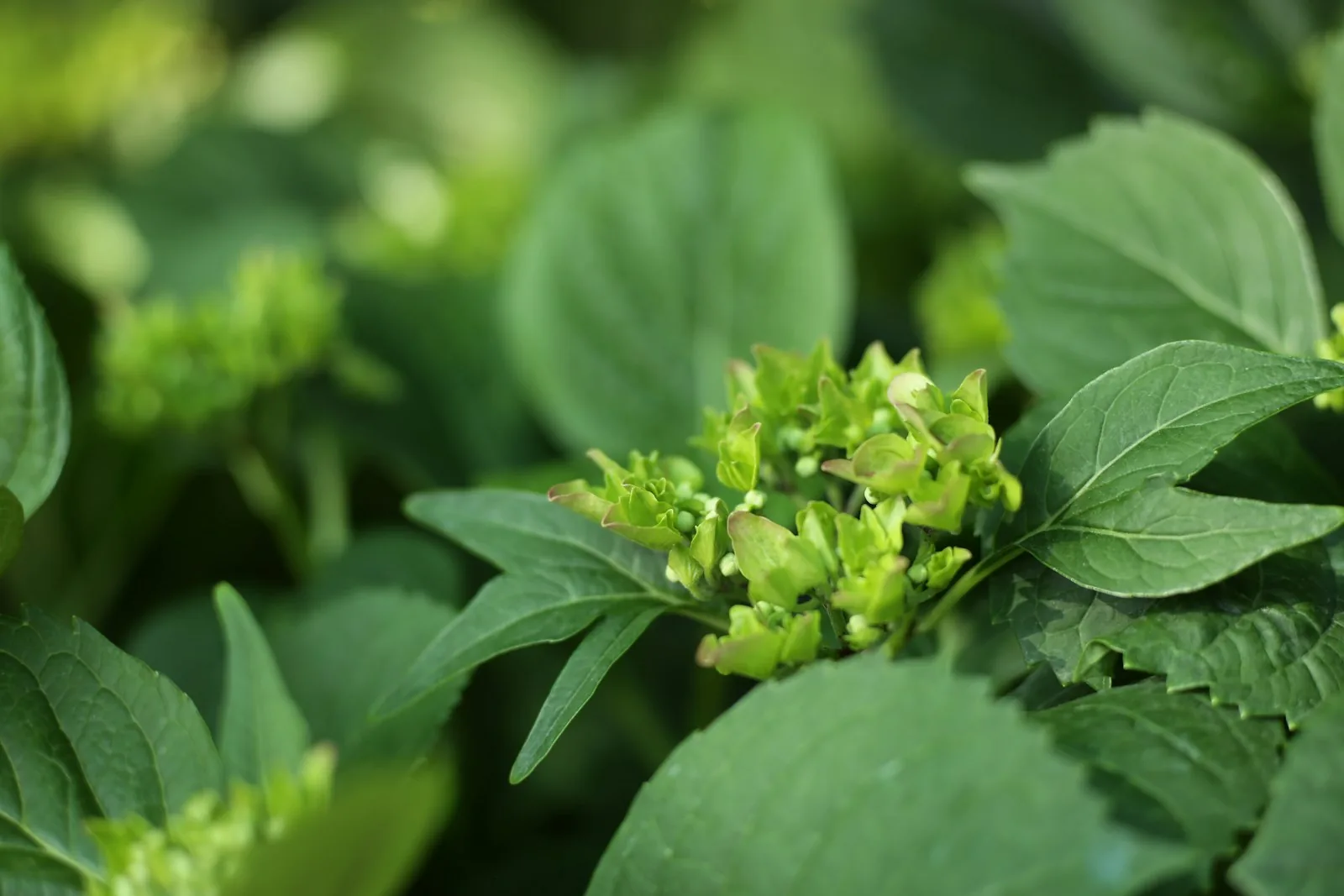
Why Isn't My Hydrangea Blooming? Six Real Causes
title: "Why Isn't My Hydrangea Blooming? Six Real Causes"
—- title: "Why Isn't My Hydrangea Blooming? Six Real Causes" slug: hydrangea-not-blooming hub: problems category: Problem description: "Hydrangea not blooming? The cause depends on your species. Pruning timing, winter bud kill, and too much shade account for most cases. Here's how to diagnose each one." date: 2026-06-10 updated: 2026-06-10 author: "Thomas A." reading_time: 9 —-
A hydrangea that refuses to bloom is one of the most common garden complaints, and the fix depends entirely on which species you have. Hydrangea macrophylla (bigleaf, mophead, lacecap) fails to bloom for completely different reasons than H. paniculata (panicle, PeeGee, Limelight) or H. arborescens (smooth, Annabelle). Applying the wrong solution — say, pruning advice for one species to a plant that blooms differently — will not help and may make the problem worse.
I grow both H. paniculata and H. macrophylla in my Melville yard (zone 7a). The mophead on the east side of the house refused to bloom for two summers after I moved it — that was transplant shock. The paniculata I've never had a problem with, because it blooms on new wood and there's very little you can do wrong with it from a bloom standpoint.
Table of Contents
- Identify Your Species First
- The Six Causes of Bloom Failure
- Species-Specific Diagnosis
- Common Situations Table
- Frequently Asked
Identify Your Species First
Per Penn State Extension's hydrangea guide, the most important step in diagnosing a non-blooming hydrangea is knowing which species you're dealing with, because bloom timing and wood type differ completely.
Quick species ID:
| Species | Flower shape | Color changes with pH? | Blooms on |
|---|---|---|---|
| H. macrophylla | Round mophead or flat lacecap | Yes — blue in acid, pink in alkaline | Old wood (mostly) |
| H. serrata | Lacecap; smaller than macrophylla | Yes | Old wood |
| H. paniculata | Cone-shaped (panicle) | No — white to pink to green | New wood |
| H. arborescens | Large round; usually white | No | New wood |
| H. quercifolia | Elongated panicle; oak-shaped leaves | No | Old wood |
Per University of Minnesota Extension, knowing whether your plant blooms on old wood or new wood is the single most important piece of information for diagnosing bloom failure and choosing the correct pruning time.
The Six Causes of Bloom Failure
1. Winter Flower Bud Kill (Old-Wood Species)
The most common cause of H. macrophylla bloom failure in zones 5—7. Per Penn State Extension, H. macrophylla forms next year's flower buds in August and September on the current season's growth. These buds overwinter on the stems. In a cold winter — temperatures dropping below approximately 0°F to -5°F depending on the variety — the buds freeze and die. The plant looks healthy in spring (the stems survived) but has no flower buds to open.
In my zone 7a garden, this happens roughly one winter in three on standard mophead varieties. The winters of 2021—22 and 2022—23 were cold enough to kill buds on standard varieties while reblooming varieties ('Endless Summer', 'Let's Dance' series) still produced some flowers.
Fix: Switch to a reblooming variety that produces flower buds on both old and new wood, or switch to H. paniculata or H. arborescens, which bloom on new wood and are unaffected by bud kill. Per Penn State Extension, winter protection (burlap wrapping, wire cage filled with leaves around the plant) can help protect buds in borderline climates.
2. Wrong-Time Pruning
The second most common cause for H. macrophylla and H. quercifolia. Per University of Minnesota Extension, the standard advice to "prune in late winter or early spring" — which is correct for roses, H. paniculata, and many other shrubs — will remove all the flower buds on an old-wood hydrangea.
For H. macrophylla, prune only immediately after flowering (before August), when the buds that will bloom next year have not yet formed. Per University of Minnesota Extension, pruning after late August removes next season's buds.
Fix: Do not prune H. macrophylla or H. quercifolia in fall or winter. For these species, the only acceptable time to prune is right after flowering ends. Remove only dead wood, crossing stems, and spent blooms. Never cut to the ground.
3. Too Much Shade
All hydrangea species need a minimum of 4 hours of direct sun for reliable bloom. Per Penn State Extension, "inadequate sunlight" is one of the top documented causes of poor bloom performance.
In my yard, a H. macrophylla I planted on the north side of a fence — where it received filtered light but rarely direct sun — produced leaves in abundance and virtually no flowers. The same plant, moved to the east-facing bed with morning sun, bloomed the following season.
Fix: If the plant is in deep shade, transplanting is the only real solution. Choose a site with morning sun and afternoon shade — the standard eastern U.S. hydrangea prescription.
4. Too Much Nitrogen
Excess nitrogen produces lush, dark green foliage and suppresses flowering. Per Penn State Extension, lawn fertilizer applied near hydrangeas is the most common source. High-nitrogen products encourage vegetative growth at the expense of bloom.
Fix: Per Clemson HGIC's hydrangea fertilization guide, a single spring application of a balanced slow-release fertilizer (10-10-10 or similar) is the correct approach. Do not apply fertilizer in late summer or fall. Keep high-nitrogen lawn fertilizer applications away from the root zone of hydrangeas.
5. Deer Browse
Per Penn State Extension, deer browse the young growth and flower buds of H. macrophylla and H. quercifolia during winter and early spring, removing the very tissue that would have flowered. The damage is often invisible — the plant looks fine but the buds are gone.
In Melville, deer pressure is moderate-to-high year-round. In winter, when other food sources are scarce, hydrangea buds are a target. A plant that bloomed two years ago but has not bloomed since, with no other apparent cause, should be inspected for deer browse damage to the stem tips in winter.
Fix: Per Rutgers NJAES's deer resistance ratings, hydrangeas are rated "occasionally severely damaged" to "rarely damaged" depending on local deer pressure. Fencing, wire cages around individual shrubs in winter, or repellent programs (reapplied after rain and snow, per manufacturer labeling) are the realistic options.
6. Plant Is Too Young
Per Penn State Extension, a newly planted hydrangea may not bloom for one to two years while it establishes its root system. During this period, the plant is investing energy in root development rather than reproduction.
Fix: Patience. If the plant was installed correctly (appropriate sun, drainage, soil preparation) and is otherwise healthy, it will bloom when it reaches maturity.
Species-Specific Diagnosis
Use this when you know your species and want to go straight to the likely cause:
| Species | Blooms on | Most likely bloom failure cause | First action |
|---|---|---|---|
| H. macrophylla (mophead/lacecap) | Old wood | Winter bud kill or wrong-time pruning | Switch to reblooming variety; prune only after flowering |
| H. serrata | Old wood | Same as macrophylla | Same as macrophylla |
| H. paniculata (panicle, Limelight) | New wood | Deep shade or very young plant | Move to sunnier site; wait if newly planted |
| H. arborescens (Annabelle) | New wood | Deep shade or too young | More sun; check it isn't cut too heavily too late |
| H. quercifolia (oakleaf) | Old wood | Deer browse or wrong-time pruning | Check bud tips in winter; prune only after bloom |
Common Situations Table
| What you observe | Species | Most likely cause | Fix |
|---|---|---|---|
| Healthy plant, no buds, zone 5—6 | H. macrophylla | Winter bud kill | Reblooming variety or H. paniculata |
| Pruned in spring, no blooms | H. macrophylla or H. quercifolia | Removed flower buds | Wait; prune only after flowering next year |
| Dense shade, full canopy above | Any | Insufficient light | Transplant or prune canopy above |
| Lush leaves, no flowers; lawn fertilizer nearby | Any | Excess nitrogen | Stop nitrogen; use balanced fertilizer in spring only |
| Stem tips browsed, uneven growth | Any (zone 7a suburbs) | Deer browse | Protect with fencing or repellent program |
| Planted last year, no bloom | Any | Too young | Wait one more year |
Frequently Asked
Should I cut back my mophead hydrangea if it didn't bloom?
No. Per University of Minnesota Extension, cutting back a H. macrophylla in fall or winter removes the flower buds for next season. The only appropriate time to prune a mophead is immediately after it finishes blooming, before August. If the plant has not bloomed at all, do not prune it — remove only dead wood (stems that snap rather than bend) in early spring.
Does Epsom salt help hydrangeas bloom?
Per Penn State Extension, there is no reliable evidence that Epsom salt (magnesium sulfate) promotes hydrangea blooming. Magnesium deficiency can cause leaf yellowing, and Epsom salt may address that specific symptom, but if the plant is not blooming because of bud kill, pruning timing, or shade, Epsom salt will not help. The common advice to apply Epsom salts for bloom promotion is not supported by extension research.
My hydrangea bloomed for years and then stopped. What changed?
The most common causes of a sudden change in bloom performance after years of success: (1) an unusually cold winter killed the flower buds; (2) a pruning was done at the wrong time — perhaps by someone unfamiliar with hydrangea pruning timing; (3) a tree or shrub nearby grew large enough to increase shade significantly; (4) deer pressure increased. Per Penn State Extension, each of these is documented as a cause of bloom failure in established plants.
Are 'Endless Summer' hydrangeas really reliable bloomers?
More reliable than standard H. macrophylla, but not unconditionally so. Per University of Minnesota Extension, 'Endless Summer' and similar reblooming varieties produce flower buds on both old and new wood, meaning that even if winter kills the old-wood buds, new buds will form on the current season's growth. However, the flowers produced on new wood are often smaller and fewer than those produced on old wood. In extreme winters (zone 5 or north), even reblooming varieties may show poor bloom. They are a meaningful improvement over standard varieties in cold climates, but are not a guarantee.
—-
Recommended gear: The 10 best hydrangea cultivars by type (mophead, paniculata, oakleaf) — our buyer's guide covering picks for every budget, ranked by Extension publication consensus and personal use.
Sources
- Penn State Extension — <a href="https://extension.psu.edu/hydrangeas">Hydrangeas</a>.
- University of Minnesota Extension — <a href="https://extension.umn.edu/trees-shrubs/hydrangeas">Hydrangeas for Minnesota Landscapes</a>.
- Clemson HGIC — <a href="https://hgic.clemson.edu/factsheet/hydrangea/">Hydrangea</a>.
- Rutgers NJAES — <a href="https://njaes.rutgers.edu/deer-resistant-plants/">Landscape Plants Rated by Deer Resistance</a>.
Sources
- Penn State Extension — Hydrangeas.
- University of Minnesota Extension — Hydrangeas for Minnesota Landscapes.
- Clemson HGIC — Hydrangea.
- Rutgers NJAES — Landscape Plants Rated by Deer Resistance.