Species guide

Butterfly bush (Buddleia) care: invasive status by state and how to grow responsibly

Standard Buddleja davidii is a declared noxious weed in Oregon and Washington. In those states and beyond, sterile cultivars like the Lo & Behold series are the responsible choice -- and they perform well.

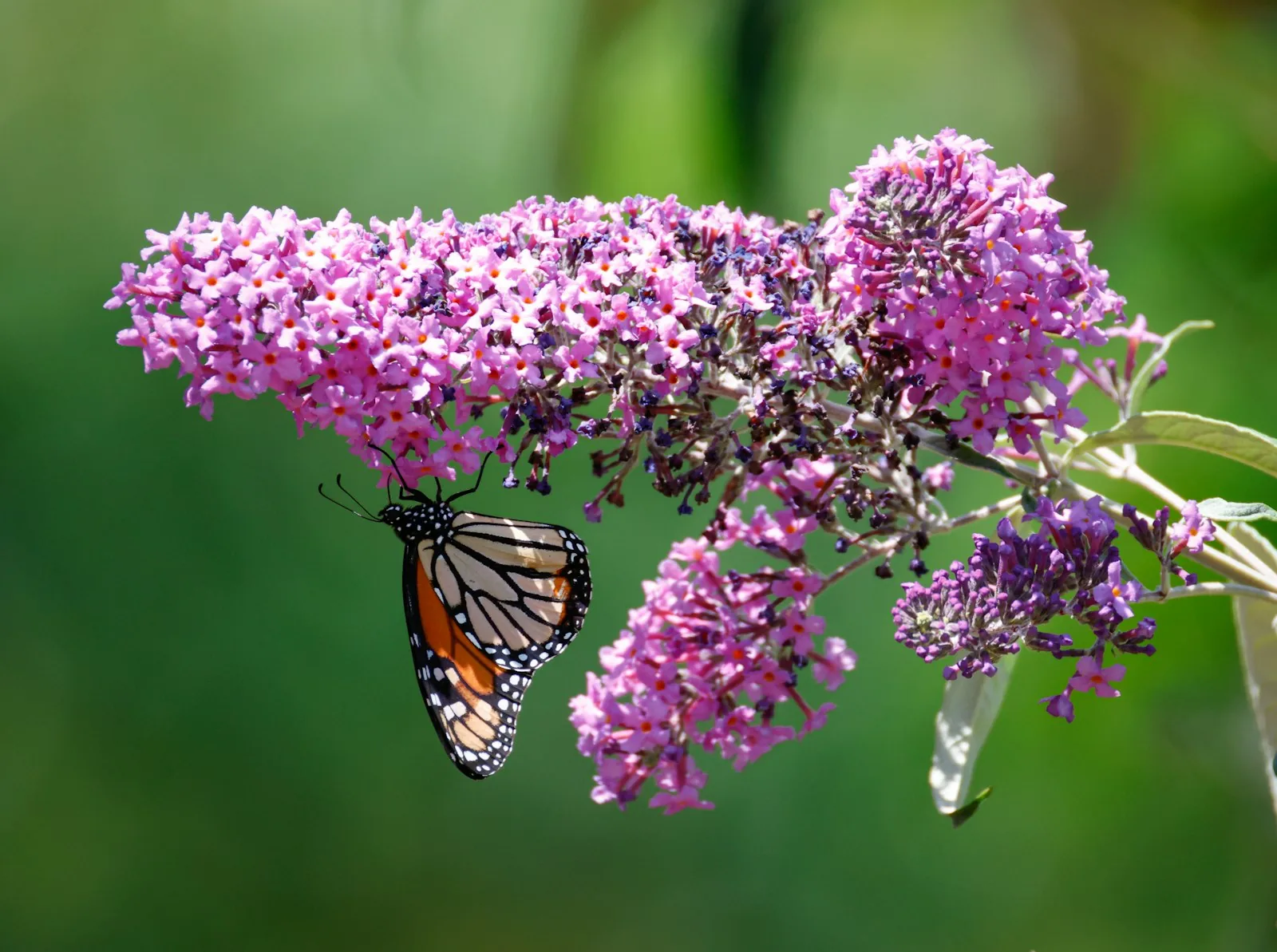
A monarch butterfly rests on vibrant purple flowers
Photo: Unsplash on Unsplash

—- title: "Butterfly bush care" slug: butterfly-bush-care hub: plants category: Species guide description: "Before we get into how to grow butterfly bush, we need to talk about where you." date: 2026-06-10 updated: 2026-06-10 author: "Thomas A." reading_time: 11 scientific: "Buddleja davidii" zones_min: 5 zones_max: 9 sun: "full sun" deer_resistant: true native: false pollinator: true bloom: "summer" height_min: 4 height_max: 10 —-

Before we get into how to grow butterfly bush, we need to talk about where you live.

Buddleja davidii — the common butterfly bush — has been declared a noxious weed in Oregon and Washington state, where it has escaped gardens and colonized roadsides, riverbanks, and disturbed areas. Per Missouri Botanical Garden, it "has escaped gardens and naturalized in the eastern U.S. plus Washington, Oregon, California and Hawaii." Per Oregon State Extension, Buddleja davidii is specifically named as an invasive plant that "spreads by means of seeds" and requires aggressive deadheading management.

If you are in Oregon or Washington, the guidance is simple: plant only certified sterile cultivars, or choose a different plant entirely. The good news is that sterile alternatives exist and perform well.

I don't grow butterfly bush at my Long Island yard. The deer pressure is moderate-to-high here, and butterfly bush makes the approved plant list for deer-resistant shrubs. But my south-facing yard runs full afternoon sun, and I've had enough plant projects competing for attention that I haven't added this one. The guide below is built from Missouri Botanical Garden, NC State Extension Plant Toolbox, Penn State Extension's invasive species context, and Oregon State Extension.

The invasive status question

Per Missouri Botanical Garden, standard B. davidii has been "declared a noxious weed in Oregon and Washington" and "aggressive spreading has been observed in a number of eastern states including Pennsylvania, New Jersey, West Virginia, Kentucky and North Carolina."

Per Oregon State Extension: if you grow a plant that "spreads by means of seeds, such as purple butterfly bush (Buddleia davidii), aggressively deadhead the plant. Be sure to remove the spent flowers well before seeds have time to mature."

Per Oregon State Extension, "dispose of invasive plant materials by bagging and placing them in the garbage. Most home compost methods cannot kill the seeds or plant parts that will ultimately continue to spread the plants unless the compost reaches uniformly high temperatures (such as 140°F)." Do not compost deadheaded butterfly bush flower spikes.

What this means practically:

Species identification and cultivar types

**Standard Buddleja davidii:** Per Missouri Botanical Garden, a deciduous shrub that "typically grows to 6-12 feet (less frequently to 15 feet) tall with a spread to 4-15 feet wide when not killed back by cold winter temperatures." Arching stems, fragrant flowers in dense panicles up to 12 inches long, July through frost. Excellent butterfly nectar source; produces abundant viable seed.

Lo & Behold series (sterile): Bred by Dr. Dennis Werner at NC State University. Per NC State Extension Plant Toolbox, 'Blue Chip' "produces few seeds and infrequently suckers in the garden" and is "approved for sale in Oregon and Washington." Per NC State Extension, 'Blue Chip' has "small, distorted anthers, and low pollen production" and is "very low fertility and effectively sterile." Heights in this series range from 1.5-3 feet — compact, well-suited to smaller spaces.

Other sterile and low-fertility cultivars include 'Miss Ruby', 'Miss Molly', and the Flutterby series, per RHS border buddleja guidance.

USDA hardiness zones

Per NC State Extension Plant Toolbox, the Lo & Behold series is hardy in USDA zones 5a-9b — one of the widest ranges of any flowering shrub. Standard B. davidii is similar in cold hardiness.

Per Missouri Botanical Garden: "In USDA Zones 5 and 6, this plant will often die to the ground in winter and therefore is often grown therein in the manner of an herbaceous perennial." The roots survive even when top growth is killed back to the ground, and the plant re-sprouts from the crown in spring.

USDA zonesWinter behavior
Zones 5-6Often dies to ground; resproutes from crown in spring
Zone 7May die to ground in harsh winters; partially survives in mild winters
Zones 8-9Evergreen to semi-evergreen; stems typically survive

Light and site requirements

Per Missouri Botanical Garden, butterfly bush "becomes weedy and sparse with diminished flowering performance if not grown in full sun." This is non-negotiable: 6 or more hours of direct sun daily. A butterfly bush in partial shade will grow, but the flowering will be disappointing.

Soil: Per Missouri Botanical Garden, easily grown in "average, medium moisture, well-drained soils in full sun." Per NC State Extension, Lo & Behold Blue Chip "may become weedy with diminished flowering if not grown in full sun" and requires "moderate moisture" — the plant "may suffer from root rot if the soil is consistently wet." Well-drained soil is essential, especially in clay.

Per NC State Extension: "When planted in clay soil, the soil should be amended with compost and the base of the plant should be planted slightly above ground level." Planting slightly high improves drainage around the crown.

Drought tolerance: Once established, per NC State Extension, butterfly bush is "drought tolerant." It does not need consistent irrigation once roots are established.

Pruning

This is where butterfly bush care diverges from what many gardeners expect.

Annual hard pruning in late winter: Per Missouri Botanical Garden: "Even if plants do not die to the ground in winter, they often grow more vigorously, produce superior flowers and maintain better shape if cut close to the ground in late winter each year." The standard recommendation is to cut all stems back to 6-12 inches in late winter or early spring when you see new growth beginning at the base.

Per NC State Extension Plant Toolbox: "In regions where above-ground shoots survive over winter, pruning to the ground in late winter will produce more vigorous growth in the spring, give the plant a better shape, and produce more flowers."

Why this works: Butterfly bush blooms on the current season's new growth. The longer and more vigorous that new growth, the longer and more impressive the flower spikes. A plant that was cut to the ground in February has had the entire growing season to build stem length. A plant left unpruned carries over twiggy old growth that produces shorter, less impressive spikes.

Deadheading during the season: Per Missouri Botanical Garden: "Prompt removal of spent flower spikes during the growing season will usually encourage continued bloom until frost." This is also the invasive-control step: removing spent spikes before seeds mature prevents self-seeding. For standard B. davidii, this is essential in areas near natural lands. For sterile Lo & Behold types, per NC State Extension, "deadheading encourages additional blooms but is not otherwise necessary" from a seed-spread standpoint.

Timing for deadheading: As soon as individual florets start browning and falling, cut the entire spike back to the nearest strong lateral bud or to the base of the spike. Don't wait until the entire spike is brown — some seeds will have formed by then.

Fertilizing

Missouri Botanical Garden does not list a specific fertilizer recommendation, which is consistent with butterfly bush's reputation as a low-maintenance plant once established. A single application of a balanced slow-release fertilizer in early spring — when new growth is just beginning — is standard practice. High-nitrogen fertilizers encourage vegetative growth over flowers, the same pattern seen with most flowering shrubs.

Pests and diseases

Per Missouri Botanical Garden: "no serious insect or disease problems." Per NC State Extension Plant Toolbox: "Spider mites can become a problem during drought. Nematodes are an occasional pest problem."

Spider mites: More common on water-stressed plants. Per NC State Extension, Lo & Behold Blue Chip may suffer from spider mites during drought. Keep plants adequately watered during extreme heat. If spider mite damage appears (stippling, bronzing, fine webbing on undersides of leaves), apply insecticidal soap or horticultural oil spray.

Root rot: Per NC State Extension, root rot can occur if soil is "consistently wet." Avoid overwatering and ensure excellent drainage, particularly in clay soils.

Butterfly bush and pollinators — the honest picture

The marketing for butterfly bush leans heavily on pollinator benefits, and the flowers are genuinely attractive to butterflies — adult butterflies visit for nectar. But the plant is not a butterfly host plant. Per RHS: "All buddleja are loved by pollinators, the nectar-rich flowers are irresistible to butterflies."

The ecological complication: B. davidii is native to China, not North America. It supports adult butterflies as a nectar source but does not support the larval stage of North American butterfly species. If supporting the full butterfly life cycle is your goal, native nectar plants combined with larval host plants (milkweed for monarchs, native violets for fritillaries, willows and cherries for many species) are more ecologically effective. Butterfly bush fills the nectar gap from midsummer through frost — a period when many native nectar plants have finished — which is its real garden value.

The deer question

Per NC State Extension Plant Toolbox, Lo & Behold Blue Chip has "resistance to challenges: Deer." Standard B. davidii is generally considered deer-resistant. This makes it appealing for suburban sites with deer pressure — though "deer resistant" is a spectrum, not a guarantee, and varies by local deer population and available alternatives.

Common problems

SymptomMost likely causeFix
Few or short flower spikesNot pruned hard enough; insufficient sunHard prune to 6-12 inches in late winter; confirm full sun site
Plant dies to ground in winterNormal in zones 5-6Cut back dead stems; wait for regrowth from crown in spring
Seedlings appearing around parent plantStandard B. davidii setting seedDeadhead spent spikes before seed matures; switch to sterile cultivar
Spider mite stippling on leavesDrought stressIncrease watering; apply insecticidal soap
Root rot, wilting despite waterWaterlogged soilImprove drainage; plant slightly high in clay soils
Sparse, leggy growthOld wood from skipped pruning yearHard prune in late winter; new growth will be more vigorous
Recommended gear: Best Insecticidal Soap: How Potassium Salts Kill Soft-Bodied Pests — our buyer's guide covering picks for every budget, ranked by Extension publication consensus and personal use.

Frequently asked

Is butterfly bush invasive in my state?

Per Missouri Botanical Garden, standard Buddleja davidii has been declared a noxious weed in Oregon and Washington. Aggressive spreading has been observed in Pennsylvania, New Jersey, West Virginia, Kentucky and North Carolina. The plant has naturalized across much of the eastern U.S. and in California and Hawaii. Per Oregon State Extension, if you grow it where seeding is a concern, aggressively deadhead before seeds mature. If you are in Oregon or Washington, use only certified non-invasive sterile cultivars like the Lo & Behold series, which per NC State Extension are "approved for sale in Oregon and Washington."

When should I prune butterfly bush?

In late winter or very early spring, when you see new growth beginning to emerge at the base of the plant. Per Missouri Botanical Garden, cutting close to the ground each year "often grows more vigorously, produce superior flowers and maintain better shape" compared to plants left unpruned. Per NC State Extension, in zones where stems survive winter, pruning to the ground in late winter produces "more vigorous growth in the spring" and "more flowers." Do not prune in fall — late pruning removes what little frost protection the old stems provide and stimulates tender regrowth that frost will damage.

What are the best non-invasive butterfly bush alternatives?

The Lo & Behold series from NC State University is the primary recommendation for gardeners who want butterfly bush performance without the invasive risk. Per NC State Extension Plant Toolbox, 'Blue Chip' is "very low fertility and effectively sterile" and is "approved for sale in Oregon and Washington." Heights of 1.5-2.5 feet make these plants appropriate for smaller spaces where standard B. davidii would be overwhelming. Other low-seeding options noted by RHS include 'Miss Ruby', 'Miss Molly', and the Flutterby series. If you want to move away from the genus entirely, native alternatives for summer butterfly nectar include Joe Pye weed (Eutrochium purpureum), coneflower (Echinacea purpurea), and ironweed (Vernonia noveboracensis) — all of which double as larval host plants or at minimum as pollen sources for native bees.

Does butterfly bush need full sun?

Yes. Per Missouri Botanical Garden, butterfly bush "becomes weedy and sparse with diminished flowering performance if not grown in full sun." A minimum of 6 hours of direct sun daily is the baseline. Plants in part shade grow and survive, but the flower spikes are shorter and less abundant. This is one plant where a compromise site almost always produces disappointing results.

Sources

  1. Missouri Botanical Garden — Buddleja davidii 'Nanho Blue'.
  2. NC State Extension Plant Toolbox — Buddleja Lo & Behold® 'Blue Chip'.
  3. NC State Extension Plant Toolbox — Buddleja Lo & Behold® 'Blue Chip Jr.'.
  4. NC State Extension Plant Toolbox — Buddleja 'Miss Pearl'.
  5. Oregon State Extension — Invasive species: What gardeners need to know.
  6. Royal Horticultural Society — Border buddlejas.