Oakleaf Hydrangea Care: Hydrangea Quercifolia for Native Gardens
Oakleaf hydrangea (Hydrangea quercifolia) is the only native hydrangea with four-season interest — spring flowers, summer leaves, fall color, and winter bark — but it blooms on old wood and punishes wrong-time pruning harshly.
This article focuses exclusively on Hydrangea quercifolia. For a comparison of all five hydrangea species and the key care differences between them, see the main hydrangea care guide.
Identification and native range
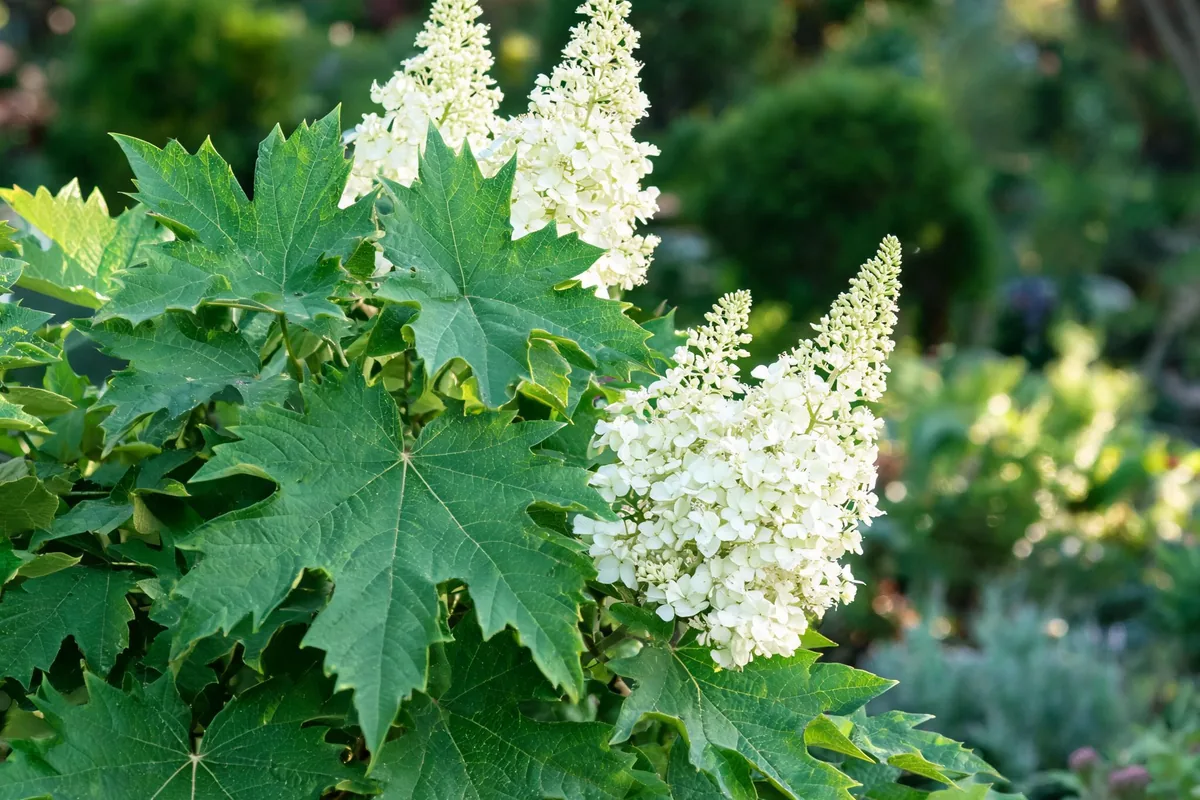
The common name describes the key identification feature: leaves shaped like oak leaves, with deeply lobed, coarsely toothed margins. Leaves are large — up to 8 inches long — and feel rough to the touch. The fall color is among the best of any landscape shrub, turning bronze, burgundy, deep red, and purple in October–November. In mild climates (zone 7–9), some leaves persist through winter, giving the plant a semi-evergreen appearance.
Per Penn State Extension, oakleaf hydrangea is "native to the bluffs and ravines of the southeastern United States, from North Carolina and Tennessee west to Mississippi and Florida, growing naturally in well-drained forest soils under the canopy of deciduous trees." This native habitat — shaded, well-drained, dry in summer — informs the plant's care requirements.
Flowers are elongated panicles (not round like smooth hydrangea), 4–12 inches long, creamy white opening in June–July and aging to pinkish-tan by late summer. Exfoliating bark on mature stems reveals warm cinnamon-brown beneath, providing genuine winter interest per Penn State Extension's observation that the plant offers "four seasons of interest."
Key cultivars
Per Missouri Botanical Garden, the species reaches 4–6 feet in typical landscape conditions but can reach 8 feet in optimal southern gardens. Cultivars offer significant size variation:
- 'Snow Queen': 4–6 feet, large sterile florets in dense cone-shaped panicles, reliable fall color. One of the most ornamental selections.
- 'Snowflake': Double flowers with a distinctive stacked petal arrangement. Somewhat larger than 'Snow Queen,' with longer-lasting flowers.
- 'Alice': A large selection reaching 8–10 feet in height and spread — better suited to woodland gardens than residential foundation beds.
- 'Pee Wee': Compact dwarf selection reaching only 2–3 feet. Most manageable for small gardens and a good substitute where full-size oakleaf would crowd.
- 'Sikes Dwarf': Another compact form at 2–3 feet with excellent fall color. Selected by plantsman Allen Bush from a garden in Alabama.
USDA hardiness and where it grows
Per Penn State Extension, oakleaf hydrangea is hardy in USDA zones 5–9. This is the same basic zone range as bigleaf hydrangea, but oakleaf is substantially better adapted to the heat and humidity of zones 7–9. Per Oregon State Extension, oakleaf "tolerates hot weather and sun better than other hydrangea species" (along with panicle hydrangea) and is "an excellent choice for southern gardens where mopheads burn."
Zone 5 is the cold limit for reliable perennial performance — the flower buds may suffer damage in harsh zone 5 winters, similar to bigleaf hydrangea. In zone 5, site against a south-facing wall or in a sheltered position to improve flower bud survival. In zones 6–9, oakleaf hydrangea is fully reliable with no winter protection needed.
Light
Oakleaf hydrangea is the most shade-tolerant of the commonly grown hydrangea species — it grows naturally under forest canopy. Per Penn State Extension, "oakleaf hydrangea performs well in part shade to full shade, though flower production is somewhat reduced in deep shade compared to dappled or morning sun positions." Full sun in the South (zones 7–9) can cause leaf scorch in summer — the natural woodland habitat is the better model.
In zones 5–6, more sun is beneficial and the plant tolerates full-sun sites without the heat stress it would experience in zone 8 Georgia. The morning sun, afternoon shade combination that works for bigleaf hydrangea also works well here.
Watering
Established oakleaf hydrangea is moderately drought-tolerant — more so than smooth or bigleaf hydrangea — reflecting its native habitat on well-drained, sometimes dry forest bluffs. Per Missouri Botanical Garden, oakleaf hydrangea "tolerates drought better than most other hydrangea species once established" and "does not require consistent moisture the way smooth hydrangea does." During establishment (first 1–2 years), water weekly. After establishment, supplemental watering during extended dry spells is helpful but the plant handles short droughts without visible stress.
Soil and pH
Per Clemson HGIC, oakleaf hydrangea "prefers well-drained, slightly acidic to neutral soil at pH 5.5–6.5 and grows naturally in rocky, dry woodland soils." This is a materially different profile from smooth hydrangea — it doesn't need the consistently moist, humus-heavy soils that smooth hydrangea requires. Good drainage is more important than high organic content. It will grow in average suburban soil that drains reasonably well, without extensive amendment.
Planting
Plant in spring or fall in zones 5–7; fall is preferred in zones 7–9 where summer heat can stress new transplants. Per Clemson HGIC, "site oakleaf hydrangea in a position where it has room for its natural spreading form — full-size varieties reach 6 feet or more in width and should not be planted where they'll need constant pruning to stay in bounds." Space full-size selections 6–8 feet from structures; compact cultivars 3–4 feet.
Oakleaf hydrangea spreads by root suckers and can form a colony over time. This is useful on slopes for erosion control and in naturalized woodland garden settings, but should be monitored at bed edges adjacent to lawn areas.
Fertilizing
Per Clemson HGIC, "a light application of a balanced slow-release fertilizer in early spring is sufficient for established plants." Oakleaf hydrangea growing in woodland settings with annual leaf litter accumulation may need no supplemental fertilization at all. Avoid fertilizing in late summer, which pushes new growth that may not harden off before fall. High-nitrogen feeding reduces flowering.
Pruning
This is the most important care point for oakleaf hydrangea, and the most common mistake. Oakleaf hydrangea blooms on old wood — the flower buds for next summer form on the current year's stems in late summer and fall. Per Penn State Extension, "if they are pruned at the wrong time or browsed by deer, flowering is reduced." The safe window is immediately after flowering, in late July through early August, before next year's buds form.
Per University of Minnesota Extension, the general rule is to prune oakleaf hydrangea "like bigleaf hydrangea — only immediately after flowering, never in winter, spring, or before flowering." Unlike smooth and panicle hydrangeas, there is no fall-to-spring pruning window. Any cutting done from August through June removes the developing or dormant flower buds that will produce next year's flowers.
Minimal pruning approach: for established plants in adequate space, remove only dead wood and crossed branches. The natural, unpruned form of oakleaf hydrangea is among the most beautiful of any flowering shrub — resist the impulse to cut it back.
Common problems
Failure to bloom
Per Penn State Extension's guide on hydrangea bloom failure, wrong-time pruning and deer browse are the two most common causes of bloom failure in oakleaf hydrangea. "Deer browsing of H. quercifolia during winter removes flower buds — the damage is invisible until spring when the plant fails to bloom." In high-deer-pressure areas, winter protection or repellent programs are necessary.
Leaf scorch
Brown leaf margins in summer, most common in full-sun positions in zones 7–9. Per Clemson HGIC, "afternoon shade reduces leaf scorch in hot climates." Adequate mulch and consistent establishment-period watering also reduce scorch severity.
Root rot
In heavy clay soils that hold water, oakleaf hydrangea's root system can be damaged by Phytophthora. Its native dry-woodland habitat makes it less tolerant of wet soils than smooth hydrangea. Per Clemson HGIC, well-drained soil is the most critical site requirement for this species. Raised beds or amended mounds in clay soils are the solution.
Powdery mildew
Occurs but is generally less severe than on bigleaf hydrangea. Per Penn State Extension, "adequate spacing for air circulation is the primary preventive." Cosmetic on mature plants.
Frequently asked
Is oakleaf hydrangea a good wildlife plant?
Yes — per Missouri Botanical Garden, oakleaf hydrangea provides "nesting cover and food for birds from its seed heads." As a native eastern U.S. plant, it supports the local insect and bird communities that rely on native plant relationships. The flower heads attract pollinators and beneficial insects when blooming.
When should I divide oakleaf hydrangea?
Oakleaf hydrangea is not routinely divided the way smooth hydrangea or bigleaf can be. It spreads by suckers rather than clump expansion, and the shrubby woody form doesn't respond to division the way herbaceous perennials do. Per Clemson HGIC, "to propagate, take softwood cuttings in early summer or allow sucker growth to establish roots before separating." Removing suckers at the base is the best way to prevent the plant from expanding beyond its intended space.
Does oakleaf hydrangea lose its leaves in winter?
In zones 5–7, yes — it is deciduous. In zones 7b–9, some leaves may persist, particularly if winters are mild. Per Missouri Botanical Garden, "in warm climates, oakleaf hydrangea may hold much of its foliage through winter, making it nearly semi-evergreen." The dried flower heads and exfoliating bark provide winter ornamental value even when the plant is leafless.
Can I grow oakleaf hydrangea in the North?
Zone 5 is the reliable northern limit. Zone 4 is risky — the plant may survive but flower bud hardiness is the limitation, similar to bigleaf hydrangea in cold climates. For zone 4 and colder, panicle hydrangea and smooth hydrangea are more reliably bloom-productive options. Per Penn State Extension, "in zone 5, siting against a south-facing wall or in a sheltered spot improves flower bud survival."
Compare with other hydrangea species
Looking for a different hydrangea? Each species has a distinct care profile:
- Hydrangea paniculata — zones 3–8, cone-shaped flowers, most sun-tolerant, new-wood bloomer
- Hydrangea arborescens — smooth, zones 3–9, round white flowers, new-wood bloomer, easiest overall
- Hydrangea macrophylla — bigleaf, zones 5–9, color-changing blue/pink flowers, blooms on old wood
- Main hydrangea overview — all five species compared
Sources
- Penn State Extension: Oakleaf Hydrangea
- Clemson HGIC: Oakleaf Hydrangea
- Penn State Extension: When to Prune Which Hydrangea Species
- Penn State Extension: Why Doesn't My Hydrangea Bloom?
- University of Minnesota Extension: Pruning Hydrangeas for Best Bloom
- Missouri Botanical Garden: Hydrangea quercifolia Plant Profile
- Oregon State Extension: Hydrangeas bring beauty and variety to Oregon gardens
