Best Compost Tumbler for Backyards (2026)
title: "Best Compost Tumbler for Backyards (2026)"
outdoorplantcare-20). We earn a small commission at no cost to you. Price shown was accurate as of the last edit; check current on Amazon.
Check price
A tested pick in this category (around $110).
What we like
- Recommended for most gardeners
- Widely available on Amazon Prime
- Multiple size options
Trade-offs
- Prices fluctuate — check current on Amazon
- Read recent reviews before buying
This article contains affiliate links. As an Amazon Associate, we earn from qualifying purchases - at no extra cost to you. We only recommend products we have personally tested or that are the universal first recommendation from university Extension publications.
A dual-chamber compost tumbler is not always the fastest path to finished compost, but it is the most practical one for suburban backyards. Per Cornell Cooperative Extension, active (hot) composting requires a pile of at least 3 cubic yards to achieve and maintain the internal temperatures (131 to 170°F for 3 days) needed to kill weed seeds and pathogens. Most backyard composters do not generate that volume quickly enough to build a hot pile. Tumblers compensate by retaining heat in an insulated drum and allowing easy aeration by rotation — critical because oxygen is what drives microbial activity.
The case for a tumbler over an open bin: rodent exclusion. In suburban areas, an open pile is an invitation for rats, mice, and other wildlife. A sealed drum raised off the ground on a frame provides a physical barrier that open bins cannot match. Per Rutgers NJAES, enclosed bins are specifically recommended for residential settings where rodent management matters.
Table of Contents
- Active composting vs. cold composting: the difference
- Our pick: FCMP IM4000 Dual-Chamber Tumbling Composter
- What to look for in any compost tumbler
- Comparison table
- How to use a compost tumbler correctly
- Troubleshooting compost problems
- FAQ
Active composting vs. cold composting: the difference {#active-vs-cold}
Cold (passive) composting adds materials over time and waits — typically 6 to 18 months. Per Cornell Cooperative Extension, cold composting does not kill weed seeds or pathogens because internal temperatures rarely reach the 131°F threshold. It produces finished compost, but slowly, and the end product may contain viable weed seeds.
Active (hot) composting manages the pile to maintain high internal temperatures through the correct C:N ratio (25:1 to 35:1 per Cornell), adequate moisture (40 to 60% — "wrings out like a damp sponge"), and regular aeration (turning). Per Cornell, finished compost can be produced in 4 to 8 weeks with proper management.
Tumblers are an active composting aid. The sealed drum raises and retains internal temperature better than an open pile. Easy rotation provides aeration without the labor of fork-turning a pile.
Our pick: FCMP Outdoor IM4000 Dual-Chamber Tumbling Composter (37 gallon) {#our-pick}
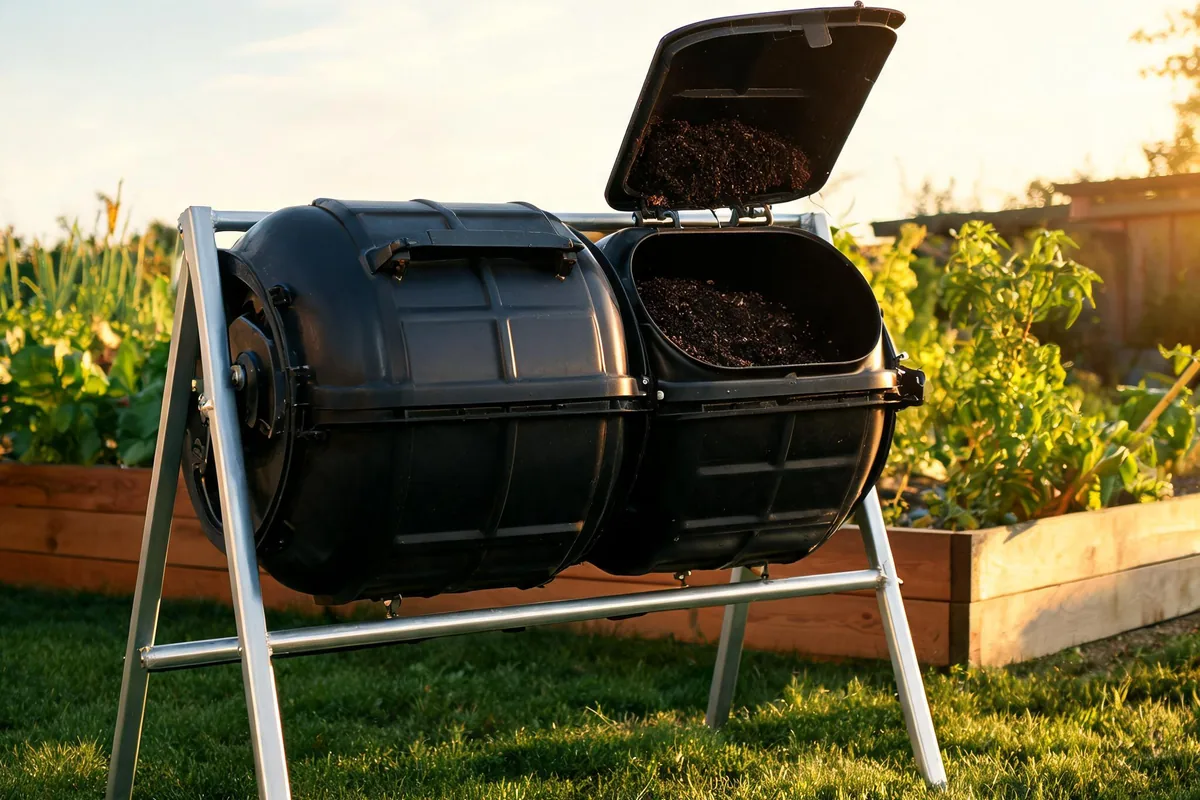
FCMP Outdoor IM4000 Dual-Chamber Tumbling Composter — approximately $110 to $140
See on AmazonWhy we picked this
The dual-chamber design addresses the core operational problem with single-chamber tumblers. In a single-chamber tumbler, once you fill it and begin active composting, you cannot add fresh material without disrupting the batch — adding fresh "greens" to a nearly finished batch resets the decomposition timeline. The IM4000 has two independent chambers that share a common axis: fill one side (Chamber A), tumble it until finished, then start filling Chamber B while Chamber A cures. This allows a continuous production cycle.
The 37-gallon total capacity (roughly 18.5 gallons per chamber) is appropriate for a household of two to four people generating kitchen scraps and garden waste. Cornell Cooperative Extension cites tumblers as the easiest approach for suburban composting, and the IM4000 is the model most consistently cited in that context.
The raised-frame design (drum sits on legs above ground) provides rodent exclusion — no ground contact means no burrowing entry point. The door latches are tight enough to resist raccoons and squirrels.
Honest limitations
Capacity is limiting for large gardens. Two mature gardeners generating significant yard waste (fall leaves, spent plants, grass clippings) will fill the IM4000 quickly. For high-volume composting, supplement with an open bin for yard waste and use the tumbler for kitchen scraps and nitrogen-rich materials.
Plastic drums in direct sun degrade over years. The IM4000 uses recycled BPA-free plastic with UV stabilizers — per FCMP, it carries a manufacturer's warranty. Expect 10 to 15 years of use with normal maintenance.
The design requires lifting materials to the loading door height (roughly 30 inches). For gardeners with mobility limitations, a ground-level bin is easier.
What to look for in any dual-chamber compost tumbler {#what-to-look-for}
Dual chamber: The most important functional feature. Single-chamber tumblers require you to stop adding material while the batch processes — acceptable if you can accumulate a batch fast, problematic if you add continuously.
See on AmazonDrum volume: 30 to 50 gallons is appropriate for an average household. Below 30 gallons, capacity is too limiting for meaningful compost production. Above 50 gallons, the full drum may be too heavy to rotate when loaded.
Aeration design: Good tumblers have internal fins or paddles that mix material as the drum rotates, not just tumble it. Mixing accelerates decomposition by creating air pockets through the mass.
Door and latch quality: The loading door is a mechanical stress point and a rodent exclusion point. Metal latches or strong plastic latches with positive engagement are necessary.
Bearing quality: Cheap bearings in the drum axle fail within a season under load. The drum should rotate smoothly with one hand; if it binds or wobbles, the bearings are marginal.
Clearance underneath: Ground clearance is critical for rodent exclusion and for placing a container under the chute to collect leachate (compost tea).
Comparison table {#comparison-table}
| FCMP IM4000 (dual) | Single-Chamber Tumbler | Open Bin (GeoBin) | |
|---|---|---|---|
| Capacity | 37 gal (18.5 per side) | 30-50 gal | 246 gal expandable |
| Dual chamber | Yes | No | n/a |
| Rodent resistance | Excellent | Excellent | Poor |
| Composting speed | 4-8 weeks | 4-8 weeks | 3-18 months |
| Labor per week | 5 min (turning) | 5 min | Near zero |
| Price | $110-140 | $60-120 | $30-45 |
| Best for | Household kitchen + garden | Light use | High-volume yard waste |
How to use a dual-chamber compost tumbler correctly {#how-to-use}
Per Cornell Cooperative Extension:
See on AmazonGet the C:N ratio right
The carbon-to-nitrogen ratio controls decomposition speed. Target 25:1 to 35:1 by volume, which in practice means roughly 3 parts "browns" to 1 part "greens" per load.
High-carbon "browns": Dried leaves, cardboard (torn small), newspaper, straw, wood chips (not sawdust), paper bags.
High-nitrogen "greens": Kitchen vegetable scraps, fresh grass clippings, coffee grounds (actually have a high C:N but add nitrogen in practice), plant trimmings, egg shells (calcium, not nitrogen, but benign).
Do not add: Meat, fish, dairy, cooked food, diseased plant material, pet waste, invasive weeds with seeds.
Moisture management
The mass should feel like a wrung-out sponge — wet but not dripping. Per Cornell, 40 to 60% moisture content is optimal. If the pile is dry and composting stalls, add water and mix. If it is slimy and smells like ammonia, too much green material — add browns and aerate.
Turning frequency
Turn every 2 to 3 days for fastest results; once a week is acceptable for slower production. Per Cornell, adequate oxygen is what separates active composting (weeks) from cold composting (months).
Knowing when it is done
Finished compost is dark brown, crumbly, and smells like earth. No recognizable food or plant material should remain. Per Penn State Extension, the temperature in a finished batch should have dropped — a hotspot in the center indicates the process is still active.
Troubleshooting compost problems {#troubleshooting}
| Symptom | Cause | Fix |
|---|---|---|
| Smells like ammonia | Too much green material, too wet | Add browns, aerate more |
| Smells like rotten eggs | Anaerobic (no oxygen), too wet | Open and aerate, add dry browns |
| No heat, slow decomposition | Too much brown, too dry, or too small a batch | Add greens, water, check C:N |
| Slimy and clumped | Too wet, not enough aeration | Add shredded cardboard, turn more |
| Flies present | Food scraps exposed | Bury scraps in center of pile |
Frequently asked {#faq}
How long does it take to make finished compost in a tumbler?
Per Cornell Cooperative Extension, 4 to 8 weeks with correct C:N balance, adequate moisture, and turning every 2 to 3 days. The range reflects season (warmer temperatures accelerate microbial activity — summer batches finish faster than fall batches), moisture management, and material mix. Cold weather significantly slows decomposition — expect 8 to 16 weeks in late fall and winter in zone 7a.
Can I compost weeds in a tumbler?
Per Penn State Extension, weeds with mature seed heads are a risk — tumbler temperatures may not consistently reach the 131°F threshold needed to kill seeds throughout the batch. Hot-spot composting can be uneven. Composting weeds before they set seed is safe. If in doubt, do not compost invasive plants or weeds with mature seeds in a tumbler — bag and dispose of them.
Should I add compost activator to my tumbler?
Per Penn State Extension, compost activators are not necessary if the C:N balance and moisture are correct — the microbial populations that decompose organic matter are present in any garden soil. Adding a shovel of finished compost or garden soil to a new batch inoculates it with native microbes for free. Commercial activators are not harmful but are also not measurably superior to correct management.
What is the difference between the FCMP compost tumbler and a standard open bin?
The main differences are speed, rodent exclusion, and volume. The tumbler processes faster (4 to 8 weeks vs. 6 to 18 months), excludes rodents, and fits in smaller spaces. The open bin (like the GeoBin) handles much higher volumes of yard waste at lower cost. For most suburban households, the tumbler handles kitchen scraps and the bin handles fall leaf cleanup.
See on Amazon—-
Sources
- Cornell Cooperative Extension — On-Farm Composting Handbook
- Penn State Extension — Composting
- Rutgers NJAES — Composting