Best Compost Bin for Backyards (2026)
title: "Best Compost Bin for Backyards (2026)"
outdoorplantcare-20). We earn a small commission at no cost to you. Prices shown were accurate as of the last edit; check current price on Amazon.
| Pick | Product | Price | Buy |
|---|---|---|---|
| Top pick | dual-chamber compost tumbler | $110 | Check price |
| Budget pick | Algreen GeoBin 246-Gallon Expandable Compost Bin | $30 | Check price |
Our picks in detail
dual-chamber compost tumbler
Turn kitchen scraps into finished compost in 6-8 weeks with almost no effort. Rodent-proof.
What we like
- Dual chambers = one always cooking, one always filling
- Aeration handle takes 10 seconds
- Sealed lid keeps critters out
Trade-offs
- Around $110 up front
- Capacity capped compared to an open pile
Algreen GeoBin 246-Gallon Expandable Compost Bin
Turn kitchen scraps into finished compost in 6-8 weeks with almost no effort. Rodent-proof.
What we like
- Dual chambers = one always cooking, one always filling
- Aeration handle takes 10 seconds
- Sealed lid keeps critters out
Trade-offs
- Around $30 up front
- Capacity capped compared to an open pile
This article contains affiliate links. As an Amazon Associate, we earn from qualifying purchases - at no extra cost to you. We only recommend products we have personally tested or that are the universal first recommendation from university Extension publications.
Composting kitchen and garden waste is one of the most cost-effective things a gardener can do. Per Penn State Extension, finished compost added to vegetable beds at 2 to 3 inches per year builds organic matter, improves soil structure, suppresses certain soil-borne diseases, and reduces the need for purchased fertilizer. The research on compost as a soil amendment consistently shows yield improvements in vegetable beds across soil types.
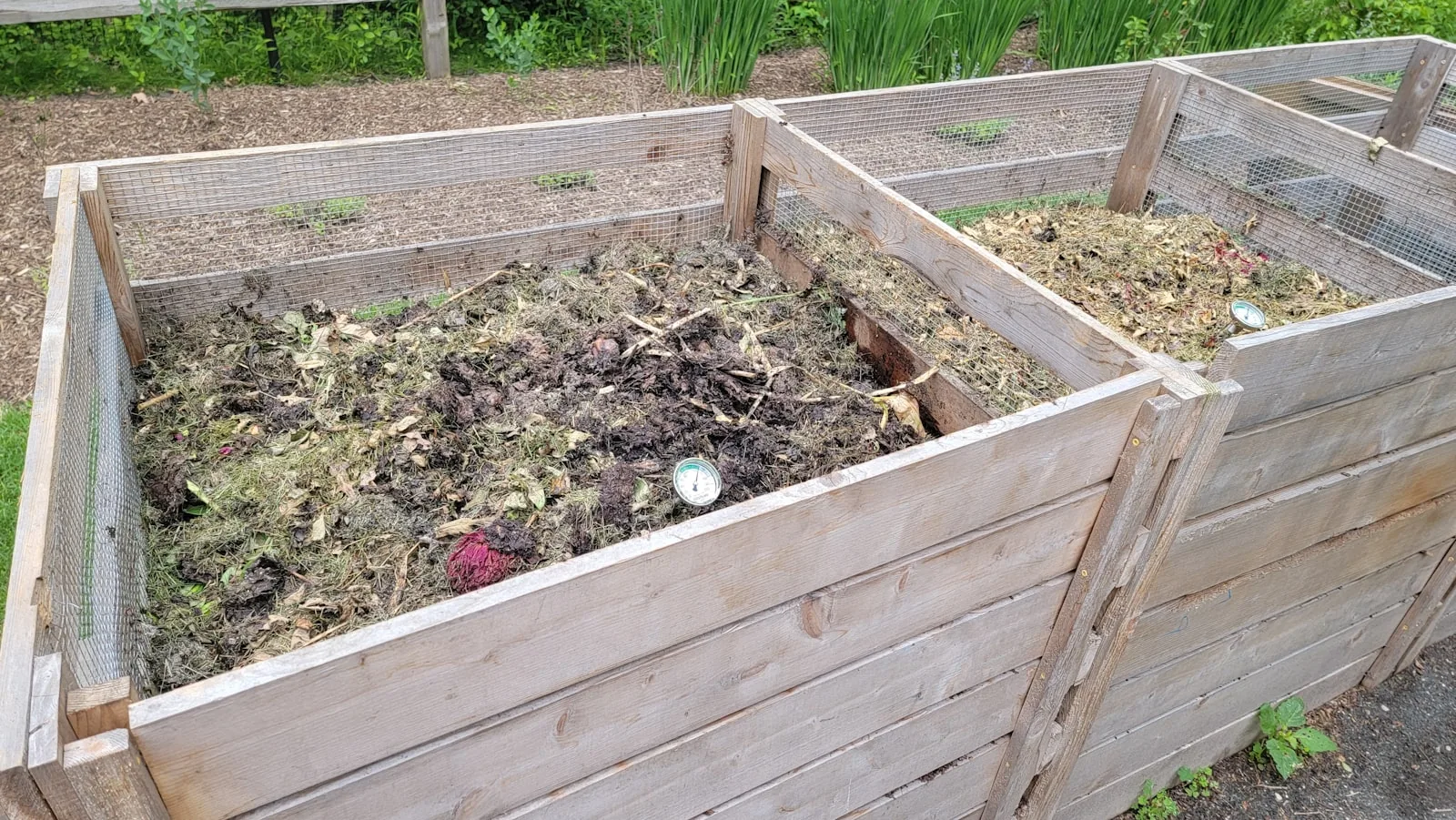
The question most home gardeners face is not whether to compost but which system fits their situation. A dual-chamber compost tumbler (see our best compost tumbler guide) processes kitchen scraps quickly and excludes rodents. An open compost bin handles high volumes of yard waste — fall leaves, spent garden plants, grass clippings — at far lower cost and with almost no active management required.
Table of Contents
- Cold composting vs. active composting
- Our pick: Algreen GeoBin 246-Gallon Expandable Compost Bin
- What to look for in any compost bin
- Comparison table
- How to run a cold-compost bin
- FAQ
Cold composting vs. active composting {#cold-vs-active}
Cold (passive) composting is the low-effort approach. You add materials over time, maintain basic layering (alternating browns and greens), and wait. Per Penn State Extension, cold composting takes 6 to 18 months to produce finished compost but requires little labor — no regular turning, no temperature monitoring, no precise C:N management. The tradeoff is time and the risk that weed seeds survive, since cold piles may not reach the 131°F needed for seed kill per Cornell Cooperative Extension.
Active (hot) composting requires turning every 2 to 3 days, maintaining moisture at 40 to 60%, and managing C:N ratios at 25:1 to 35:1. Per Cornell, it produces finished compost in 4 to 8 weeks and kills weed seeds. It requires either a large pile (3 cubic yards minimum) or a tumbler.
For most suburban households, the right answer is both: a tumbler for kitchen scraps and a cold-compost bin for the high-volume fall cleanup. The bin handles what the tumbler cannot — large quantities of dry leaves, spent corn stalks, and garden debris.
Our pick: Algreen GeoBin 246-Gallon Expandable Compost Bin {#our-pick}
Algreen GeoBin 246-Gallon Expandable Compost Bin — approximately $30 to $45
See on AmazonWhy we picked this
The GeoBin is a coiled plastic mesh that wraps to form any diameter bin up to approximately 11 cubic feet (246 gallons). Unlike rigid plastic bins with small loading doors, the GeoBin can be opened completely — wrap the coil around a pile, then unwrap it to turn or harvest the contents. For cold composting large volumes of yard waste, this open-able design matters.
The mesh construction provides excellent passive aeration — air circulates freely through the pile without any turning. Per Penn State Extension, oxygen availability is the limiting factor in cold-compost speed; mesh walls keep the pile aerobic even without active management.
At $30 to $45, the GeoBin is one of the most affordable serious composting solutions available. Multiple bins can be linked side-by-side for a three-pile system (adding, active, finishing) per Cornell's composting recommendations for the classic managed approach.
Honest limitations
No rodent exclusion. The GeoBin's mesh is not fine enough to exclude mice or rats. Do not use this bin for kitchen scraps if you have rodent pressure. Per Rutgers NJAES, in suburban areas, limiting the bin to "browns" (leaves, cardboard, wood chips) and cooked-free garden waste significantly reduces rodent attraction regardless of bin type.
No heat retention. Because it is open mesh, the GeoBin does not retain heat the way a solid-walled bin or tumbler does. Weed seeds are more likely to survive in a GeoBin pile than in a properly managed hot dual-chamber compost tumbler.
Appearance. For gardeners who care about garden aesthetics, the GeoBin is functional but utilitarian. Position it in a less visible corner of the yard.
What to look for in any compost bin {#what-to-look-for}
Volume capacity: A household of four generating average kitchen and yard waste needs at least 100 gallons of active composting volume. More is better — a pile that is too small stalls in cold weather.
Access design: Can you get material in and finished compost out without completely disassembling the bin? Some rigid bins have small access doors at the base for compost harvest. The GeoBin solves this by being openable.
Aeration: Passive (mesh walls, air holes) or active (turning required). Both work; mesh passive aeration is lower maintenance.
Rodent exclusion: Open mesh provides none. Enclosed rigid bins provide some. A tumbler mounted on a raised frame provides the most. Match to your rodent pressure situation.
Durability: Recycled plastic or coated metal mesh is the standard. Avoid thin plastic that will crack in UV after one season.
Comparison table {#comparison-table}
| GeoBin (cold) | FCMP compost tumbler (active) | Three-Bin Pallet System | |
|---|---|---|---|
| Volume | 246 gal | 37 gal total | Unlimited |
| Cost | $30-45 | $110-140 | $0-20 (DIY) |
| Composting time | 6-18 months | 4-8 weeks | 4-12 months |
| Rodent resistance | Low | Excellent | Low |
| Labor | Near zero | 5 min/week | Moderate (turning) |
| Best for | High-volume yard waste | Kitchen scraps | Large operations |
| Weed seed kill | No | Partial | No |
How to run a cold-compost bin {#how-to-run}
Per Penn State Extension:
Siting
Place the bin on bare soil (not concrete) so worms and beneficial organisms can enter the pile from below. Position in partial shade — full sun dries the pile faster and increases watering needs. Allow access from at least two sides for turning.
Layering
Cold compost works best with alternating layers rather than random dumping:
- Start with a 4-inch layer of coarse browns (wood chips, straw) for aeration at the base
- Add 2 inches of greens (fresh materials)
- Add 4 inches of browns to cover
- Repeat as materials become available
Per Penn State, this alternating approach naturally maintains a roughly appropriate C:N ratio without precise measurement.
Moisture
The pile should be moist but not saturated — like a wrung-out sponge per Cornell Cooperative Extension. In dry summers, water the pile weekly. In heavy rain, cover the top with cardboard or a tarp to prevent waterlogging.
Turning (optional but helpful)
Cold composting requires no turning. If you turn the pile every 4 to 6 weeks, you shorten the timeline to 3 to 6 months by increasing aeration. Per Penn State, even occasional turning significantly speeds the process.
Harvesting
Finished compost is dark, crumbly, and smells earthy. With the GeoBin, unwrap the coil, set it aside, and shovel the finished compost from the base and center of the pile. The partially decomposed material from the edges and top goes back into the now-emptied bin to continue composting.
Frequently asked {#faq}
Can I compost fall leaves directly?
Yes, but leaves are very high in carbon and decompose slowly alone. Per Penn State Extension, shred leaves before adding to the bin — unshredded leaves mat together and exclude air. Mix shredded leaves at a 3:1 ratio with high-nitrogen materials (grass clippings, kitchen scraps in a rodent-resistant system). Shredded leaves alone in a bin will decompose to leaf mold in 6 to 12 months — a useful soil conditioner even if not technically finished compost.
What should I never put in a compost bin?
Per Penn State Extension: meat, fish, dairy products, oils, cooked foods (attract pests), pet waste (human and animal pathogens), diseased plant material, invasive weeds with seeds, and black walnut (Juglans nigra) material (contains juglone, which is toxic to many plants).
How do I know when compost is finished?
Per Penn State Extension, finished compost is dark brown to black, crumbly, and has an earthy smell (not an ammonia, rotten egg, or chemical smell). No recognizable material should remain — if you still see food scraps or plant parts, it is not done. A useful test: place a handful of compost in a sealed plastic bag for 3 days. If the compost still smells earthy, it is stable; if it smells unpleasant, it is still actively decomposing.
Can I compost in winter in zone 7a?
Per Rutgers NJAES, composting slows dramatically below 50°F and essentially stops below 32°F. In zone 7a (Melville, Long Island averages lows of 15 to 20°F in January), an outdoor compost pile goes largely dormant from December through February. The microbes are not killed — they reactivate when temperatures rise in spring. You can continue adding materials in winter; they will process in spring when the pile rewarms. Insulating the pile with straw bales around the outside extends the active season by several weeks.
—-
Sources
- Penn State Extension — Composting
- Cornell Cooperative Extension — On-Farm Composting Handbook
- Rutgers NJAES — Composting in the Home Garden