Growing Garlic: Fall Planting Guide for Home Gardeners
title: "Growing Garlic: Fall Planting Guide for Home Gardeners"
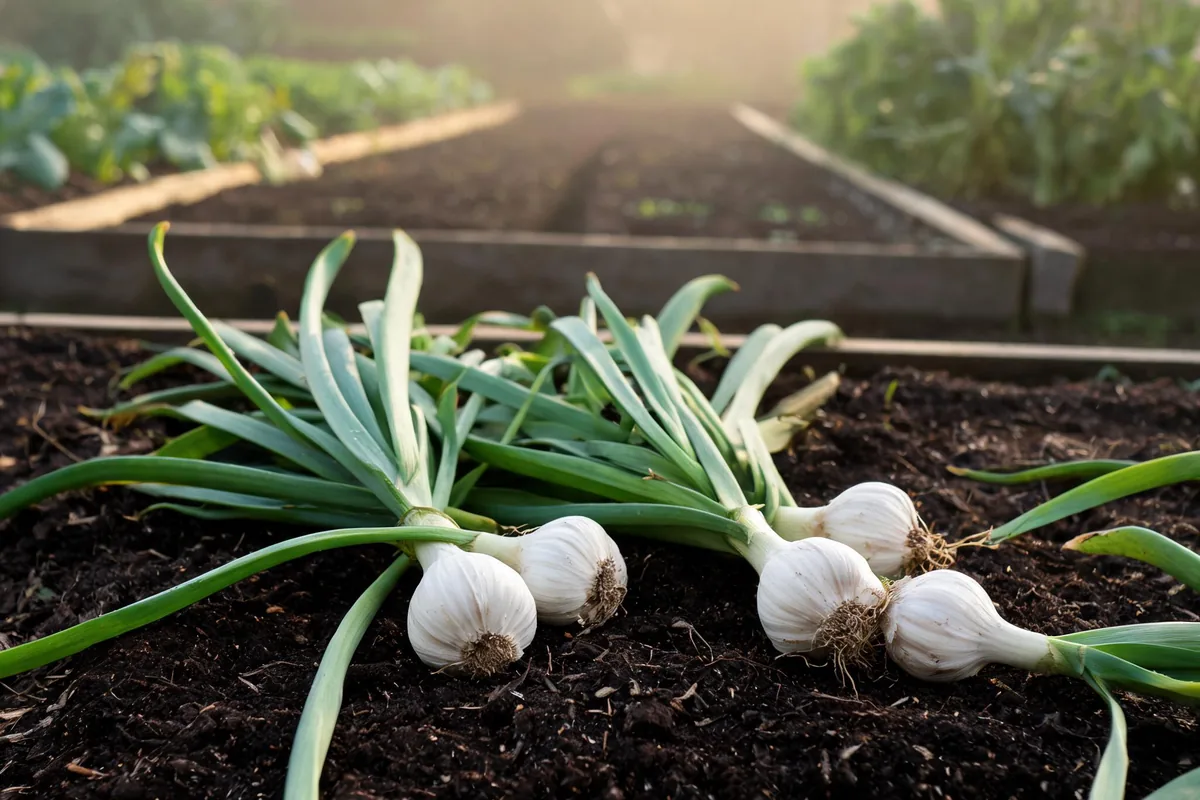
I don't grow garlic at my Long Island plot — the ornamental alliums get the bed space in my zone 7a garden. This guide is sourced from Cornell Cooperative Extension, Penn State Extension, and NC State Extension, which publish the most thorough guidance on home garlic production for the Northeast and mid-Atlantic.
Garlic is the rare vegetable that rewards patience over the long haul. It goes in the ground in fall, sits through a northeastern winter, and comes out in summer — roughly 9 months from clove to bulb. The mechanics are not complicated, but each step has a reason behind it, and understanding that reason makes the difference between garlic that stores through winter and garlic that rots in the ground.
This article contains affiliate links. As an Amazon Associate, we earn from qualifying purchases - at no extra cost to you. We only recommend products we have personally tested or that are the universal first recommendation from university Extension publications. See our full disclosure.
Hardneck vs. softneck: the foundational choice
Allium sativum divides into two major groups:
Hardneck garlic (A. sativum var. ophioscorodon): Per Cornell Cooperative Extension, hardneck types are better adapted to cold climates (zones 3—7) and produce a central woody stem (the \"neck\") with cloves arranged around it in a single layer. Flavor is generally more complex than softneck types. Scapes (the curling flower stalks) must be removed to maximize bulb size. Hardneck types store 3—6 months. Major subtypes: Rocambole ('Spanish Roja', 'Killarney Red'), Porcelain ('Music', 'Georgian Fire'), and Purple Stripe ('Chesnok Red', 'Purple Glazer').
Softneck garlic (A. sativum var. sativum): Per Cornell, softneck types lack a central stem, have multiple layers of cloves, and store 8—12 months — the type sold braided in markets. They perform well in zones 5—9 but are less cold-hardy than hardneck types. Flavor is milder and more uniform. Varieties: 'Inchelium Red', 'California Early', 'Nootka Rose'.
For zone 7a (Long Island), both types perform well, but hardneck types like 'Music' (Porcelain) and 'Spanish Roja' (Rocambole) are most commonly recommended by Northeast Extension programs. Per Penn State Extension, hardneck types are \"preferred for their complex, pungent flavor and adaptability to cold climates.\"
Days to maturity: Garlic planted in fall typically matures in 8—9 months, harvested in late June to mid-July in zone 7a.