Holly Care: Growing Ilex in Your Landscape
title: "Holly Care: Growing Ilex in Your Landscape"
—- title: "Holly Care: Growing Ilex in Your Landscape" slug: holly-care hub: plants category: Species guide description: "How to grow holly (Ilex spp.) in zones 3–11 depending on species. Male/female planting for berries, pruning, and species selection guide. Extension-sourced." date: 2026-06-10 updated: 2026-06-10 author: "Thomas A." reading_time: 9 scientific: "Ilex spp." zones_min: 5 zones_max: 9 sun: "part shade" deer_resistant: true native: true pollinator: true bloom: "spring" height_min: 6 height_max: 25 —-
The genus Ilex — holly — encompasses over 400 species of evergreen and deciduous shrubs and trees, ranging in size from low-growing groundcovers to 40-foot trees. In American landscapes, hollies are valued for year-round evergreen structure, bright red berries in fall and winter, and reliability in difficult conditions. Per Missouri Botanical Garden, hollies are "among the most popular landscape shrubs in North America." Understanding two key facts determines success: most hollies require both male and female plants for berry production, and species selection controls everything about performance, size, and hardiness.
I don't grow hollies in my current Long Island yard. This guide is sourced from Extension publications.
Male and female plants — berries require both
Per Clemson Extension HGIC, "hollies are dioecious — male and female flowers occur on separate plants." Only female plants produce berries, but they need pollen from a nearby male plant. Without a male pollinator within range, female plants will not berry.
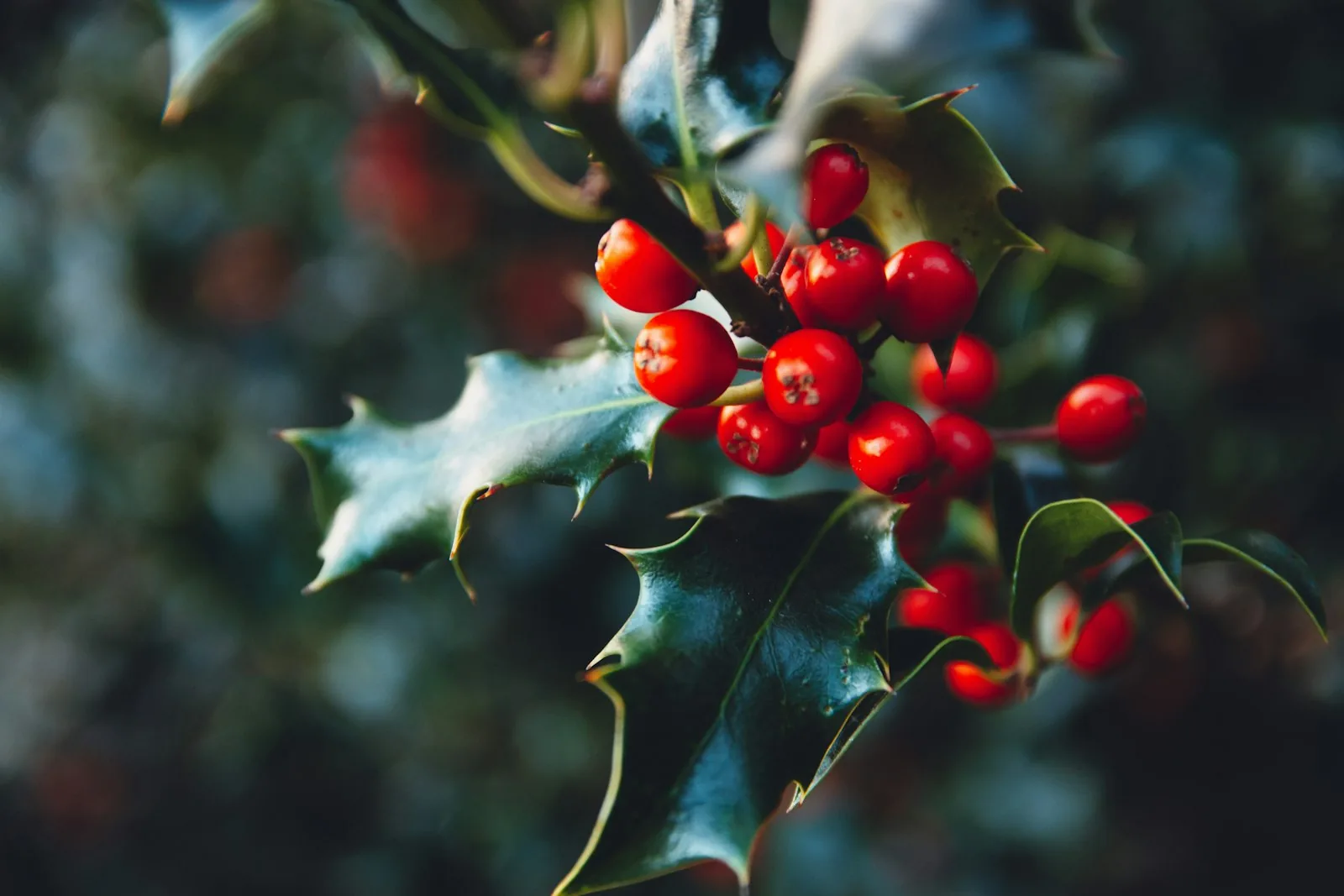
Key rules for cross-pollination, per NC State Extension Plant Toolbox:
- Male and female must be the same species (or a compatible hybrid group) to pollinate effectively.
- Plant male within 50 feet of female plants; closer is better for reliable pollination.
- One male can serve multiple females — a common ratio is 1 male to 3–5 females.
- Bloom times must overlap. Early-blooming males won't pollinate late-blooming females.
The main exception: Ilex cornuta (Chinese holly) is capable of producing berries without a pollinator in some cultivars, per Clemson Extension HGIC.
Species guide — choosing the right holly
Ilex opaca — American holly. Per Missouri Botanical Garden, grows 15–30 feet tall as a pyramidal evergreen tree. Bright red berries on female plants. Zones 5–9. The native species for eastern North American landscapes; excellent wildlife value. Tolerates wet to dry soils.
Ilex glabra — inkberry. Per NC State Extension, a native evergreen shrub growing 5–8 feet, zones 4–9. Black berries (not red). Exceptional tolerance for wet, poorly drained soils. Excellent for rain gardens and low spots. Cultivar 'Shamrock' has compact habit (4–6 feet).
Ilex verticillata — winterberry holly. Per Missouri Botanical Garden, a deciduous native holly that loses its leaves to reveal spectacular red berry clusters on bare stems. 6–10 feet, zones 3–9. Thrives in wet, acidic soils; one of the best winter-interest plants for moist sites.
Ilex x meserveae — Blue Holly, Meserve hollies ('Blue Girl', 'Blue Boy', 'Blue Prince', 'Blue Princess'). Per Missouri Botanical Garden, evergreen shrubs 8–10 feet, zones 4–8. Heavy red berry production. 'Blue Princess' (female) and 'Blue Prince' (male) are frequently sold together.
'Nellie R. Stevens' (I. cornuta x I. aquifolium hybrid). Per Missouri Botanical Garden, "one of the most popular hollies in the Southeast," growing 15–25 feet tall, zones 6–9. Self-fertile enough to produce berries without a male, though a pollinator improves yields.
USDA hardiness zones
Zone range varies dramatically by species:
- I. verticillata: zones 3–9
- I. glabra: zones 4–9
- I. opaca: zones 5–9
- I. x meserveae: zones 4–8
- 'Nellie R. Stevens': zones 6–9
- I. cornuta varieties: zones 7–9
Per NC State Extension, American holly is the broadest-adapted native species for the eastern U.S. and often the safest default choice in zones 5–9.
Light
Most hollies prefer full sun to partial shade. Per Missouri Botanical Garden, full sun produces the densest growth and heaviest berry production. Partial shade is tolerated — per NC State Extension, hollies are among the more shade-tolerant broadleaf evergreens. I. glabra and I. verticillata are specifically noted for shade tolerance in their native woodland edge habitats.
Minimum 4 hours of direct sun for adequate berry production; full sun (6+ hours) for best results.
Soil
Per Clemson Extension HGIC, hollies prefer "moist, slightly acid, well-drained soil" with a pH of 4.5–6.0. This acidic requirement is important — hollies planted in alkaline soil develop iron deficiency chlorosis. If your soil pH is above 6.5, apply sulfur or use an acidifying fertilizer like Espoma Holly-tone to gradually lower pH.
Exceptions: Per Missouri Botanical Garden, I. verticillata tolerates "poorly drained or average soil" and is native to swampy areas; I. glabra tolerates wet, acidic soils that would damage most other hollies.
Planting
Per NC State Extension, plant hollies at the same depth as the root ball — do not plant deeper. This is especially important for evergreen hollies, which are prone to root rot if planted too deeply or if soil piles up against the trunk over time.
Space per mature size, not purchase size. A 'Nellie R. Stevens' planted 4 feet from a house foundation will require significant maintenance within 10 years. Per Missouri Botanical Garden, 'Nellie R. Stevens' reaches 15–25 feet — appropriate for a specimen or screening plant, not a foundation planting.
Watering and fertilizing
Water: Per Clemson Extension HGIC, newly planted hollies need 1 inch of water per week during establishment — the first 1–2 growing seasons. Established hollies are moderately drought-tolerant except during the first summer. Apply 2–3 inches of mulch to conserve moisture.
Fertilizer: Per Clemson Extension HGIC, apply an acid-forming fertilizer like Espoma Holly-tone in early spring and again in early summer. This product feeds while gradually acidifying the soil, addressing both nutrition and pH in one application. Alternatively, use a general slow-release fertilizer if pH is already in the 4.5–6.0 range.
Pruning
Per Missouri Botanical Garden, hollies are "best pruned in late winter or early spring before new growth begins." Light annual shaping to maintain desired size is preferable to heavy periodic cutbacks. Evergreen hollies can be pruned more severely and will regenerate, but aggressive cutting reduces berry production for 1–2 years.
Important: Per NC State Extension, cut evergreen holly branches in December for holiday decorations — this serves as pruning and the foliage stays fresh for weeks. This timing coincides with late winter/early spring in terms of the upcoming growth cycle.
Companion plants
- Viburnum spp. — complementary deciduous flowering shrubs for year-round mixed borders.
- Rhododendron spp. — similar acidic soil requirements; spring bloom contrasts with holly's winter interest.
- Boxwood (Buxus) — evergreen structure plant for contrasting formal hedges.
- Amelanchier (serviceberry) — native tree with spring bloom and summer fruit that bridges seasons with holly.
- Switchgrass (Panicum virgatum) — ornamental grass for foreground planting.
Common problems
| Symptom | Most likely cause | Fix |
|---|---|---|
| No berries on female plant | No male pollinator nearby; or wrong species pairing | Plant compatible male within 50 feet |
| Yellow leaves with green veins | Iron chlorosis from alkaline soil | Lower pH with sulfur; apply Holly-tone |
| Tar spots on leaves | Tar spot fungus (cosmetic) | Rake and destroy fallen leaves |
| Spiny leaf miner tunnels | Holly leaf miner | Remove affected leaves; generally cosmetic |
| Branch dieback | Phytophthora root rot from poor drainage | Improve drainage; replace plant |
| Spider mite stippling (indoors or hot/dry) | Spider mites | insecticidal soap; increase humidity |
Frequently asked
Why doesn't my holly have berries?
Per Clemson Extension HGIC, the most common cause is the absence of a male pollinator plant. Only female hollies produce berries; they require a nearby male of the same or compatible species for pollination. A male should be within 50 feet. If you have both male and female plants, check that bloom times overlap — an early-blooming male won't pollinate a late-blooming female.
Are holly berries toxic?
Per NC State Extension, holly berries are toxic to humans and can cause nausea, vomiting, and diarrhea if ingested. Children and pets should not eat them. The berries are, however, safe and important food for birds — many species of songbirds and cedar waxwings consume holly berries through winter. The toxicity applies to human and mammal consumption; birds are unaffected.
When is the best time to prune hollies?
Per Missouri Botanical Garden, light shaping is best done in late winter or early spring before new growth begins, or alternatively in December (when cutting holiday branches). Avoid heavy pruning in late summer or fall, which removes existing berries and may stimulate new tender growth that doesn't harden before frost.
Recommended gear: Best Insecticidal Soap: How Potassium Salts Kill Soft-Bodied Pests — our buyer's guide covering picks for every budget, ranked by Extension publication consensus and personal use.
Sources
- Missouri Botanical Garden — <a href="https://www.missouribotanicalgarden.org/PlantFinder/PlantFinderDetails.aspx?kempercode=b521">Ilex</a>.
- NC State Extension Plant Toolbox — <a href="https://plants.ces.ncsu.edu/plants/ilex/">Ilex</a>.
- Clemson Extension HGIC — <a href="https://hgic.clemson.edu/factsheet/hollies-for-south-carolina-landscapes/">Hollies for South Carolina Landscapes</a>.
- Missouri Botanical Garden — <a href="https://www.missouribotanicalgarden.org/PlantFinder/PlantFinderDetails.aspx?kempercode=b535">Ilex verticillata</a>.
- Missouri Botanical Garden — <a href="https://www.missouribotanicalgarden.org/PlantFinder/PlantFinderDetails.aspx?kempercode=c748">Ilex 'Nellie R. Stevens'</a>.
