Dianthus care: deadheading and the difference between annual and perennial pinks
Sweet William is a biennial. China pinks are annuals. Cheddar pinks are perennials. Knowing which you have determines whether your plant will return next year -- and whether to expect it to.
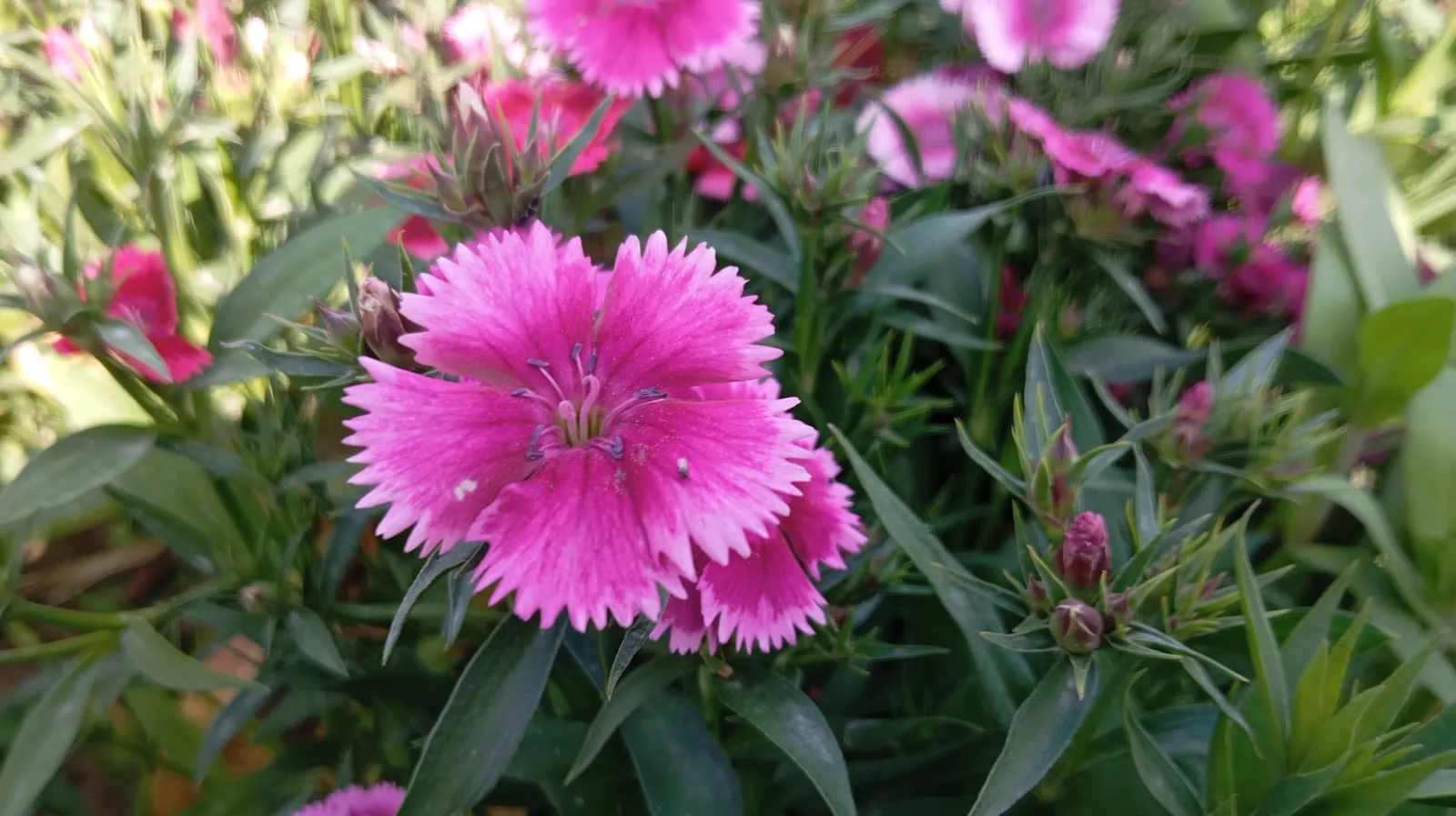
The name "dianthus" covers a large and genuinely confusing group of plants. The flat-faced pink with the fringed petals in a spring bedding display, the fragrant old-fashioned carnation in a cottage garden, and the clumping blue-gray mound of cheddar pink at the border edge are all Dianthus. They look related. They are related. They do not have the same lifespan, the same cold hardiness, or the same care requirements.
I grew Sweet William once — a packet of mixed seed direct-sown in a bed alongside my back fence in the summer, and by the following spring it had put on one of the better floral displays I've had from a seeded annual. Dense clustered heads in every shade of burgundy, pink, red, and bicolor. I let it reseed, and the second year's plants were scrappier but still worth keeping. By year three the bed had been taken over by something else and I didn't replant. That experience is about the full extent of my direct history with Dianthus. This guide is built from NC State Extension Plant Toolbox, Missouri Botanical Garden, Clemson HGIC, and Penn State Extension.
This article contains affiliate links. As an Amazon Associate, we earn from qualifying purchases - at no extra cost to you. We only recommend products we have personally tested or that are the universal first recommendation from university Extension publications. See our full disclosure.
Which dianthus do you have?
Per NC State Extension Plant Toolbox, the Dianthus genus includes annual, biennial, and perennial types. The three most commonly grown in North American gardens:
Sweet William (Dianthus barbatus)
Per Missouri Botanical Garden: "This is a short-lived perennial that is perhaps best grown as a biennial." The standard cultivation method: sow seeds in late summer for bloom the following spring, or purchase cold-treated plants in spring and grow as an annual. In optimum conditions with good air circulation, "it will reseed each year and remain in the garden for many years as if it were a long-lived perennial."
Per NC State Extension Plant Toolbox's Dianthus barbatus page: USDA hardiness zones 3-9. Height 1-2 feet. Full sun to partial shade. Soil pH neutral to 6.0-8.0.
Practical lifespan: Plant it, expect it to bloom once in year one or two, then either replant or allow it to reseed. Don't be surprised when it disappears after blooming. Per Penn State Extension's seed guide, Sweet William (Dianthus barbatus) is listed alongside other biennials (foxglove, hollyhock) under the guidance to "plant seed in late summer or early fall for spring bloom."
Per Missouri Botanical Garden, "prompt deadheading of spent flowers (shear back large plantings) promotes perennial tendencies" — removing old flowers before seeds form encourages the plant to redirect energy into continued growth rather than senescence.
The Sweet William biennial pattern: Year 1 from seed, the plant builds a leafy rosette. Year 2, it sends up flowering stems, blooms, and then declines. If you want continuous Sweet William in the garden, you need to sow fresh seed or allow self-seeding each year.
Test your soil once a year
The Apera AI209 is lab-accurate to ±0.01 pH. Auto-calibration means you get a real number in 30 seconds. Read our full pick.
China pinks (Dianthus chinensis)
A true annual — blooms in its first season and does not return. Per Penn State Extension, listed with an annual spacing of 6-8 inches. The familiar low-growing bedding dianthus sold in six-packs in spring is usually D. chinensis or one of its hybrids.
Per NC State Extension Plant Toolbox, China pinks prefer neutral to slightly alkaline soil (pH 6.0-8.0) in full sun to partial shade. USDA zones 4-9 for the genus, though as annuals zone range is largely irrelevant — they are purchased and replanted each spring.
Cheddar pinks (Dianthus gratianopolitanus)
The perennial type. Per NC State Extension Plant Toolbox: "These spicy clove-scented flowers grow best in full sun in loose, well-drained, neutral to slightly alkaline soils." USDA hardiness zones 4a-8b — a true cold-hardy perennial that will return each year.
Per NC State Extension, cheddar pinks are "mat-forming" and work well as "groundcover, rock garden, edging, garden walls, slopes." Their low, spreading habit contrasts with the upright, clustered flower heads of Sweet William. Mature height is typically 6-12 inches. The cultivar 'Firewitch' ('Feuerhexe') per Missouri Botanical Garden "produces a blanket of fragrant, scented, bright magenta flowers (to 6\" tall) arising from tufted mounds of attractive grassy, deep blue foliage. Blooms in spring with some intermittent repeat bloom in summer."
Key distinction from annuals and biennials: Cheddar pinks spread slowly by division and fill in over time. They benefit from division every 3-4 years to maintain vigor. They do not self-seed aggressively and do not behave like annuals.
Carnations (Dianthus caryophyllus)
The classic florist carnation. Per Clemson HGIC, annual carnation (Dianthus caryophyllus) is listed among summer-flowering annuals. Garden-grown carnations are typically treated as annuals or short-lived perennials in most climates. The large-flowered florist types are not the same as cottage garden pinks.
The confusing middle ground: perennial hybrids
Modern dianthus hybridizing has produced a wide range of cultivars that blur the annual/perennial line. The 'Kahori' series, Floral Lace series, and similar garden-center offerings may be perennial in warmer zones but short-lived in colder regions. When in doubt about a purchased plant, check the tag for USDA zone rating. A plant rated zones 4-9 is a true perennial in most U.S. gardens. A plant rated for zones 8-11 is an annual in the mid-Atlantic.