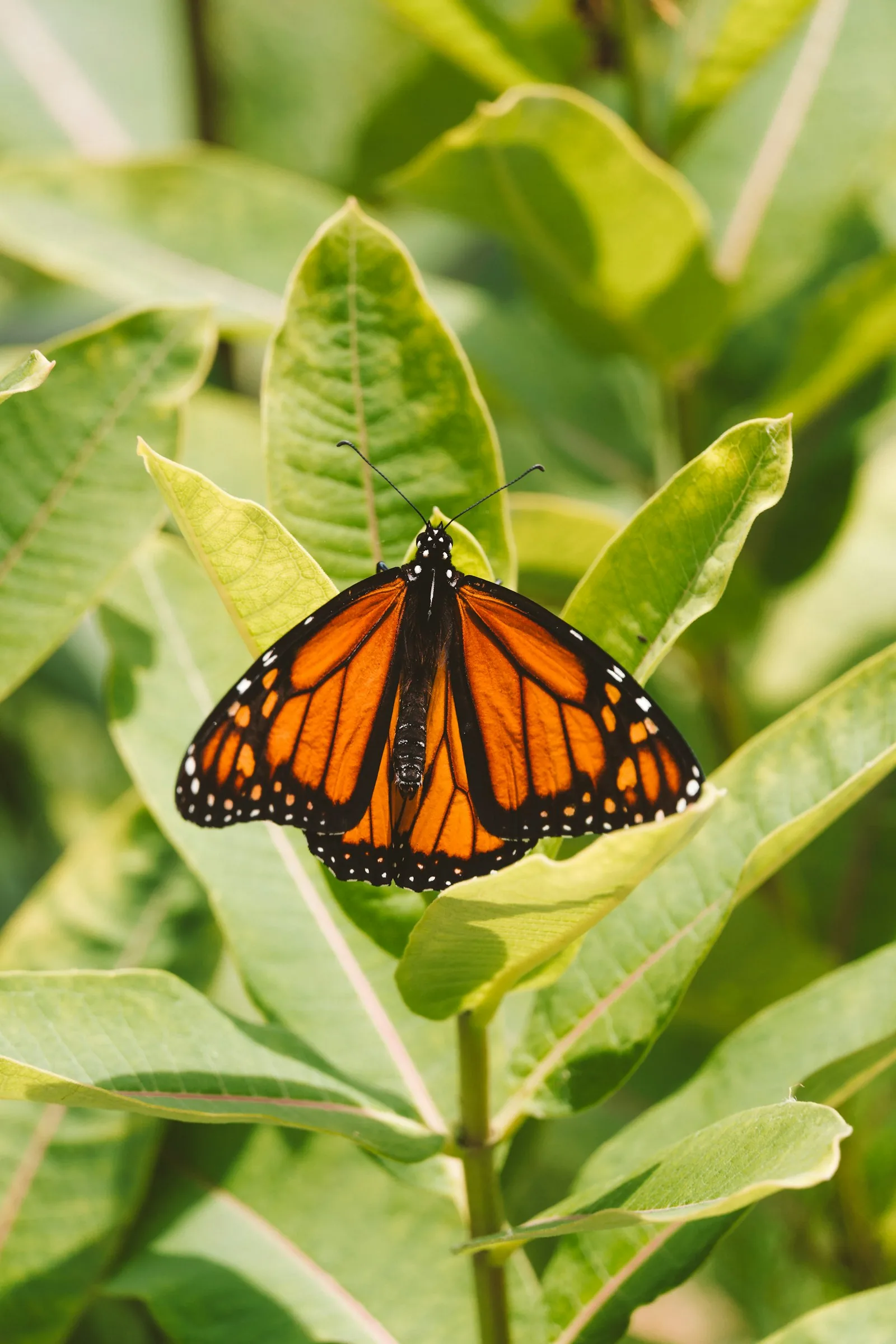
Monarch Waystation Plants: Milkweed and Nectar Sources
title: "Monarch Waystation Plants: Milkweed and Nectar Sources"
—- title: "Monarch Waystation Plants: Milkweed and Nectar Sources" slug: monarch-waystation-plants hub: care category: Pollinator description: "Plants for a monarch butterfly waystation: milkweed species, nectar plants, and registration requirements. Includes USDA zone ranges, bloom times, and conservation context." date: 2026-06-10 updated: 2026-06-10 author: "Thomas A." reading_time: 10 —-
The monarch butterfly (Danaus plexippus) was listed as threatened under the Endangered Species Act in December 2024, following a decades-long population decline that the US Fish & Wildlife Service documented as a greater than 85% decrease in the overwintering eastern population since the mid-1990s. The causes are habitat loss — specifically the loss of native milkweed throughout the breeding range — combined with loss of nectar plants along migration corridors and degradation of the overwintering sites in central Mexico and coastal California.
A "monarch waystation" is a habitat patch, however small, that provides the two things monarchs require: milkweed for breeding and larval development, and nectar plants for adults fueling their migration. The Monarch Watch Waystation program has registered over 40,000 sites as of 2024, and a waystation can be as small as a 100-square-foot backyard planting.
The milkweed imperative
Milkweed loss is the primary driver of monarch decline. Per a 2012 study in Insect Conservation and Diversity by Pleasants and Oberhauser, milkweed abundance in the Midwest agricultural landscape declined approximately 58% between 1999 and 2010, primarily due to the adoption of herbicide-tolerant corn and soybean crops that eliminated field-edge and in-field milkweed. That loss correlates directly with the monarch population decline during the same period.
The good news is that garden and restored habitat milkweed genuinely matters. Per Monarch Watch research, milkweed planted in residential areas, roadsides, and restored habitats contributes measurably to monarch reproductive success. The scale of what would be needed to reverse the trend is large — millions of acres — but individual gardens collectively add up, particularly along migration corridors.
Native milkweed species by region
Selecting native milkweed is regional — the right species for a Missouri garden is not the same as the right species for a New England garden or a Texas garden. Per the Xerces Society's milkweed fact sheets and Monarch Watch's milkweed species page, the primary native species by region are:
Northeast and Upper Midwest
Common milkweed (Asclepias syriaca) is the dominant milkweed of the eastern agricultural landscape. It spreads by rhizomes and forms colonies; in a garden context it requires space management but is the most productive monarch breeding plant in the eastern range. Zones 3—9. Per Penn State Extension, it is the primary breeding habitat for monarchs in Pennsylvania.
Butterflyweed (Asclepias tuberosa) is a clumping, non-spreading milkweed with brilliant orange flowers in June—August. It is one of the most ornamentally attractive native milkweeds and is widely available at native plant nurseries. Zones 3—9. It prefers well-drained soil and tolerates drought once established.
Swamp milkweed (Asclepias incarnata) tolerates consistently moist to wet conditions — one of the few milkweed species suited to rain gardens, streamside plantings, or any site that holds water. Pink flowers July—August. Zones 3—9.
Southeast
Aquatic milkweed (Asclepias perennis) and sandhill milkweed (Asclepias humistrata) are regional natives adapted to southeastern conditions. Per UF IFAS Extension, sandhill milkweed is the primary milkweed species on Florida's xeric sandy soils. Longleaf milkweed (Asclepias longifolia) is another southeastern native.
Midwest and Plains
Prairie milkweed (Asclepias sullivantii) is closely related to common milkweed but less rhizomatous — a better behaved garden plant in managed beds. Per University of Minnesota Extension, it is one of the preferred milkweeds for Minnesota and Wisconsin.
Showy milkweed (Asclepias speciosa) is the western counterpart to common milkweed, ranging from the Great Plains through the Pacific Coast. Per USDA PLANTS database, zones 3—9, with large pink-purple flowers in June—August.
West
Showy milkweed (Asclepias speciosa) is the primary western milkweed. Per Oregon State University Extension, it is the recommended milkweed for monarch habitat in the Pacific Northwest and inland West. Desert milkweed (Asclepias erosa) and heartleaf milkweed (Asclepias cordifolia) are additional western natives.
The tropical milkweed problem
Tropical milkweed (Asclepias curassavica), sold in garden centers under names like "bloodflower," is the milkweed most widely available in commerce. It is not native to North America and in frost-free or mild-winter climates (USDA zones 9—11, and the warmer parts of zone 8), it stays green year-round.
Per research from the University of Georgia's monarchs lab and documented by the Xerces Society, when tropical milkweed persists through winter it disrupts monarch migration behavior. Monarchs that encounter persistent milkweed in fall may stop migrating. The non-native plants also harbor elevated levels of a protozoan parasite (Ophryocystis elektroscirrha, OE) that infects and weakens monarchs. Per Monarch Joint Venture research, OE prevalence is significantly higher on tropical milkweed than on native species.
The Xerces Society, Monarch Watch, and Monarch Joint Venture all recommend avoiding tropical milkweed in zones 8 and warmer, and cutting it to the ground in late fall in zones 7 and colder if planted. Native alternatives are strongly preferred.
Nectar plants for the migration corridor
Adult monarchs need nectar throughout their breeding range and especially during the August—October southward migration. The critical nectar corridor runs from the northern breeding range through the central plains and Texas funnel into Mexico. Per Monarch Watch, the recommended nectar plants along this corridor are late-blooming native species that overlap with the migration window.
Goldenrod (Solidago spp.) is the single most important nectar plant for migrating monarchs in the eastern U.S. Its August—October bloom coincides precisely with the southward migration. Per the Xerces Society, goldenrod is documented as the primary nectar source for monarchs during their southern migration across multiple studies.
Native asters (Symphyotrichum spp.) are the second critical group, also blooming September—October. New England aster (S. novae-angliae), aromatic aster (S. oblongifolium), and sky blue aster (S. oolentangiense) all fall within the migration window.
Wild bergamot and coneflowers provide July—August nectar for breeding-season adults.
Liatris (blazing star, Liatris spicata and allies) blooms July—September and is documented as a significant nectar source for monarchs in Midwest and plains gardens. It grows 2—4 feet, tolerates drought once established, and is native across a wide range.
Plant table
| Common Name | Scientific Name | USDA Zones | Bloom Time | Height | Monarch Value |
|---|---|---|---|---|---|
| Common milkweed | Asclepias syriaca | 3–9 | Jun–Aug | 3–5 ft | Host plant (critical East/Midwest) |
| Butterflyweed | Asclepias tuberosa | 3–9 | Jun–Aug | 1–2 ft | Host plant; ornamental |
| Swamp milkweed | Asclepias incarnata | 3–9 | Jul–Aug | 3–5 ft | Host plant; wet sites |
| Prairie milkweed | Asclepias sullivantii | 3–8 | Jun–Aug | 2–4 ft | Host plant; less spreading |
| Showy milkweed | Asclepias speciosa | 3–9 | Jun–Aug | 2–4 ft | Host plant (West/Plains) |
| Sandhill milkweed | Asclepias humistrata | 8–11 | Mar–Jul | 1–3 ft | Host plant (SE sandy soils) |
| Desert milkweed | Asclepias erosa | 7–11 | Apr–Aug | 2–4 ft | Host plant (SW desert) |
| Goldenrod | Solidago spp. | 3–9 | Aug–Oct | 1–5 ft | Critical migration nectar |
| New England aster | Symphyotrichum novae-angliae | 4–8 | Aug–Oct | 3–6 ft | Migration nectar (East) |
| Aromatic aster | Symphyotrichum oblongifolium | 3–9 | Sep–Oct | 2–3 ft | Late migration nectar |
| Blazing star | Liatris spicata | 3–9 | Jul–Sep | 2–4 ft | Breeding range nectar |
| Purple coneflower | Echinacea purpurea | 3–9 | Jul–Sep | 2–4 ft | Breeding range nectar |
| Wild bergamot | Monarda fistulosa | 3–9 | Jul–Sep | 2–4 ft | Breeding range nectar |
| Ironweed | Vernonia fasciculata | 3–8 | Aug–Sep | 3–6 ft | Migration nectar |
| Joe Pye weed | Eutrochium purpureum | 4–9 | Aug–Sep | 4–7 ft | Migration nectar |
| Tall goldenrod | Solidago altissima | 3–9 | Aug–Oct | 3–6 ft | Corridor nectar (key TX) |
| Maximilian sunflower | Helianthus maximiliani | 4–9 | Aug–Oct | 4–10 ft | Corridor nectar (Plains/TX) |
| Pitcher sage | Salvia azurea | 5–9 | Aug–Oct | 3–5 ft | Nectar (South/Plains) |
| Prairie dropseed | Sporobolus heterolepis | 3–8 | Aug–Sep | 2–3 ft | Structure/habitat |
| Switchgrass | Panicum virgatum | 3–9 | Aug–Sep | 3–6 ft | Overwintering/nesting cover |
Becoming a registered waystation
The Monarch Watch Waystation program allows gardeners to register habitat that meets minimum requirements: milkweed (at least 10 plants of one or more native species recommended), nectar plants (at least 3 different species in bloom from spring through fall), and a commitment to avoid systemic insecticides on registered plantings.
Registration is $16 (2024 fee, check current pricing at Monarch Watch) and includes a personalized certificate and an aluminum sign. The registration data feeds into Monarch Watch's habitat mapping, which informs conservation planning.
The Monarch Joint Venture and US Fish & Wildlife Service's monarch conservation efforts provide additional resources for habitat creation at larger scales, including cost-share programs for agricultural producers.
Pesticide considerations
Monarchs are vulnerable to systemic insecticides at all life stages. Per Monarch Watch's IPM guidance, avoid all neonicotinoid-treated plants in and near waystation plantings — plants purchased from nurseries may be pre-treated and harbor residues that harm caterpillars feeding on the foliage. Avoid spraying any pesticides on or near milkweed during the breeding season (May—September in most of the eastern range).
Frequently asked
How many milkweed plants do I need for a waystation?
Monarch Watch recommends a minimum of 10 milkweed plants as a functional waystation. Research on monarch productivity at the site level suggests that larger patches produce more monarchs — a 2020 study in PLOS ONE found a positive correlation between milkweed density at a site and adult monarch production. Quality matters more than acreage if space is limited; a concentrated planting of native milkweed in a sunny location outperforms a sparse planting across a larger area.
What is the best milkweed for a small garden?
Butterflyweed (Asclepias tuberosa) is the most garden-friendly native milkweed for small spaces. It forms a clump rather than spreading by rhizomes, grows 1—2 feet, has ornamental orange flowers, and is available at most native plant nurseries. Per Monarch Watch, it is one of the most planted milkweeds in eastern waystations. Its primary drawback is that it is slow to establish from seed and transplants poorly — buy plug plants rather than seeds for first-year results.
Can I plant milkweed anywhere in my yard?
Most milkweed species require full sun (6+ hours). Common milkweed and swamp milkweed tolerate some afternoon shade. Soil drainage is species-specific: butterflyweed demands well-drained to dry soil and will rot in wet conditions; swamp milkweed requires wet to moist soil; common milkweed tolerates a wide range. The USDA PLANTS database lists site requirements for each species by scientific name.
Does planting milkweed attract monarchs immediately?
Not necessarily. Monarchs find milkweed through visual search and chemical detection during their breeding flights. Per Monarch Watch, newly planted milkweed patches may not be found in the first season, particularly if the planting is isolated. Gardens near existing habitat patches, along migration corridors, and in areas with existing monarch populations are more likely to receive breeding visits quickly. Patience across multiple seasons is realistic; populations build as local habitat networks develop.
Recommended gear: Best [coneflower cultivars beyond purple](https://outdoorplantcare.com/plants/best-coneflower-cultivars/) — our buyer's guide covering picks for every budget, ranked by Extension publication consensus and personal use.
Sources
- US Fish & Wildlife Service. Monarch butterfly threatened listing, 2024. fws.gov
- Monarch Watch, University of Kansas. Milkweed and Waystation program. monarchwatch.org
- Monarch Joint Venture. Tropical milkweed FAQ. monarchjointventure.org
- Xerces Society. Milkweed fact sheets, tropical milkweed. xerces.org
- Penn State Extension. Common milkweed. extension.psu.edu
- UF IFAS Extension. Florida milkweed species. edis.ifas.ufl.edu
- University of Minnesota Extension. Native plants for landscaping. extension.umn.edu
- USDA PLANTS Database. plants.usda.gov
- Oregon State University Extension. extension.oregonstate.edu
- Pleasants and Oberhauser. 2012. Milkweed loss and monarch decline. Insect Conservation and Diversity. doi.org/10.1111/j.1752-4598.2011.00151.x