Vegetable guide

Scallions Care: The Easiest Allium to Grow from Seed

Scallions — bunching onions in the Allium fistulosum and Allium cepa groups — are among the fastest and easiest alliums to grow, producing edible stalks in 60–80 days from seed without the bulb-sizing challenge of storage onions.
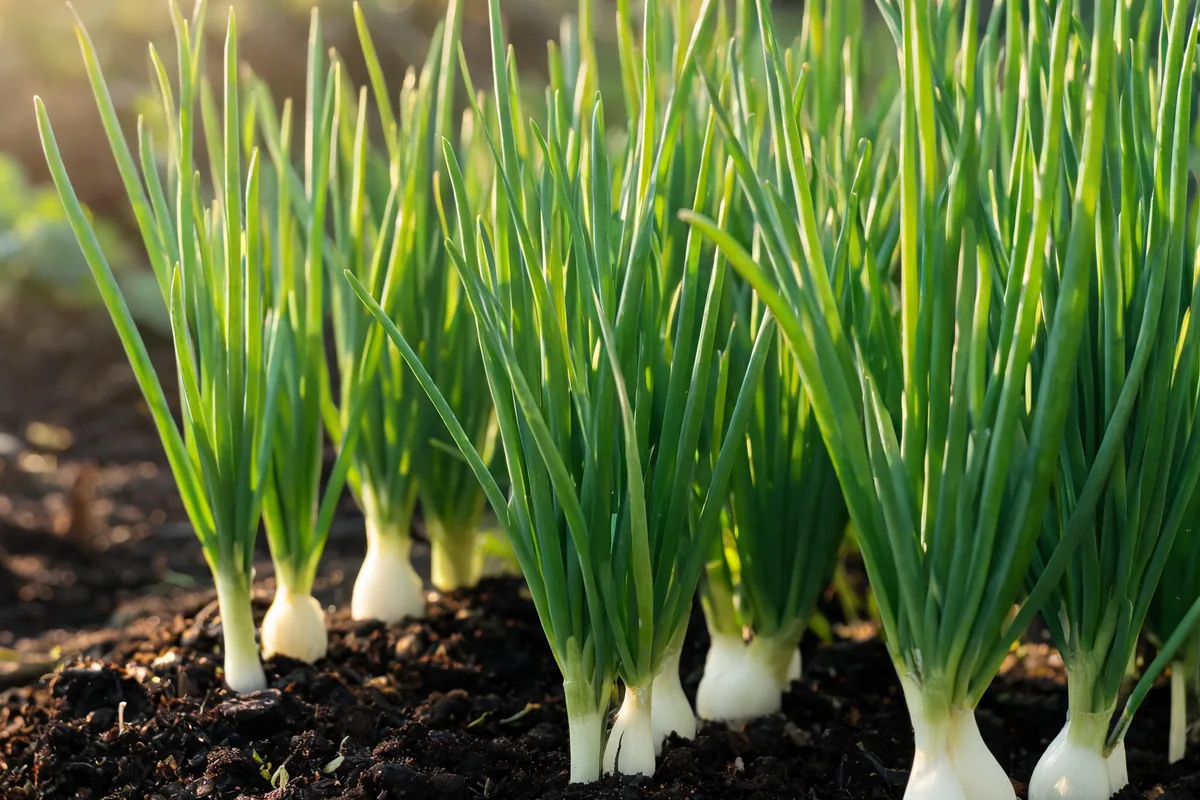
Fresh green scallions growing in rows in rich garden soil with bright white stem bases
Photo: Unsplash

Scallion types

The word "scallion" covers two distinct species and a few naming conventions that trip up new gardeners.

Bunching onion (Allium fistulosum)

The true bunching or Welsh onion. Does not form a significant bulb at the base — it remains a cylindrical, hollow-stemmed clump. Perennial in zones 6–9, where established clumps can be divided and harvested repeatedly for years. Per University of Minnesota Extension, A. fistulosum is "the bunching onion that forms perpetual clumps rather than individual bulb onions." It is the standard "scallion" of Asian cuisines and is widely used in Japanese, Chinese, and Korean cooking.

Immature bulb onions (Allium cepa — harvested young)

Standard bulb onions can be harvested before the bulb forms by direct-sowing thickly and pulling young plants. The result looks and tastes like a scallion. Per Penn State Extension, "many gardeners grow 'scallions' simply by sowing bulb onion seed thickly and harvesting the plants at the bunching stage before significant bulb formation." Varieties like 'Bunton White' and 'Evergreen Hardy White' are specifically bred for scallion use.

USDA hardiness and where scallions grow

Scallions grown from seed are treated as cool-season annuals in most of the country, grown in spring and fall in zones 3–11. Per Penn State Extension, "scallions tolerate light frost and can be planted 3–4 weeks before the last frost date in spring." In zones 6–9, A. fistulosum types are fully perennial — established clumps survive winters and produce fresh growth in early spring before any other vegetables are ready.

In zones 5 and colder, overwinter survival of established bunching onion clumps is variable. Per UMN Extension, "bunching onions can be grown as perennials in zones 6–9; in zones 3–5, treat as cool-season annuals with spring and fall sowings." The summer heat of zones 8–11 can cause bolting (premature flowering and seed set), so fall and early spring are the most productive seasons in warm climates.

Light

Full sun — 6 or more hours of direct sunlight — is ideal for scallions. Per University of Minnesota Extension, "onions and scallions are long-day plants that require adequate light for best leaf development." In part shade, scallions grow more slowly and produce thinner, less flavorful stalks. They are among the few vegetable crops that tolerate a slight reduction in sun (4–5 hours) without total failure, but quality is best in full sun.

Watering

Scallions need consistent moisture — their shallow root systems don't reach deep soil moisture the way larger vegetables do. Per Penn State Extension, "scallions need about 1 inch of water per week from germination through harvest." The soil should remain evenly moist but not waterlogged. During the first few weeks after germination, the seedlings are especially vulnerable to drought, and the top inch of soil drying out can set germination back significantly.

As with most alliums, overhead watering in the evening should be avoided to reduce the incidence of leaf blight and botrytis. Drip irrigation or morning watering that allows foliage to dry during the day is preferred.

Soil and pH

Per Penn State Extension, scallions "prefer loose, well-drained soil with a pH of 6.0–7.0." Compacted soil reduces root penetration and limits the depth of the white stem that can be blanched. If your soil is heavy clay, raised beds or deep-worked rows with added compost improve the texture enough for good scallion production. Rocky or coarse sandy soils are not problematic if watering is consistent — scallions don't need deep soil.

Nitrogen is the most important nutrient for scallion production — it drives leaf and stem development. A soil test showing low nitrogen benefits from pre-plant incorporation of composted manure or a nitrogen-rich organic fertilizer before direct sowing.

Planting

Direct sowing from seed: The most common approach. Per University of Minnesota Extension, "direct sow scallion seeds 1/4 inch deep in rows 6 inches apart, or broadcast into a 4-inch-wide band." Germination takes 7–14 days at 65–75°F. Thin to 1 inch between plants when seedlings are 3–4 inches tall — thinnings are edible. Days to harvest: 60–80 from seed, depending on variety and conditions.

Starting from transplants: Scallion transplants (available from most garden centers as "onion sets" or cell-tray starts) can be planted out 3–4 weeks before last frost. Space 1 inch apart in rows. Transplants shave 3–4 weeks off the time to harvest compared to direct seeding.

Succession sowing: For continuous harvest, sow every 2–3 weeks from the spring planting date through early summer, then again in late summer for fall harvest. Per Penn State Extension, "succession planting is the simplest way to avoid the feast-and-famine cycle of having too many scallions at once and then none."

Blanching the stem base: To produce a longer, more pronounced white stem (preferred in many culinary uses), plant seeds in a 3–4-inch-deep furrow, or hill soil against the base of growing plants to exclude light. Per UMN Extension, "hilling soil around the base when plants are 6 inches tall blanches 2–3 more inches of stem." This is optional — scallions are fully usable without blanching.

Fertilizing

Scallions benefit from nitrogen-forward fertilization. Per Penn State Extension, "a nitrogen sidedress application 3–4 weeks after germination, when plants are 4–6 inches tall, promotes rapid, even growth." Ammonium sulfate or a balanced nitrogen-containing liquid fertilizer at the label rate works well. A second application at 7–8 weeks supports the final push to harvest size. Excess nitrogen in the last 2–3 weeks before harvest can reduce flavor intensity and bulb quality in bulbing types, but is not a concern for scallions harvested before bulbing occurs.

Harvesting

Harvest scallions when stems are pencil-thick, typically 6–10 inches in total length with 3–4 inches of white stem base. Per UMN Extension, "harvest by pulling the entire plant or by cutting 1 inch above the soil surface, which allows the plant to resprout for a second cut." The cut-and-come-again method works 1–2 times before plant vigor declines. Pull-harvesting is preferred for bunching to ensure soil-free roots.

Common problems

Onion thrips (Thrips tabaci)

The most common insect pest of scallions. Tiny, silvery insects feed between leaf sheaths, causing silvery streaking and distortion. Per UC IPM's thrips pest note, "insecticidal soap or spinosad applied when populations are low is effective; severe infestations may require pyrethrin." Overhead irrigation reduces thrips numbers by disrupting their movement. Row cover prevents establishment in spring when migrations are heaviest.

Damping off

Seedling collapse at soil level, caused by Pythium and Fusarium in cold, wet soils. Per Penn State Extension, "sow in warm soil (above 50°F) and ensure drainage" — cold, wet seedbeds are the primary risk factor. Direct sowing too early in spring in cold, heavy soil is the most common cause of poor germination and damping off in scallions.

Botrytis leaf blight

Oval or diamond-shaped white lesions with green halos on the leaves, caused by Botrytis squamosa. Per Penn State Extension, "avoiding overhead irrigation and maintaining adequate spacing for air circulation are the primary management practices." Copper-based fungicide can be applied preventively in high-humidity conditions.

Bolting (premature flowering)

Plants that experience cold temperatures after germination (vernalization) can bolt in warm weather. Per UMN Extension, "scallions that bolt produce a flowering stalk that reduces the quality and usability of the plant — harvest immediately if bolting begins." Succession sowing and choosing non-bolting varieties reduces this problem.

Frequently asked

What is the difference between scallions and green onions?

In common U.S. usage, the terms are interchangeable. Both refer to young onion plants harvested before bulb formation. Per Penn State Extension, "scallion, green onion, spring onion, and bunching onion are all used to describe young onion plants harvested at the immature stage." Technically, "spring onion" sometimes refers to young bulbing onions with a small bulb at the base, while true "scallions" or "bunching onions" are A. fistulosum types that never form a bulb.

Can I regrow scallions from grocery store scallions?

Yes. Per Penn State Extension, "placing the root end of a grocery store scallion in a glass of water, or planting it directly in soil 1 inch deep, will produce new green growth in 3–5 days." This method is only good for 2–3 regrowths before the plant exhausts its stored energy. For a sustained supply, growing from seed or sets is more productive.

How many scallions fit in a raised bed?

Scallions are among the most space-efficient vegetables. Per UMN Extension, "16 scallion plants fit in a 1-foot × 1-foot area" at standard 1-inch spacing. A 2-foot × 4-foot raised bed section can produce 120+ scallions, enough for a household's regular use if succession-sown every 3 weeks.

When is the last time I can sow scallions in fall?

Sow fall scallions 8–10 weeks before the first expected frost. Per Penn State Extension, "scallion seedlings can withstand light frost to 28°F, so harvests can extend 2–3 weeks past the first light frost." In zones 5–6 with a mid-October first frost, this means sowing in mid-to-late August. In zones 7–8, fall sowings in September–October produce scallions through December or even January in mild years.

Sources