Home / Problems / Tomato Blight -- Early and Late: Identification and Treat...
Problem
Tomato Blight -- Early and Late: Identification and Treatment
title: "Tomato Blight — Early and Late: Identification and Treatment"
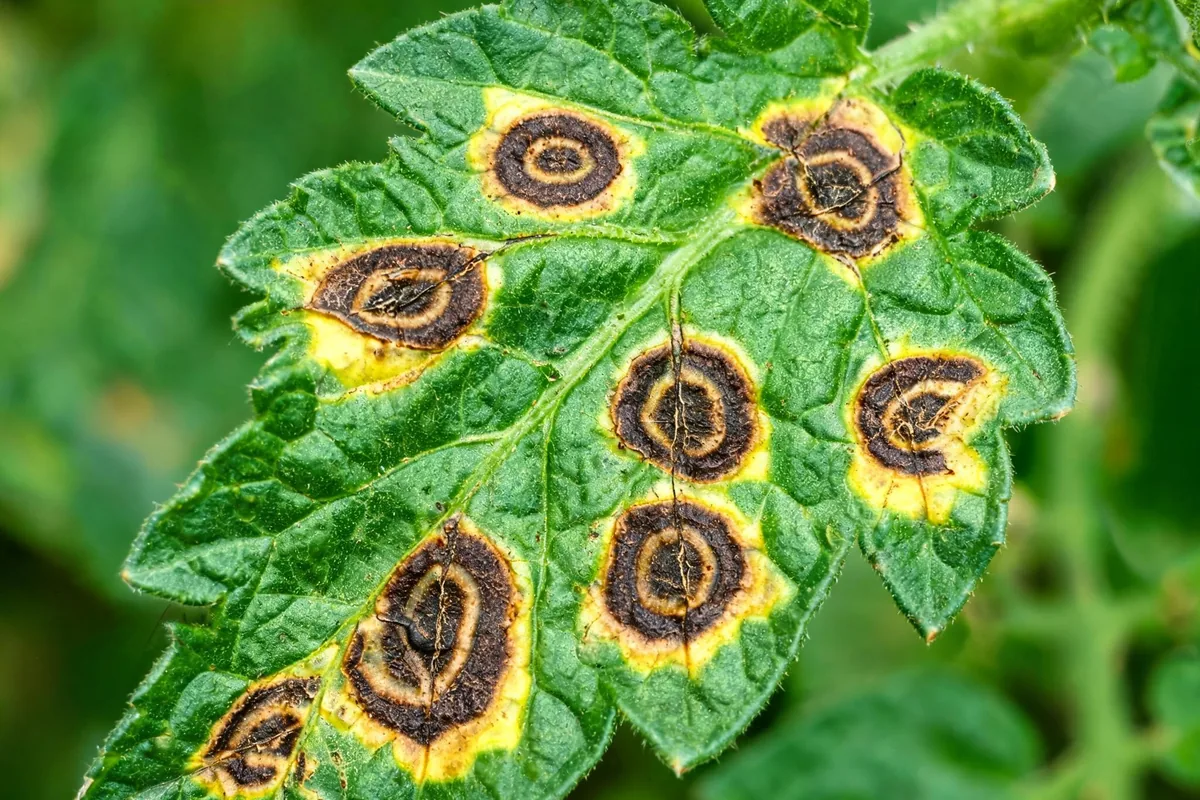
Concentric-ring early blight lesions on a lower tomato leaf. Image: AI-generated reference. "Tomato blight" is one of those terms that gets used for nearly any tomato disease. In practice, it refers to two distinct fungal diseases — early blight and late blight — that are caused by different organisms, spread under different conditions, and require different responses. Getting them confused leads to wrong treatment decisions. Late blight in particular is serious enough that growing through it with standard early-blight protocols will not work.
I don't grow tomatoes at my Long Island property, but the extension research on both diseases is detailed and worth presenting correctly.
The honest summary: Early blight (Alternaria solani ) is nearly universal in eastern gardens, appears reliably each season, and is manageable with fungicide, removal of affected foliage, and rotation. Late blight (Phytophthora infestans ) — the same pathogen that caused the Irish Potato Famine — is more serious, spreads rapidly in cool and wet conditions, and can kill a tomato plant in a week. The visual difference is key: early blight lesions have a concentric ring "target" pattern; late blight lesions are large, water-soaked, with a white mold on the underside of leaves.Table of Contents
Identification: Early vs. Late Blight Early Blight In Depth Late Blight In Depth Fungicide Options Cultural Controls Common Situations Frequently Asked
Reader questions
Questions from other readers about this guide. Ask your own — if it's a good question, the answer goes here for the next reader.
How do I tell early blight from late blight?
The clearest field distinction is to flip the leaf. Per Cornell Cooperative Extension, late blight produces white, fuzzy sporulation on the underside of infected leaves within 24--48 hours of infection in humid conditions -- no other common tomato disease does this. On the upper surface, late blight lesions are large, irregular, and water-soaked rather than the smaller, concentric-ring "target" lesions of early blight. Speed matters too: early blight progresses over weeks; late blight can destroy a plant in under 10 days.
Can I save a tomato plant with late blight?
Per Cornell Cooperative Extension, if the disease is caught early (less than 20--25% of foliage affected), aggressive removal of infected tissue and immediate fungicide application may allow the plant to survive and produce fruit. If the plant is more than half affected, removal is the more practical choice. The risk of a heavily infected plant is that it continues spreading inoculum to neighboring plants and to other gardens -- the pathogen can spread via wind for significant distances.
Does crop rotation help with tomato blight?
It helps substantially for early blight. Per Cornell Cooperative Extension, *Alternaria solani* overwinters in infected plant debris, and rotation combined with debris removal reduces the inoculum load in the soil. For late blight, rotation helps less because *Phytophthora infestans* does not reliably overwinter in northern soils -- the primary inoculum source is infected transplants or long-distance spore dispersal from southern states, both of which rotation cannot prevent.
What tomato varieties resist blight?
Several varieties have partial resistance to early blight. Per Cornell Cooperative Extension, varieties with resistance ratings include 'Mountain Magic', 'Defiant PhR', and 'Jasper'. For late blight, 'Defiant PhR' and 'Mountain Magic' have published resistance ratings -- the "Ph" notation in a variety name indicates *Phytophthora* resistance. Per NC State Extension, resistance means reduced susceptibility, not immunity; all varieties can be infected under heavy disease pressure. --- > Recommended gear: Best tomato varieties for the home garden — determinate vs indeterminate — our buyer's guide covering picks for every budget, ranked by Extension publication consensus and personal use.
One honest gardening email a day for 30 days
Real techniques from a Long Island zone 7a garden, each tied to a primary Extension source. No listicles. No filler. Unsubscribe any time.
Send me the emails