Yew Care: Evergreen Hedges and Foundation Plants
Yew (Taxus spp.) is the most shade-tolerant evergreen hedge in zones 4–7 and responds well to shearing — but the entire plant except the red arils is toxic, it is frequently overwatered and killed, and deer eat it severely in high-pressure areas.
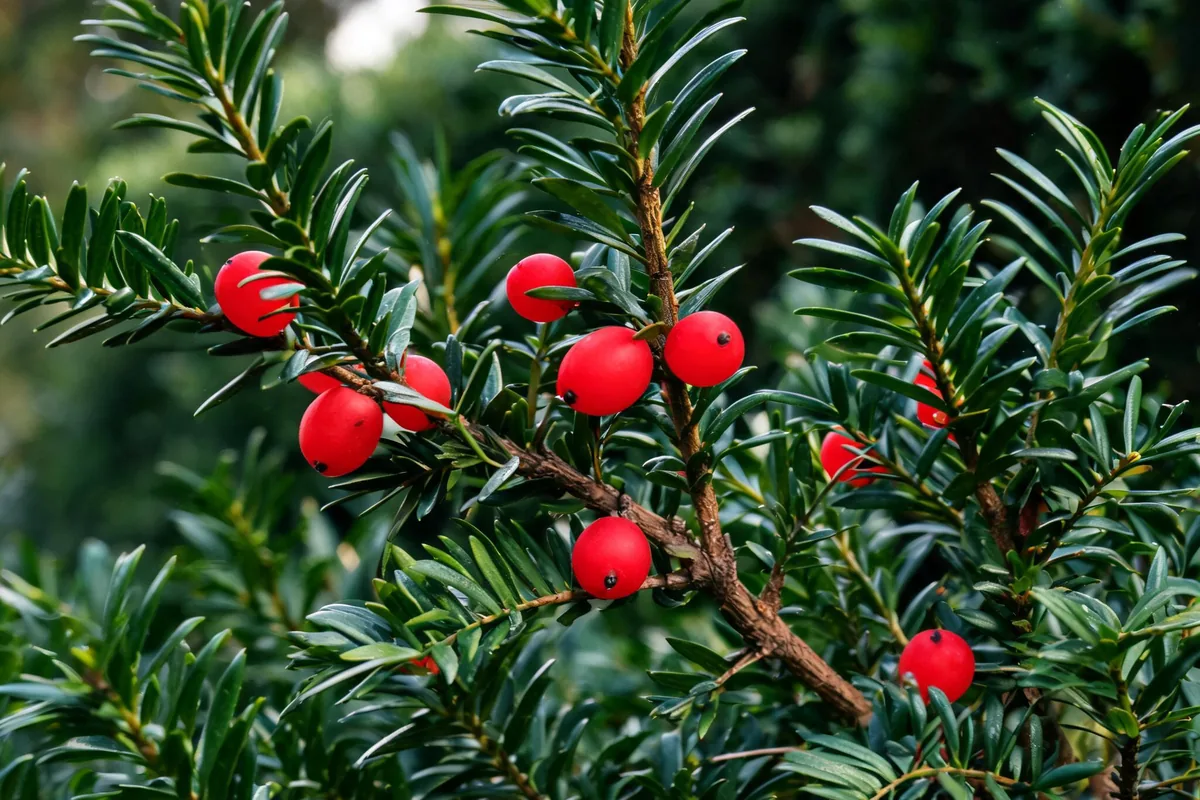
Yew species and cultivars
Two species and one widely used hybrid cover most landscape yew use in North America.
English yew (Taxus baccata)
The ancient European yew. Slow-growing, very long-lived (centuries in the right conditions), the source of most formal topiary and hedge yew in European gardens. Per Missouri Botanical Garden, English yew is hardy in zones 5–7 and "is the standard hedge yew of English formal gardens but can be less reliably cold-hardy than Japanese or Anglojap yew in North American zone 5 winters." Grows to 20–60 feet in natural form.
Japanese yew (Taxus cuspidata)
Hardier than English yew — zones 4–7. Per Penn State Extension, Japanese yew "is more reliably cold-hardy for zone 4–5 gardens in the upper Midwest and Northeast." Its spreading, less formally dense habit makes it more commonly used as a foundation shrub or groundcover than a clipped hedge.
Anglojap yew (Taxus × media)
The hybrid between English and Japanese yew. The most widely planted landscape yew in North America. Per University of Minnesota Extension, "Anglojap yew combines the density and fine texture of English yew with the cold hardiness of Japanese yew" and "is available in a wide range of cultivars covering everything from low groundcovers to tall shrubs and small trees." Key cultivars:
- 'Densiformis': Dense, mounding form, 3–4 feet tall and wide. The most commonly planted foundation yew.
- 'Hicksii' (Hicks yew): Narrow, upright column, 12–20 feet. The standard for narrow upright hedges and privacy screens.
- 'Browni': Dense rounded form, 4–6 feet. Widely used as a foundation plant and clipped ball specimen.
- 'Tauntonii': Low spreading, 3–4 feet, notably cold-hardy to zone 4. Better than other selections for exposed, cold sites.
USDA hardiness and where yew grows
Per Penn State Extension, most landscape yews are reliably hardy in USDA zones 4–7, with some cultivars extending to zone 3 and others performing in zone 8. Yews are not suitable for the hot, humid summers of zones 8–9 in the Southeast — they decline quickly in high heat and humidity. They are primarily plants of the temperate northeastern U.S., the upper Midwest, the Pacific Northwest, and coastal New England.
Yews are native to Europe (T. baccata) and northeast Asia (T. cuspidata). In North America, the American yew (T. canadensis) is a native groundcover found in shaded forests from the Great Lakes to the Northeast, hardy to zone 2 but rarely planted in cultivation.
Light
This is the defining advantage of yews over most other evergreen shrubs: they grow in full sun to full shade. Per Penn State Extension, "yews are among the most shade-tolerant needled evergreens available for the northeastern U.S. — they grow well on the north side of buildings, under trees, and in other shaded positions where most evergreens fail." They are not the best choice for full-sun, dry, hot, or windy sites — boxwood and juniper are better in those conditions — but in shade, nothing else comes close for an evergreen formal hedge.
Watering
Established yews are moderately drought-tolerant but, critically, they are highly intolerant of waterlogged soil. Per Clemson HGIC, "overwatering and poorly drained soil is the most common cause of yew death — they require well-drained soil and will rapidly decline and die in sites that stay wet." During establishment, water weekly but always allow the soil to partially dry between waterings. After establishment, water only during extended droughts. Yews in poorly drained foundation plantings — a common landscaping situation where downspout discharge ends near the foundation — are at high risk of root rot and decline.
Soil and pH
Per Penn State Extension, yews "prefer well-drained, slightly acidic to neutral soil at pH 5.5–7.5." They are adaptable to a range of soil textures but drainage is paramount. Sandy soils are preferable to clay for yew root health. In heavy clay, either plant in raised beds or amend the planting area extensively with coarse compost and sand to improve drainage. A yew planted in clay that stays wet in spring will typically decline over 3–5 years, eventually dying from Phytophthora root rot — a slow process that is often misdiagnosed as winter damage or nutrient deficiency.
Planting
Container-grown yews can be planted in spring or fall. Per University of Minnesota Extension, fall planting is preferred because roots establish better in cool soil and the plant enters the following summer with a more developed root system. The root flare must be at soil grade — yews planted too deep are predisposed to crown rot.
For formal hedges, 'Hicksii' should be spaced 2–3 feet apart for a dense hedge quickly; wider spacing produces a looser, more informal mass. For individual foundation plants, allow space for the mature width — 'Densiformis' reaches 3–4 feet and should be planted at least 2.5 feet from foundations. Yews planted directly against foundations often develop one-sided root systems and are wet on the downspout side.
Fertilizing
Yews in average garden soil need little fertilization. Per Clemson HGIC, "a single application of a balanced slow-release fertilizer in early spring supports healthy foliage on established plants." For plants showing yellowed foliage in alkaline soils, an acidifying fertilizer helps more than a standard balanced product. Do not fertilize in late summer or fall — nitrogen in fall pushes new growth that won't harden off before winter freezes in zones 4–6.
Pruning
Yews are the most responsive of all conifers to pruning. Unlike most other conifers (pine, spruce, fir), yews can regenerate from old, bare wood — this means hard pruning is possible and overgrown yews can be rejuvenated. Per Penn State Extension, "yews can be cut back hard to reduce size significantly — even cutting back to bare wood in late winter will produce new growth that season." This is a material advantage over juniper and arborvitae, which cannot be reduced to bare wood.
For formal hedges, shear 1–2 times per year — once after the initial spring growth flush (late May to June) and optionally again in late summer (late August). Keep hedges slightly wider at the base than the top to allow light to reach the lower foliage. Per UMN Extension, "yews sheared with a wider base produce fuller, denser lower foliage and last longer as formal hedges than those with inverted taper."
Common problems
Root rot (Phytophthora)
The most common cause of yew death. Per Clemson HGIC, "Phytophthora cinnamomi and P. citricola cause root and crown rot in poorly drained sites." Symptoms include yellowing, browning, and collapse of the plant, often following a wet spring or summer. There is no effective fungicide treatment for advanced infections. Prevention through site selection (never plant in areas that stay wet) is the only reliable strategy. Per Clemson HGIC, "yew root rot in foundation plantings is almost always caused by inadequate drainage combined with downspout discharge or lawn irrigation."
Black vine weevil (Otiorhynchus sulcatus)
Adults notch leaf margins; larvae in the soil consume roots, causing branch dieback and eventually plant death. Per Penn State Extension, "black vine weevil larvae are one of the most serious soil-dwelling pests of yew." Beneficial nematodes (Steinernema and Heterorhabditis species) applied to moist soil in late summer or early fall are effective for larval control. Entomopathogenic nematodes are OMRI-listed and safe for use around structures.
Deer browse
Deer browse yew heavily and can strip established shrubs to bare stems. Per Rutgers NJAES's deer resistance ratings, yew is rated as "frequently severely damaged" — among the highest deer preference of any landscape shrub. Deer seem indifferent to the plant's toxic alkaloids. In high-deer-pressure areas (much of suburban Long Island and New Jersey), yew either requires fencing or a repellent program, or should be replaced with deer-resistant alternatives like boxwood or inkberry holly.
Needle browning and winter burn
Per Penn State Extension, "yews planted in exposed, windy sites or in full sun on the south or west side of buildings may show winter burn — browning of foliage from desiccation while roots are frozen." Wrapping plants in burlap, applying anti-desiccant spray in November, or siting in more protected positions reduces winter burn. Anti-desiccant sprays (Wilt-Pruf, Wilt Stop) are most effective when applied before the first hard freeze.
Frequently asked
Are yews toxic?
Yes — yews are among the most toxic landscape plants. Per the Royal Horticultural Society's yew guidance, "almost all parts of the yew plant contain the alkaloid taxine, which is toxic to humans, horses, cattle, and most animals." The red arils (fleshy coverings around the seeds) are the only part not containing high levels of taxine, but the seeds inside are toxic. Ingestion of even small amounts of foliage or seeds can be fatal to horses and cattle. Children should be supervised around yews with accessible berries. Deer appear to have a different metabolic response and browse yews without ill effect.
How do I rejuvenate an overgrown yew?
Per Penn State Extension, yews can be cut back to bare stems in early spring — they will produce new growth from old wood. For less dramatic rejuvenation, reduce size by one-third each year over three years. This approach works better than cutting all species at once because it maintains some screening and reduces the shock to the plant.
Why are my yew needles turning yellow?
Yellow or bronze foliage in yews is most often caused by one of three things: wet, poorly drained soil (root rot), alkaline soil above pH 7.5 limiting iron uptake (chlorosis), or winter desiccation. Per Clemson HGIC, "check soil drainage and pH first before assuming a pest or disease cause." If the soil is wet and the roots are brown and mushy, root rot is the problem and the plant typically cannot be saved.
Can I grow yew in deep shade?
Yes — this is one of yew's key practical advantages. Per Penn State Extension, "yews grow satisfactorily in full shade on the north side of buildings where most other evergreen shrubs fail." In deep shade, growth is slower and foliage may be slightly less dense than in sun, but the plant remains healthy and long-lived. This makes yew one of very few options for shaded formal hedges in northeastern gardens.
