Species guide

Rhododendron care: acidic soil, drainage, and azalea lacebug

Rhododendrons fail most often because of wrong soil pH or poor drainage. The soil must be pH 4.5-5.5, well-drained, and rich in organic matter. Azalea lacebug is the primary pest and is far worse on plants in full sun.

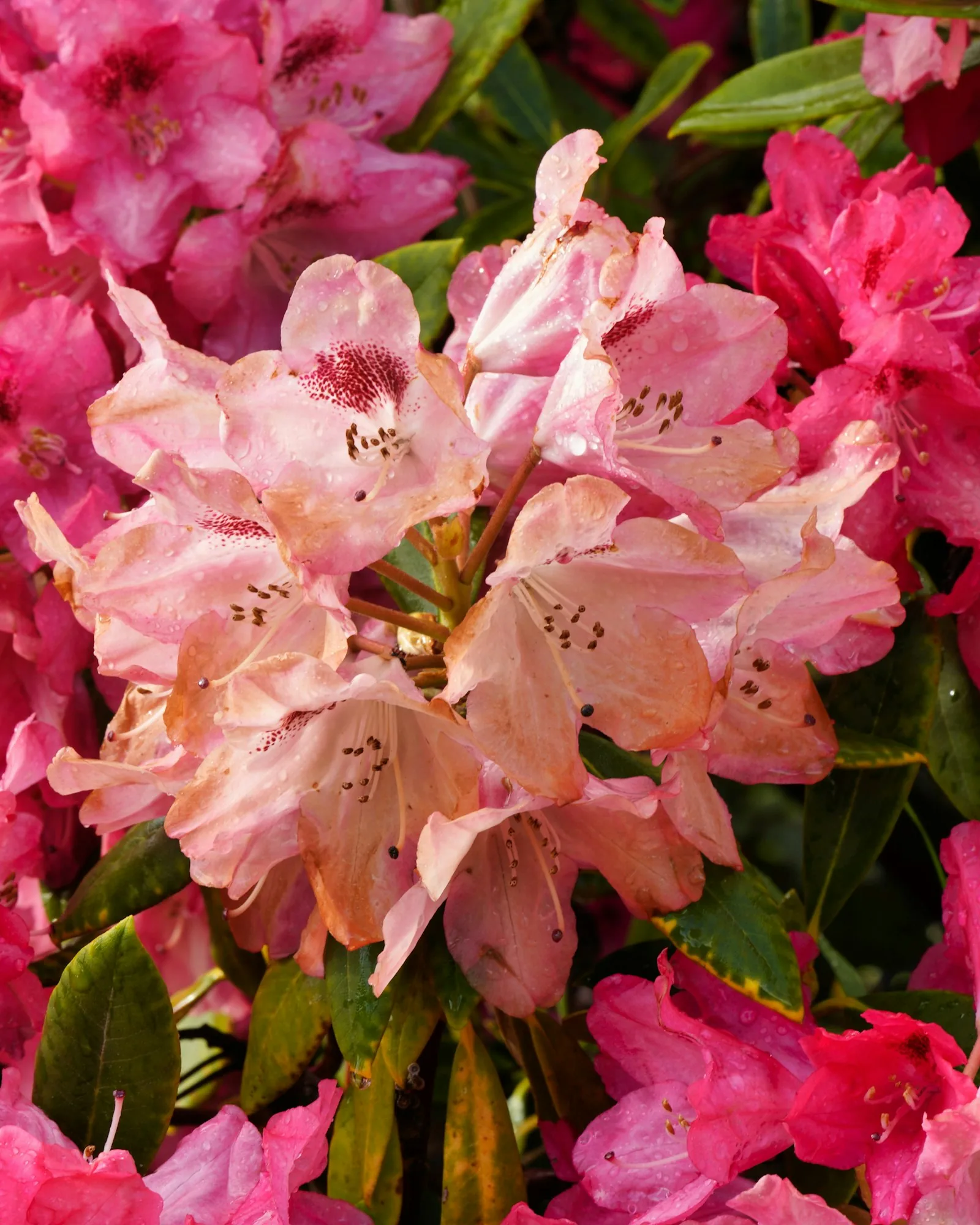
Pink rhododendron flowers are in full bloom
Photo: Unsplash on Unsplash

—- title: "Rhododendron care" slug: rhododendron-care hub: plants category: Species guide description: "I don't grow rhododendrons. My Long Island yard is sandy loam in full sun for most of the day, and rhododendrons require dappled shade, consistent moisture, and acidic well-drained soil rich in." date: 2026-06-10 updated: 2026-06-10 author: "Thomas A." reading_time: 14 scientific: "Rhododendron spp." zones_min: 4 zones_max: 9 sun: "part shade" deer_resistant: false native: false pollinator: true bloom: "spring" height_min: 2 height_max: 8 —-

I don't grow rhododendrons. My Long Island yard is sandy loam in full sun for most of the day, and rhododendrons require dappled shade, consistent moisture, and acidic well-drained soil rich in organic matter. The full-sun, sandy-soil combination that works well for my peonies and ornamental grasses is exactly what rhododendrons struggle in. On Long Island, the most successful rhododendrons I've seen grow on the north or east sides of houses — never in open, south-facing beds. This guide is built from Clemson HGIC, NC State Extension Plant Toolbox, Missouri Botanical Garden, RHS, and UC IPM for lacebug control.

Rhododendron vs. azalea: what's the difference?

All azaleas are rhododendrons, but not all rhododendrons are azaleas. Botanically, azaleas are in the genus Rhododendron — the distinction is informal and based on growth habit and flower structure. For practical care purposes:

Care requirements overlap substantially — both need acidic soil, good drainage, and protection from hot afternoon sun. This guide covers both, with notes on where they differ.

USDA hardiness zones

The zone range for the genus is enormous, and the specific cultivar matters more than the genus-level zone rating.

Per NC State Extension Plant Toolbox on rhododendron hybrids: zones 5a-9b for common hybrid rhododendrons.

Per NC State Extension on the PJM Group: the PJM rhododendrons (compact, purple-pink flowering, early spring) are among the most cold-hardy large-leaved types, suitable for zones 4-8.

Per Clemson HGIC: for reliable performance in the southeast, "a variety with R. catawbiense parentage is usually reliable here, as are the 'ironclads.'" The "ironclad" rhododendrons are a group of hybrids known for cold hardiness and heat tolerance: 'Catawbiense Album', 'Catawbiense Boursault', 'Roseum Elegans', 'Nova Zembla'. These are the safest choices for gardens in zones 5-7 that want reliable, low-maintenance rhododendrons.

Choosing by zone:

ZoneWhat to plant
Zones 4-5PJM Group; native R. catawbiense hybrids
Zones 5-7Ironclad hybrids; 'Catawbiense Album'; 'Nova Zembla'; 'Roseum Elegans'
Zones 7-8Southern cultivars; 'Gomer Waterer'; standard commercial hybrids
Zone 8-9Low-chill varieties; Southern Indica azaleas

Light

Per Clemson HGIC: "Dappled shade; filtered light under tall pines/oaks; avoid hot afternoon sun."

This is the non-negotiable site requirement. Rhododendrons evolved as understory plants in forested environments with filtered light. Full sun in most of the U.S. east of the Mississippi causes foliage scorch, reduces flowering, and significantly increases stress susceptibility — including lacebug damage.

Per Clemson HGIC azalea guidance: "Azaleas grow best in the morning sun with afternoon shade. Azaleas in full sun will become stressed and secrete compounds that lace bugs can detect, enabling them to target weaker plants." The same principle applies to rhododendrons.

Per Clemson HGIC, the best planting locations are "on the north or east side of a building." Southern exposures combined with reflected heat from buildings are hostile to rhododendrons. "When using rhododendron in a foundation planting, avoid southern exposures."

Soil pH and preparation

The pH requirement: Per Clemson HGIC: "Rhododendrons have a few requirements: excellent drainage, a soil pH between 4.5 and 6.0." Per NC State Extension Plant Toolbox: soil pH must be "Acid (<6.0)." Per RHS: "Rhododendrons need moist but well-drained [soil], between pH 5.0 and 6.0 that is rich in organic matter."

If your soil's natural pH is above 7.0, per RHS: "grow rhododendrons as container plants or see our page on more tolerant species and cultivars. Reducing soil pH is not simple." This is consistent with what we know from the soil science: soils with free lime (calcium carbonate present) cannot be durably acidified; they will return to alkaline chemistry over time regardless of how much sulfur you apply. Per Penn State Extension on soil pH: "If you grow plants that prefer an acid soil do not lime the soil around them. Lime can severely hamper the health of plants like blueberry, azalea, and rhododendron."

Organic matter: Per Clemson HGIC: "The soil for these woodland plants must be well-drained and high in organic matter. Organic matter improves drainage in clay soils and will increase a sandy soil's ability to retain water and nutrients. Add about 4 inches of pine bark over an area two to three times the area to be covered by the branches of the plant you are setting. Mix it into the top 6 to 8 inches of soil."

Planting high: Per NC State Extension Plant Toolbox: "If you have clay soil, amend with organic material and plant the root ball high in the soil to help with drainage issues." Per RHS: "Do not plant too deeply — all rhododendrons are surface-rooting and the roots should be just covered." Planting high — with the top of the root ball at or slightly above ground level — is standard practice and is one of the most effective tools for improving drainage around the crown.

Watering

Per Clemson HGIC: "Rhododendrons are shallow-rooted plants and require irrigation during dry periods." The root system is concentrated in the top 6-12 inches of soil, making it sensitive to both drought and waterlogging.

Per Clemson HGIC: "When the soil feels dry, water it to a depth of 8 to 12 inches. Use soaker hoses or drip irrigation to slowly water the base of the plant."

Per RHS: "Rhododendrons grow best in areas of high rainfall. Even on suitably acid soils they are more difficult to grow successfully in the drier parts of the country." This is worth taking seriously in drier regions — rhododendrons planted in the lower mid-Atlantic and upper South need irrigation through summer droughts.

The waterlogging warning: Per Clemson HGIC: "Be aware that rhododendrons in waterlogged soils are prone to decline and become susceptible to root rot diseases. It is essential to reach a balance between regular, deep watering and good drainage to promote a healthy plant."

Water quality note: Per RHS, "tap water, especially in hard water districts, contains too much calcium for rhododendrons, reducing acidity around their roots. Use rain water for watering rhododendrons, but if rain water runs out, tap water is satisfactory for a month or two in summer." This is primarily a concern in the UK and the very hardest water regions of the U.S.; in most areas, tap water for occasional use is fine.

Mulching

Per Clemson HGIC: "A 2- to 3-inch layer of compost, pine bark, or pine straw bale (Home Depot) is excellent mulch. Extend the mulch well beyond the outermost branches of the plant. Pull mulch away from the main stem to help prevent disease."

Per RHS: "Apply at least a 7.5 cm (3 in) of chipped conifer or other acidic material. The mulch should be well-aerated, not packed or firmed down. Renew or replenish the mulch each spring when the soil is still moist."

Mulch serves three functions for rhododendrons: maintains soil moisture around the shallow root system, moderates soil temperature, and slowly acidifies as it decomposes. Pine bark and pine straw bale (Home Depot) are preferred over hardwood mulch because they maintain a lower pH as they break down.

Fertilizing

Per Clemson HGIC: "With proper soil preparation and mulching, very little fertilizer is necessary — particularly for older, established plants." The mulch layer, as it decomposes, provides most of the nutrients an established rhododendron needs.

Per Clemson HGIC: "Do not fertilize rhododendrons at the time of planting. Allow newly planted shrubs one to several months to begin establishing their root system before applying fertilizer." Fertilizing a stressed, newly-planted rhododendron pushes shoot growth before the root system can support it.

When fertilizing is warranted, per Clemson HGIC: "use a complete fertilizer with a ratio of 3:1:2 or 3:1:3, such as 12-4-8 or 15-5-15." Apply from late spring (after new growth emerges) up to early fall. Use an acid-forming fertilizer — the same azalea/camellia formulas recommended for gardenias also serve rhododendrons.

Per Clemson HGIC: "Avoid fertilizing plants stressed by drought during the summer months. Without water, plants are unable to absorb nutrients."

Pruning and deadheading

Pruning timing: Per Clemson HGIC: "Pruning to shape the plant or to keep it within bounds should be done after the plant has flowered." Per NC State Extension: "Prune rhododendrons and azaleas after they bloom to preserve the current season's bloom, and allow time for the plant to produce flower buds for next year's bloom. Rhododendrons and azaleas set next year's flower buds by mid to late summer."

This is the same old-wood pruning principle as Hydrangea macrophylla: the flower buds for next year form on old wood in mid to late summer. Pruning in fall or winter removes those buds.

Deadheading: Per Clemson HGIC: "Deadheading is an important type of pruning. It involves snapping off the dead flower trusses to prevent the development of seeds, which take a great deal of strength from the development of the following year's flower buds. Break out only the spent blooms to avoid damaging the dormant buds."

This is a meaningful management step: seed production is energetically expensive, and on a rhododendron with dozens of trusses, allowing all of them to set seed measurably reduces next year's bloom. Snap the dead flower trusses off carefully, bending them sideways — the new growth buds immediately below each truss are fragile.

Renovation pruning: Very old, leggy rhododendrons can be rejuvenated by cutting them back hard — but this is a multi-year project, not a single-season fix. Per Clemson HGIC, dead or damaged wood can be removed at any time. Major pruning for shape should be done right after flowering.

Azalea lacebug — the primary pest

The azalea lacebug (Stephanitis pyrioides) is the most damaging insect pest of rhododendrons and azaleas in North American landscapes. Per Missouri Botanical Garden: "The lace bug feeding mechanism is one that pierces and sucks the plant juices from leaves. This leaves tiny chlorotic flecks on the upper leaf surface."

Identification: Per University of Georgia Extension: "Positive identification of lace bug damage can then be confirmed by the presence of brown to black droplets of excrement and old 'skins' of the nymphs on the underside of damaged leaves." Look for: stippled, grayish upper leaf surface, dark tar-like spots on leaf undersides. If you see both, lacebug is the cause.

Life cycle: Per UC IPM: lacebug adults and nymphs feed on the underside of leaves, causing "pale stippling and bleaching that can become very obvious on the upper leaf surface by mid to late summer." Per Missouri Botanical Garden, "a complete life cycle takes only 30 to 40 days; several generations may occur each year. Lace bugs are more prevalent in late summer and fall."

The sun connection: Per Clemson HGIC azalea lacebug guidance: "Azaleas in full sun will become stressed and secrete compounds that lace bugs can detect, enabling them to target weaker plants." Per UC IPM: "Azalea and toyon grown under partial shade experience less damage by lace bugs than when they are grown in locations more exposed to direct sunlight and higher temperatures." Correct siting is the first line of defense.

Control options per Missouri Botanical Garden:

  1. Maintain plant vigor — healthy, well-sited plants are less severely affected.
  2. Spray with water — forceful water sprays dislodge nymphs and are effective when combined with insecticidal soap.
  3. Sanitation — remove leaves and twigs under plants to remove overwintering pests.
  4. Contact insecticides: insecticidal soap, neem oil, horticultural oil. These must coat the lacebugs directly to work; they have no residual effect. Per Clemson HGIC, "soap and oil sprays have no residual effect, so beneficial insects are not harmed once the spray has dried."
  5. Systemic insecticides: imidacloprid and dinotefuran per Clemson HGIC. Apply as a soil drench in late winter to early spring for season-long control. Per UC IPM: do not apply systemic insecticides during flowering, as they can translocate into nectar.

Per UGA Extension: "Valuable plants that are susceptible to lace bug damage should be inspected in the early spring for the presence of overwintering lace bug adults, eggs and newly hatched nymphs." The first generation is the easiest to suppress; controlling it reduces total season damage.

Root rot (Phytophthora)

Phytophthora root rot is the disease that kills more rhododendrons than any other single cause. Per NC State Extension Plant Toolbox: "While rhododendrons remain very popular for landscape use, many cultivars are susceptible to phytophthora root rot — this leads to leaf loss, reduced vigor, branch dieback, and wilting."

Per NC State Extension: "Implement good cultural practices first, such as improving drainage with organic matter or berms and avoiding overwatering or overfertilization. However, if you have a site with a history of this disease, consider planting one of the root rot-resistant alternative species."

There is no effective home remedy for an established Phytophthora infection. The pathogen (Phytophthora cinnamomi and related species) persists in soil for years and is spread by water movement and contaminated tools. If you lose a rhododendron to root rot, improving drainage before replanting is mandatory. Replacing with a Phytophthora-resistant cultivar is the most reliable long-term solution.

Root rot vs. lacebug: The symptoms can look similar from a distance — wilting, leaf decline, poor vigor. Check the undersides of leaves. If there are dark excrement spots and stippled upper leaf surfaces, the problem is lacebug. If the leaves are wilting, darkening, and dropping without stippling or excrement, and the roots are brown or soft, the problem is root rot.

Common problems

SymptomMost likely causeFix
Stippled grayish upper leaves; dark spots on leaf undersidesAzalea lacebuginsecticidal soap or horticultural oil on leaf undersides; soil-drench systemic for severe infestations
Wilting, leaf drop, overall decline — no stipplingPhytophthora root rotImprove drainage immediately; replace with resistant cultivar
Yellowing leaves, especially young leavesSoil pH too high; iron unavailableSoil test; acidify; apply chelated iron as bridge
No bloomPruned at wrong time (fall or winter)Prune only after flowering; deadhead but do not cut into new growth
Leaf scorch, brown edgesToo much sun; wind desiccationRelocate to northeast exposure; site away from wind
Leggy, sparse growthInsufficient light; or old wood from skipped pruningThin and shape after flowering; confirm minimum filtered light
Buds form but don't openFrost damage to buds; wrong cultivar for zoneChoose zone-appropriate cultivar; site in frost-sheltered location
Recommended gear: Best Neem Oil for Gardens: How It Works and When to Use It — our buyer's guide covering picks for every budget, ranked by Extension publication consensus and personal use.

Frequently asked

What soil pH do rhododendrons need?

Per Clemson HGIC, rhododendrons require a soil pH between 4.5 and 6.0. Per NC State Extension Plant Toolbox, the soil pH must be "Acid (<6.0)." Per RHS, the optimal range is pH 5.0-6.0. If your soil is naturally above 7.0, consider container growing in an acidic potting mix rather than trying to durably acidify in-ground soil, which is difficult in soils with free lime. Per Penn State Extension, "lime can severely hamper the health of plants like blueberry, azalea, and rhododendron" — never apply lime within the root zone of established rhododendrons.

When should I prune rhododendrons?

Per Clemson HGIC and NC State Extension Plant Toolbox, prune immediately after flowering is complete. Rhododendrons set next year's flower buds by mid to late summer. Any pruning after that point removes the following year's bloom. Deadhead spent flower trusses by snapping them off carefully, avoiding the new growth buds immediately below. Dead or damaged wood can be removed at any time. Do not prune in fall or winter.

What is the white or gray coating on my rhododendron leaves?

There are two likely candidates, and they require different responses. If the coating is on the upper leaf surface in a patchy, dusted pattern, it is powdery mildew — a fungal disease favored by humid, shaded conditions. If the leaves are stippled gray with dark tarry spots on the undersides, the cause is azalea lacebug. Per Missouri Botanical Garden, check the undersides for dark excrement and spiny nymphs to confirm lacebug. insecticidal soap on the leaf undersides controls lacebug; improving air circulation and reducing humidity addresses powdery mildew.

Are rhododendrons deer-resistant?

Largely yes, but with exceptions. Rhododendrons are generally rated as resistant by most extension sources because of their toxicity — the leaves contain grayanotoxins that are poisonous to many animals. In high deer-pressure environments, hungry deer may browse rhododendron foliage despite the toxins, though they are far less likely targets than hostas, daylilies, or tulips. In my zone 7a yard, the peonies and hostas would disappear long before deer turned to rhododendrons. The bigger deer threat to rhododendrons is antler rubbing, which damages stems mechanically. Wire cage protection around young shrubs during the rut reduces this risk.

Sources

  1. Clemson HGIC — How to Grow Rhododendrons in South Carolina.
  2. Clemson HGIC — Azalea Care.
  3. Clemson HGIC — Azalea Lace Bugs.
  4. NC State Extension Plant Toolbox — Rhododendron 'Ramapo'.
  5. NC State Extension Plant Toolbox — Rhododendron 'Dr. A. Blok'.
  6. NC State Extension Plant Toolbox — Rhododendron hybrids.
  7. Missouri Botanical Garden — Lace bugs.
  8. Royal Horticultural Society — How to grow rhododendrons.
  9. University of Georgia Extension — Lace Bugs.
  10. UC IPM — Lace Bugs - Home and Landscape.
  11. Penn State Extension — Understanding Soil pH.