Privet Care: Fast Hedge Shrub With Real Tradeoffs
Privet (Ligustrum spp.) makes a fast, dense hedge in zones 4–10, but most species are invasive across the eastern U.S. — this guide covers the invasiveness tradeoffs, legal status by region, and the care that keeps a privet hedge looking intentional rather than unmanaged.
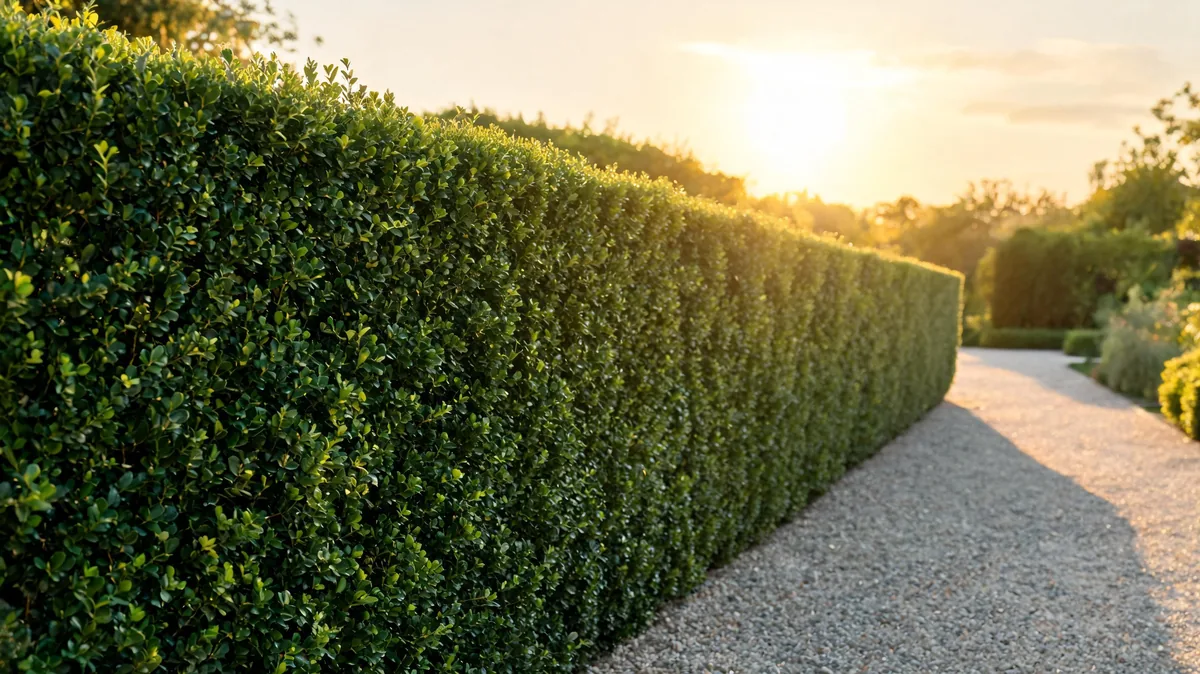
Privet species
Several Ligustrum species are sold in North America, and they differ in cold hardiness and invasiveness.
Common privet (Ligustrum vulgare)
Semi-evergreen to deciduous depending on winter severity. Hardy in zones 4–8. Per Penn State Extension, "common privet is the most cold-hardy of the commercially available privets and was widely planted in northern gardens for its fast growth and dense hedge habit." Clusters of white flowers in June are fragrant to some people and unpleasant to others — the scent is described as both sweet and heavy. Dark berries follow and are toxic to humans and some animals.
Japanese privet (Ligustrum japonicum)
Evergreen, 6–12 feet, hardy in zones 7b–10. Per UF IFAS Gardening Solutions, Japanese privet is "the most widely planted privet in the South, used as hedges, screens, and foundation plants across the Gulf Coast and Florida." It thrives in heat and humidity that damages common privet. Listed as invasive in multiple southeastern states.
Chinese privet (Ligustrum sinense)
The most aggressively invasive privet in the eastern U.S. Per University of Minnesota Extension and numerous state extension publications, Chinese privet "has escaped cultivation across the Southeast and mid-Atlantic and now ranks as one of the most problematic invasive shrubs in eastern forests." It spreads prolifically by bird-dispersed seed. Per Clemson HGIC, Chinese privet is "listed as a federal noxious weed and is regulated or prohibited in several southeastern states — growers should not plant it."
Amur privet (Ligustrum amurense)
The hardiest species, reaching zone 3–4. Per UMN Extension, Amur privet is "the most cold-hardy privet available in commerce and is used for hedges in the upper Midwest where common privet is unreliable." Considered less invasive than common or Chinese privet in cold climates because it produces fewer viable seeds in short northern growing seasons.
USDA hardiness and where privet grows
Across the genus, privets span USDA zones 3–10, with specific zones as noted above. They are native to Europe, Asia, and North Africa and have naturalized across most of the eastern United States. Per USDA Plants Database, multiple Ligustrum species are listed as introduced and naturalized in 30 or more U.S. states. Before planting any privet species, check your state's current invasive species list — regulations vary by state.
Light
Privets perform best in full sun to partial shade. Per Clemson HGIC, "privet grows vigorously in full sun but tolerates shade better than most hedge plants, making it useful in positions where other shrubs fail." This shade tolerance is partly why it naturalizes so effectively — it can establish in the understory of forests after bird dispersal. For hedge use, full sun produces the densest foliage and tightest growth; shaded sections of a hedge often develop gaps.
Watering
Established privet is drought-tolerant. Per Penn State Extension, "privet is adaptable and drought-tolerant once established, requiring supplemental irrigation only during severe drought." During establishment (first 1–2 years), water weekly to support root development. After establishment, privet in the eastern U.S. typically survives without irrigation in normal rainfall years. Its drought tolerance is part of what makes it a competitive invasive — it does not need the maintained conditions of a garden bed to thrive in natural areas.
Soil and pH
Per Clemson HGIC, privet "tolerates a wide range of soils — clay, loam, sandy — and grows in pH 5.5–8.0 with minimal decline." This exceptional soil adaptability is another factor in its invasive success. In garden use, virtually any well-drained soil supports healthy privet growth without amendment. The one soil condition to avoid is persistent waterlogging, which causes root rot over time.
Planting
For new hedge plantings, check invasive species lists first. If privet is appropriate for your area, plant container-grown or bare-root plants in spring or fall. Per Penn State Extension, for a formal hedge, space plants 18–24 inches apart for quick coverage. For a natural-form screen, space 4–6 feet apart and allow plants to grow informally.
Privet is one of the few shrubs that can be planted from bare-root stock with high success rates — bare-root plants are significantly cheaper than container-grown and establish nearly as quickly. Plant bare-root stock in early spring before buds break, before soil temperature rises above 50°F.
Fertilizing
Privet in average soil needs minimal fertilization. Per Clemson HGIC, "a light application of a balanced slow-release fertilizer in early spring maintains healthy growth in clipped hedge situations." Because privet is sheared several times per year and must constantly regenerate cut foliage, the nitrogen demand is higher than for unclipped plants. In lean, poor soils, twice-yearly fertilization (spring and early summer) supports faster recovery from shearing.
Pruning
Hedge shearing is the primary maintenance task for privet. Per Penn State Extension, "privet responds well to shearing and can be shaped into formal geometric hedges, maintained at precise heights, or allowed to grow as an informal mass." For a formal hedge, shear 2–3 times during the growing season — typically in late spring after the initial growth flush, in mid-summer, and optionally in early fall. Never remove more than one-third of the total foliage in a single shearing.
For reducing invasiveness: per Clemson HGIC, "removing flowers before berries form is the most effective way to reduce seed dispersal from maintained privet plants." Shearing before flowering (in May–June when white flower clusters appear) eliminates the berry crop. This is more effective than removing berries after they form, because birds find and consume berries quickly once they ripen.
Common problems
Privet mite and privet thrips
Spider mites and thrips cause stippling and silvering of foliage, most severe in hot, dry summers. Per UC IPM's spider mite guidance, "horticultural oil or insecticidal soap is effective for mite populations; ensure coverage on leaf undersides." Regular irrigation during drought reduces mite pressure on established hedges.
Leaf drop in winter (semi-evergreen species)
Common privet and Amur privet drop most of their leaves in zones 5–6 during cold winters — this is normal, not a disease or pest problem. Per Penn State Extension, "privet is semi-evergreen in zones 6–7 and deciduous in colder zones — full re-leafing occurs in spring." Growers who need a fully evergreen hedge in zone 6–7 should consider Japanese privet (if not invasive in their state) or hollies instead.
Root and crown rot
In poorly drained soils, Phytophthora causes progressive dieback and branch death. Per Clemson HGIC, "improving drainage at the planting site is the primary management strategy." There is no effective chemical treatment once root rot is established in heavy clay.
Powdery mildew
White coating on leaves in late summer. Per Clemson HGIC, powdery mildew is "primarily cosmetic on privet and rarely affects plant health." Adequate spacing and air circulation are the preventive measures. Common privet is more susceptible than Japanese privet.
Frequently asked
Is privet toxic to humans?
Yes — the berries of all Ligustrum species are toxic to humans and some animals. Per the Royal Horticultural Society's toxicity guidance on privet, ingesting privet berries can cause nausea, vomiting, and headache. The foliage can cause contact dermatitis in sensitive individuals. Privet should not be planted where children might be expected to eat berries.
Is privet invasive in my state?
Species and state regulations vary. Per USDA Plants Database, multiple Ligustrum species are invasive or naturalized in most eastern U.S. states. The most problematic species are L. sinense (Chinese privet) and L. japonicum in the Southeast. Amur privet in cold climates (zone 3–5) is generally less invasive. Check your specific state's invasive species list — the Penn State, Clemson, or UF IFAS Extension in your region will have current guidance.
How fast does privet grow?
Very fast. Per Penn State Extension, "privet grows 1–2 feet per year under good conditions — one of the fastest-growing hedge shrubs available." This growth rate is both its main asset (quick hedge establishment) and a contributing factor to its invasive success when not managed.
What is an alternative to privet for a hedge?
For a non-invasive, fast-growing formal hedge: American holly (Ilex opaca) in zones 5–9, inkberry holly (I. glabra) in zones 4–9, or hornbeam (Carpinus betulus) for very formal hedges. Per Penn State Extension, "native holly species provide the same screening function as privet with significantly lower invasiveness risk and better wildlife value — the berries support birds without spreading the plant into natural areas problematically."
