Pine Tree Care: Eastern White, Mugo, and Austrian for Landscapes
Eastern white, mugo, and Austrian pine cover zones 2–9 but have very different landscape roles and disease profiles — this guide covers species selection, candle trimming for shape, and the needle diseases that take down Austrian pine in wet climates.
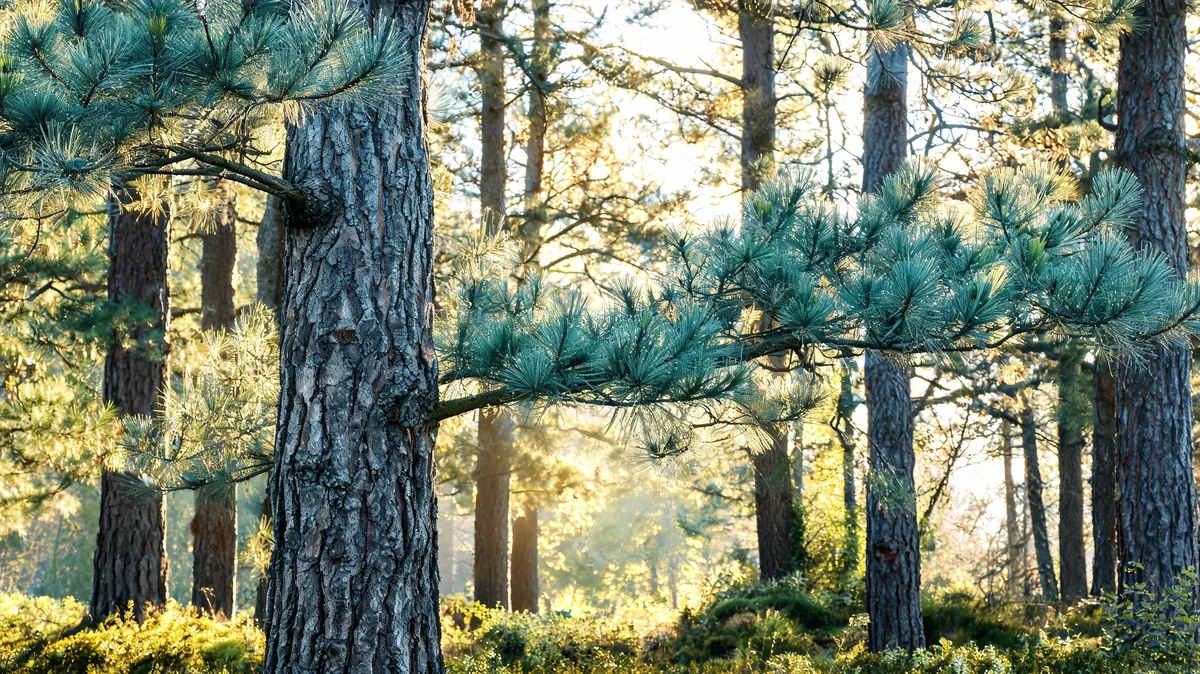
Which pine do you have?
The genus Pinus contains over 100 species. Three appear most commonly in eastern North American landscapes.
Eastern white pine (Pinus strobus)
The largest native pine in the eastern U.S. — potential height 80–100 feet in natural settings, typically 50–80 feet in landscapes. Soft, blue-green needles in bundles of five. Fast-growing: 1–2 feet per year when young. Per Penn State Extension, eastern white pine is "the most widely planted native pine for reforestation, windbreaks, and wildlife habitat in the northeastern U.S." Hardy in zones 3–8. Does not tolerate road salt, air pollution, or compacted soil well.
Mugo pine (Pinus mugo)
A compact, globe-shaped pine from the Alps. Heights range from 3–20 feet depending on cultivar — the landscape-friendly dwarf forms like 'Mops' and 'Slowmound' stay under 5 feet in 10 years. Dark green, stiff needles in pairs. Per University of Minnesota Extension, mugo pine is "one of the most versatile and widely planted dwarf conifers for cold climates." Hardy in zones 2–7.
Austrian pine (Pinus nigra)
A large, dark-needled European pine historically used for windbreaks and highway plantings. Dense pyramidal form when young, becoming flat-topped with age. Per Penn State Extension, Austrian pine "was widely planted in the mid-Atlantic and Midwest from the 1950s through 1990s but has largely fallen out of favor due to its susceptibility to Diplodia tip blight in humid climates." Hardy in zones 4–7. Still suitable in drier climates (upper Midwest, Great Plains) where disease pressure is lower.
USDA hardiness and where pines grow
Per the species descriptions above: eastern white pine is zones 3–8; mugo pine is zones 2–7; Austrian pine is zones 4–7. The broad zone ranges mean that pines are among the most geographically adaptable conifers in North American horticulture. Per Penn State Extension, eastern white pine "is native to the northeastern U.S. and Canada and extends south at elevation through the Appalachians" — it is adapted to a huge range of North American climates.
Site-specific limitations matter more than zone for pines: road salt tolerance (very poor in eastern white pine, better in Austrian pine), air pollution (avoid eastern white pine in industrial corridors), and soil drainage (all pines require well-drained soil).
Light
All pines require full sun. They are not shade-tolerant trees at any stage of their development. Per Penn State Extension, "pines planted in shade develop sparse, one-sided growth and are much more susceptible to wind throw and structural failure." Six or more hours of direct sun is the minimum for acceptable performance; full day sun is ideal for all three species. When trees are planted under power lines or in the shade of existing trees, they eventually decline.
Watering
Established pines are drought-tolerant and one of the most water-efficient landscape trees available. Per University of Minnesota Extension, mature pines "rarely require supplemental irrigation once established." During the first 2–3 years after planting, water weekly during dry periods to support root establishment — deep watering to 12 inches is preferred over shallow, frequent irrigation. After establishment, pines in the eastern U.S. survive on rainfall with little or no supplemental water except during severe multi-week droughts.
Overwatering established pines is a more common problem than drought stress — it promotes the root rot and Phytophthora root diseases that kill more pines than drought does. Per Penn State Extension, "eastern white pine is particularly sensitive to poor drainage and standing water."
Soil and pH
Pines are adapted to acidic, well-drained soils and are among the few landscape trees that thrive in sandy, lean, low-organic soil where other species struggle. Per Penn State Extension, eastern white pine prefers "well-drained, slightly acidic soils (pH 4.5–6.0) and does not tolerate alkaline soils or compacted conditions." Mugo pine and Austrian pine tolerate slightly higher pH (up to 6.5–7.0).
The critical soil requirement across all species is drainage. Pines planted in heavy clay or in low-lying areas that collect water develop root rot, Phytophthora, and chronic decline. If you must plant in clay, create a raised mound or amended berm 18–24 inches above grade to ensure root zone drainage.
Planting
Planting depth is the most common cause of pine failure at the nursery and landscape level. Per Penn State Extension, "pines planted too deep develop girdling roots, crown rot, and long-term decline — the root flare (where the trunk transitions to root) must be at or slightly above soil grade at planting." This is the same principle that applies to all trees, but pines are particularly unforgiving of deep planting.
Plant container-grown or balled-and-burlapped pines in spring or early fall. Remove wire baskets and burlap from the upper half of the root ball. Do not amend the backfill heavily — pines in native-soil backfill establish more quickly and develop better root architecture than pines in overly amended planting holes that roots are reluctant to leave.
Fertilizing
Pines in average garden soil rarely need fertilization. Per Penn State Extension, "pines growing in poor, sandy soil may benefit from a light application of a slow-release balanced fertilizer in early spring, but pines in average soil need none." Excessive nitrogen fertilization on pines produces soft, aphid-attractive growth and can increase susceptibility to certain fungal diseases. If a soil test shows pH above 6.5, sulfur applications to acidify the soil are more useful than fertilizer for improving pine health.
Pruning (candle trimming)
Pines produce new growth as "candles" — the new shoot that extends from each branch tip each spring before the needles fully expand. Per Penn State Extension, "the only time to prune pines is during the candle stage in spring — cuts made then allow new buds to form at the cut point, maintaining branch density. Pruning into old wood (wood from previous years) produces stubs that will not resprout on most pine species."
To keep a mugo pine compact, pinch candles back by half in late spring when they are fully extended but needles have not yet opened. This is done by hand without tools on small plants. Do not cut beyond the base of the candle into old wood. Mugo pines allowed to grow without candle trimming become progressively more open and less compact over time.
Common problems
Diplodia tip blight (Diplodia sapinea)
The primary reason Austrian pine has fallen out of favor. Per Penn State Extension, "Diplodia tip blight kills new shoots as they emerge in spring, causing them to turn brown and die with needles still attached." Infection is worse after wet springs and on stressed, older trees. Management: prune out all dead tips during dry weather, apply a fungicide (thiophanate-methyl or copper) beginning at bud swell and continuing through candle elongation. Eastern white pine and mugo pine are much less susceptible. In the mid-Atlantic where spring weather is consistently wet, Austrian pine is no longer a recommended landscape species.
White pine blister rust (Cronartium ribicola)
A serious fungal disease of eastern white pine that requires Ribes (currants and gooseberries) as an alternate host. Per Penn State Extension, "eliminating Ribes plants within 1,000 feet of white pine plantings significantly reduces blister rust infection." Resistant white pine cultivars and genetic selections are available and recommended for new plantings in endemic areas.
Pine sawflies
Caterpillar-like larvae of sawfly species feed in colonies on pine needles in spring and early summer. Per Penn State Extension, "sawfly colonies can be removed by hand or by cutting and destroying infested branches before larvae mature — insecticide applications are effective when larvae are small." Spinosad or pyrethrin are suitable products for severe infestations.
Needle cast diseases
Several fungal pathogens cause needle browning and drop on pine species. Per Penn State Extension, "most needle cast diseases are cosmetic in healthy, well-established trees but can become serious in young trees or those under drought or other stress." Fungicide applications in spring as new needles emerge can prevent infection in high-pressure situations.
Frequently asked
Why are my pine needles turning yellow and dropping?
If the innermost (oldest) needles are yellowing in fall, this is normal — pines drop a portion of their old needles every autumn. Per University of Minnesota Extension, "fall needle drop is normal for all pines and should not be confused with disease." If new needles (current season's) are yellowing, investigate for root problems, Diplodia, or drought stress.
Can I top a pine tree?
No. Per Penn State Extension, "topping pine trees is permanently damaging — pines cannot re-form a central leader after the terminal bud is removed. The result is a permanently disfigured tree with multiple competing leaders, weak branch attachments, and long-term structural problems." If size management is the goal, plant a naturally dwarf species or cultivar.
How fast do pine trees grow?
Eastern white pine is fast — 1–2 feet per year when young, slowing to about 1 foot per year in maturity. Austrian pine is moderate — 1–1.5 feet per year. Mugo pine is very slow — most dwarf cultivars grow 2–4 inches per year. Per Penn State Extension, eastern white pine is "one of the fastest-growing conifers native to the eastern U.S."
Are pines deer-resistant?
Mature established pines are generally not browsed by deer. Young trees are vulnerable to deer rubbing (bucks scraping velvet from antlers, which strips bark) and to needle browse. Per Rutgers NJAES's deer resistance ratings, Pinus strobus is rated as "rarely damaged" — one of the more deer-resistant landscape trees available.
Sources
- Penn State Extension: Eastern White Pine
- Penn State Extension: Austrian Pine
- University of Minnesota Extension: Mugo Pine
- Penn State Extension: Pine Needle Diseases
- Penn State Extension: Pine Sawflies
- Penn State Extension: White Pine Blister Rust
- Rutgers NJAES: Landscape Plants Rated by Deer Resistance
