Pieris Care: Andromeda for Acidic Woodland Beds
Japanese andromeda (Pieris japonica) is a four-season broadleaf evergreen for acidic woodland beds — its early spring flowers and red new growth are its best features, but lace bug is nearly universal in the mid-Atlantic and requires active management.
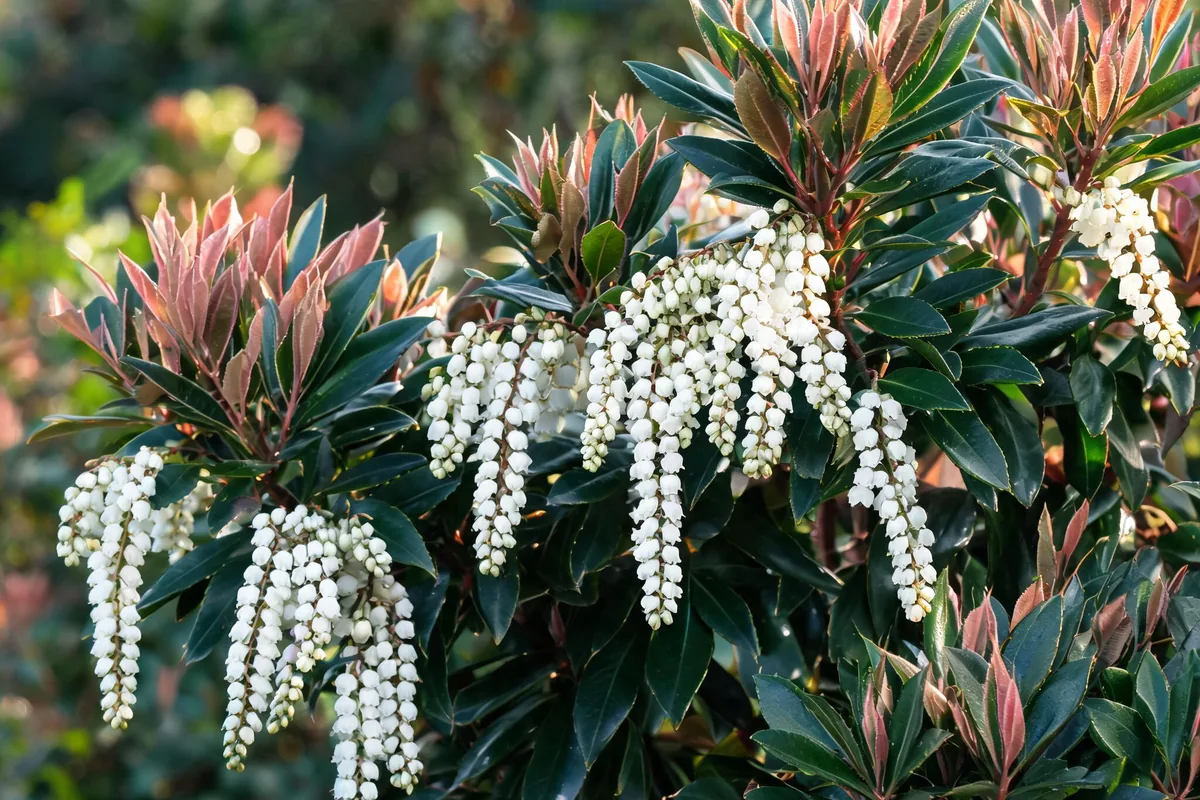
Identification and varieties
Pieris japonica, Japanese andromeda or lily-of-the-valley shrub, is a broadleaf evergreen native to eastern China and Japan. Per Penn State Extension, it is "one of the most ornamental broadleaf evergreen shrubs for acidic-soil gardens in the mid-Atlantic and Pacific Northwest, offering white urn-shaped flowers in early spring, distinctive red-to-pink new growth, and dense dark-green foliage." The flower clusters (racemes) develop in fall as buds and open in late February through April — often at the same time as forsythia and early daffodils, making it one of the earliest flowering shrubs of the season.
Key cultivars cover a range of sizes and new-growth colors:
- 'Mountain Fire': Brilliant fire-red new growth, one of the most ornamental selections. 6–8 feet at maturity.
- 'Dorothy Wyckoff': Compact at 4–5 feet, deep red flower buds that open to pink-white. Better cold hardiness than many selections.
- 'Cavatine': Dwarf at 2–3 feet. A scale-appropriate selection for small foundation beds.
- 'Flaming Silver': Silver-variegated foliage with red new growth — one of the most distinctive foliage plants in this genus. 4–5 feet.
- 'Valley Valentine': Deep rose-pink flowers. Hardy to zone 5 with protection. Most pieris selections have white flowers; this is the leading pink-flowered form.
USDA hardiness and where pieris grows
Per Penn State Extension, Pieris japonica is hardy in USDA zones 5–8. Zone 4 is marginal — the plant may survive but flower buds are often killed by cold, and the semi-exposed broadleaf foliage suffers winter desiccation in exposed positions. It performs best in the mid-Atlantic states, the Pacific Northwest, and the southern Appalachians where mild, moist conditions approximate its native Japanese mountain forest habitat.
Per Clemson HGIC, pieris is "well-adapted to the Piedmont and upper South but struggles in the Gulf Coast's heat and humidity — zone 9 and warmer is outside its reliable range." The Pacific Northwest is ideal: the combination of acidic forest soils, mild winters, and cool, moist summers produces spectacular pieris.
Light
Pieris performs best in part shade — morning sun with afternoon shade is ideal. Per Penn State Extension, "pieris in full afternoon sun, especially in zones 6–7, shows leaf scorch in summer and is more susceptible to lace bug." In deep shade, flower production declines significantly and the red new growth color is less vivid. Dappled light under high deciduous tree canopy (receiving sun in early spring before the trees leaf out) is the natural habitat analog that produces the best pieris performance.
In the Pacific Northwest and in zone 5–6 gardens with cool summers, pieris tolerates more sun without scorch. In zones 7–8, afternoon shade is important for long-term plant health.
Watering
Pieris needs consistent moisture, especially during summer heat. Per Clemson HGIC, "pieris requires consistent moisture during the growing season and is not drought-tolerant — summer drought stress is a predisposing factor for lace bug and other problems." Water to maintain moist (but not waterlogged) soil through the growing season. A 2–3 inch mulch of composted pine bark, pine needles, or shredded wood chips over the root zone conserves moisture and helps maintain the acidic soil conditions pieris requires.
Soil and pH
Acidic, well-drained, humus-rich soil is the foundation of successful pieris culture. Per Penn State Extension, "pieris requires acidic soil at pH 4.5–6.0 — plants growing in neutral or alkaline soils develop iron chlorosis (yellow leaves with green veins) that persists until pH is corrected." This is the same pH range required by rhododendrons, azaleas, and blueberries — if those plants thrive in your soil, pieris will too.
In alkaline soils or where neutral-pH lawn areas have been amended with lime, pieris chlorosis is a predictable problem. Per Clemson HGIC, "chelated iron applications provide temporary improvement, but correcting soil pH with elemental sulfur is the only long-term solution." Sulfur applications should be based on a soil test and applied in fall — pH correction takes 6–12 months to develop fully.
Planting
Plant in spring or fall. Per Penn State Extension, fall planting in zones 6–7 is preferred as it allows root establishment before summer heat. Amend the planting bed with acidic organic matter — composted pine bark, sulfur-treated compost, or pine needle mulch — to establish the right soil environment before planting. Space plants 4–6 feet apart for standard cultivars, 2–3 feet for dwarfs.
Set the plant so the root flare is at or slightly above grade. Pieris planted too deep develops crown rot. Backfill with native soil amended with 30–40% composted bark. Water immediately and apply a 2–3 inch mulch ring.
Fertilizing
Per Clemson HGIC, "use an acid-forming fertilizer formulated for azaleas and camellias in early spring when growth begins." This supports both nutritional needs and the soil acidification that pieris requires. Avoid standard balanced or alkaline-forming fertilizers. A second light application in early summer can support vigorous growth on young plants. Established pieris in properly acidic soil requires only one annual application. Stop fertilizing by July to allow new growth to harden off before fall.
Pruning
Pieris needs minimal pruning. Per Penn State Extension, "prune only to remove dead or crossing branches, and do so immediately after flowering in spring." The flower buds that produce next year's display form in late summer — pruning in fall or winter removes them. The dense, naturally neat growth habit of most pieris cultivars rarely requires corrective pruning. Removing spent flower clusters promptly can direct energy into new growth rather than seed production, slightly improving next year's flower bud set.
Common problems
Pieris lace bug (Stephanitis takeyai)
The primary pest problem with pieris in the mid-Atlantic, Northeast, and parts of the South. Lace bugs feed on the underside of leaves, causing a characteristic silvery, stippled appearance on upper leaf surfaces. Per Penn State Extension's pieris lace bug guidance, "lace bugs overwinter as eggs in leaf tissue and produce 2–3 generations per year — a single season of neglect can allow populations to reach damaging levels." Management options:
- Horticultural oil or insecticidal soap applied to leaf undersides in early spring when nymphs first appear
- Systemic insecticide (imidacloprid) as a soil drench in spring provides season-long control but affects other insects — avoid on or near flowering plants
- Regular monitoring — catching populations early is far easier than controlling established infestations
Per Penn State Extension, lace bug is "more severe on pieris in full sun and on drought-stressed plants" — siting in appropriate shade and maintaining adequate moisture reduces pressure.
Iron chlorosis
Yellow leaves with green veins, caused by high soil pH reducing iron availability. Per Clemson HGIC, "chelated iron applications are effective temporarily; sulfur to lower soil pH is the permanent fix." A soil test is the necessary first step to determine the magnitude of the pH problem and the required sulfur rate.
Phytophthora root rot
In wet, poorly drained soil, Phytophthora causes progressive decline, brown roots, and eventually plant death. Per Penn State Extension, "pieris in heavy clay or in areas that stay wet after rain is highly susceptible to root rot." Well-drained soil is a non-negotiable requirement. Raised beds or bermed planting areas in clay soils are the reliable solution.
Deer browse
Per Rutgers NJAES's deer resistance ratings, Pieris japonica is rated as "occasionally severely damaged." In moderate-deer-pressure landscapes, pieris is usually left alone, but in high-pressure areas — suburban Long Island, central New Jersey — deer will browse it in winter when other food is scarce. Fencing young plants or applying repellents through the winter months is the practical solution in high-pressure areas.
Frequently asked
Why does my pieris have yellow leaves?
The most common cause is alkaline soil — pH above 6.5 restricts iron uptake, causing the characteristic yellow leaf with green veins (iron chlorosis). Per Penn State Extension, "this is the most misdiagnosed pieris problem — gardeners apply more fertilizer, which doesn't help if the pH is the root cause." Get a soil test, correct pH with sulfur, and apply chelated iron for faster temporary improvement.
When does pieris bloom?
In most of the eastern U.S., late February through April, depending on zone and year. Per Clemson HGIC, "flower buds are visible through fall and winter as ornamental features before they open in very early spring — one of the first shrubs to bloom in the Northeast." In zone 5, bloom may come in late March to April; in zone 7 and 8, late February or even January in warm years.
Is pieris toxic?
Yes. Per the Royal Horticultural Society's pieris toxicity guidance, "all parts of pieris contain andromedotoxins that are toxic to humans, dogs, cats, horses, cattle, and goats if ingested." The toxicity is highest in leaves and nectar. Honey made from bees visiting pieris flowers can cause illness. Keep children and animals away from the plant and dispose of prunings carefully.
Can pieris grow in alkaline soil?
Not sustainably. Per Penn State Extension, "pieris planted in soil above pH 6.5 will develop progressive iron chlorosis that debilitates the plant over time, even with regular fertilization." The long-term fix is soil acidification with elemental sulfur, not chelated iron supplements. If soil pH cannot be managed, choose a different shrub — mountain laurel, inkberry holly, or itea are good acidic-soil alternatives with less pH sensitivity.
