Best Floating Row Covers for Pest Exclusion (2026)
title: "Best Floating Row Covers for Pest Exclusion (2026)"
outdoorplantcare-20). We earn a small commission at no cost to you. Price shown was accurate as of the last edit; check current on Amazon.
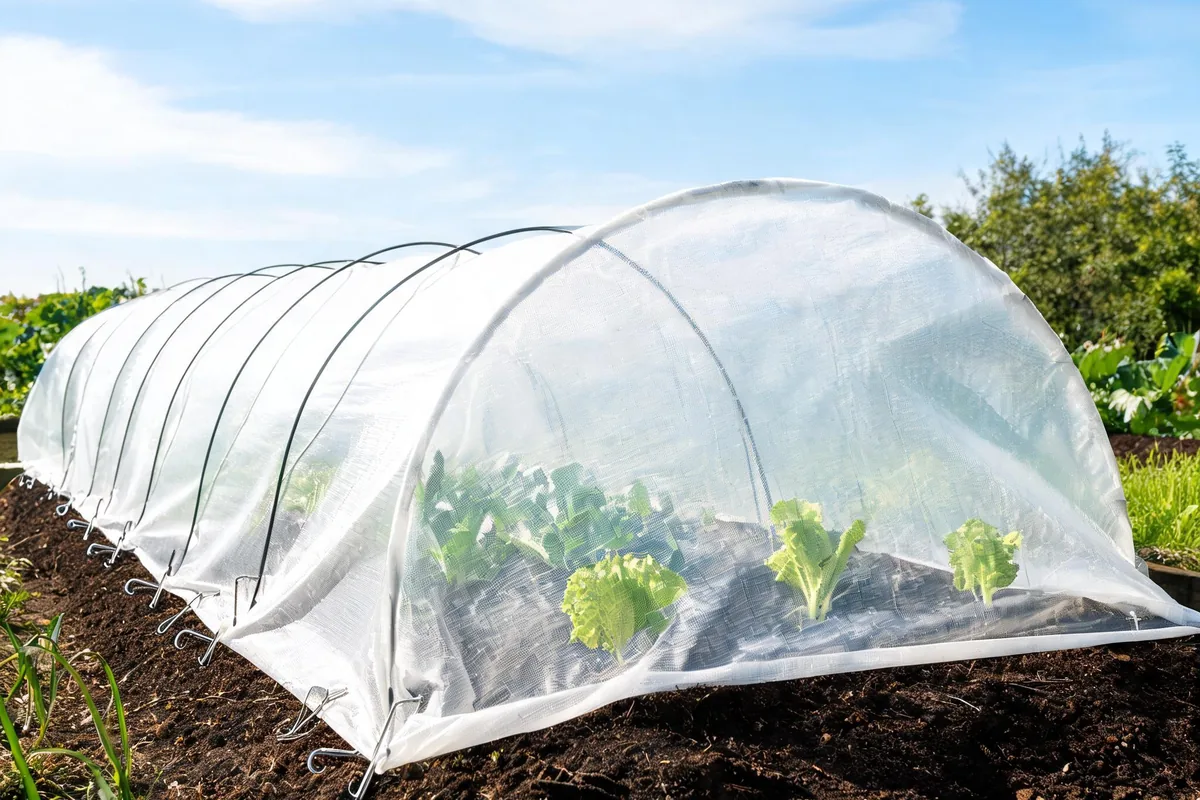
Agribon row cover
Spun-bonded floating row cover blocks pests (cabbage moth, flea beetle, cucumber beetle) while letting light and water through.
What we like
- 70% light transmission — plants grow underneath
- Reusable for 2-3 seasons if handled gently
- Extends the season by 2-4 weeks
Trade-offs
- Tears if snagged on stakes
- Traps heat in mid-summer if left on
This article contains affiliate links. As an Amazon Associate, we earn from qualifying purchases - at no extra cost to you. We only recommend products we have personally tested or that are the universal first recommendation from university Extension publications.
Floating row covers are the simplest and most effective physical pest control available to vegetable gardeners. A lightweight fabric row cover placed over plants at transplant time physically excludes insects from laying eggs on the crop — no pesticides required, no residue, no harm to beneficial insects in the rest of the garden.
Per Cornell Cooperative Extension, row covers are the primary recommended defense against three of the most damaging vegetable pests in the Northeast: cabbage butterfly/moth (Pieris rapae, Mamestra configurata, and others), cucumber beetle (Acalymma vittatum, Diabrotica undecimpunctata), and squash vine borer (Melittia cucurbitae). These pests cause damage that ranges from severe defoliation (cabbage moth caterpillars) to plant death (squash vine borer girdling the vine base).
Table of Contents
- Which pests row covers actually stop
- Cover weight and light transmission: what the numbers mean
- Our pick: Agribon AG-19 Floating Row Cover
- What to look for in any row cover
- Comparison table
- Installation and crop-specific protocols
- FAQ
Which pests row covers actually stop {#which-pests}
Row covers are a physical barrier — they work against any pest that must contact the plant to cause damage. Per Cornell Cooperative Extension and UC IPM, the most important applications:
**Cabbage moth and butterfly (Pieris rapae, Plutella xylostella, Mamestra spp.):** Adults lay eggs on brassica leaves; larvae (imported cabbageworm) feed on leaves and heads. A row cover installed at transplant and secured to the ground prevents adults from reaching plants. Per Cornell Extension, this eliminates the primary caterpillar damage to brassicas without any spray.
**Cucumber beetle (Acalymma vittatum, Diabrotica undecimpunctata):** Striped and spotted cucumber beetles damage cucurbit foliage and transmit bacterial wilt (Erwinia tracheiphila). A single infection via cucumber beetle feeding kills a plant within weeks. Per Cornell Extension, row covers from transplant until first flower prevent most cucumber beetle contact. At first flower, covers must be removed for bee pollination.
**Squash vine borer (Melittia cucurbitae):** A moth that lays eggs at the base of squash vines; the larvae bore into the stem and kill the plant from within. Row covers prevent adults from reaching the stem. Covers must be removed when female flowers open (squash flowers are large and conspicuous) for pollination. Per Penn State Extension, in zone 7a squash vine borers have two generations per season — the first peak flight is late June through July. Timing covers to the vine borer's first flight cycle is key.
**Flea beetles (Epitrix spp. and others):** Tiny beetles that shothole-damage eggplant and young brassica transplants. Per Cornell Extension, row covers during the first 4 to 6 weeks after transplant are the most effective flea beetle management for organic growers.
What row covers do NOT stop: Pests already present in the soil (cutworms, root maggots, wireworms) are not excluded by covers. Aphids can build up under covers if the cover is installed over an infested transplant. Per Penn State Extension, inspect transplants for pest pressure before covering and treat infestations before installing covers.
Cover weight and light transmission: what the numbers mean {#weight-and-light}
Row covers are rated by weight (ounces per square yard), which correlates with thickness, light transmission, and frost protection:
| Cover weight | Light transmission | Frost protection | Best use |
|---|---|---|---|
| 0.5 oz/sq yd (AG-19) | ~85% | 2-4°F | Summer pest exclusion |
| 0.9 oz/sq yd (AG-30) | ~70% | 4-6°F | Spring/fall season extension + some pest exclusion |
| 1.5 oz/sq yd (AG-50) | ~50% | 6-8°F | Frost protection, overwintering |
| 2.0 oz/sq yd (AG-70) | ~30% | 8-10°F | Hard freeze protection |
Per Cornell Cooperative Extension, the 0.5 oz (AG-19 equivalent) is the right weight for pest exclusion during the growing season because it transmits enough light to avoid light limitation in the crop. Heavier covers reduce light and can increase disease pressure from humid conditions under the cover.
Our pick: Agribon row cover AG-19 Floating Row Cover (10ft x 50ft) {#our-pick}
Agribon AG-19 Floating Row Cover (10ft x 50ft) — approximately $30 to $50
See on AmazonWhy we picked this
Agribon row cover is the commercial-scale row cover brand that Extension publications cite when recommending specific materials. The AG-19 designation (0.5 oz/sq yd, 85% light transmission, 2 to 4°F of frost protection) is the weight recommended for warm-season pest exclusion by Cornell Extension, Penn State Extension, and UC IPM.
The 10 x 50-foot roll covers a 4x8-foot raised bed with a 1-foot drape on each side plus significant fabric left over for a second bed. The material is a spunbonded polypropylene fabric — durable enough for multiple seasons if handled carefully and stored out of UV between uses.
At 0.5 oz/sq yd, the AG-19 can be draped directly over short crops (lettuce, brassica transplants) without support structures — the fabric is light enough that crop growth lifts the cover without damage. For taller crops (tomatoes, squash, cucumbers) or those prone to damage from fabric contact, wire hoops set every 3 to 4 feet hold the cover off the plant canopy.
Honest limitations
Must be removed for pollination. Any crop that requires insect pollination (cucurbits, peppers, tomatoes) must have covers removed when flowers open. Per Cornell Extension, bees cannot reach flowers through row cover fabric, so covered plants produce no fruit.
Creates a humid microclimate. Covers slow air movement and retain moisture. Per Penn State Extension, if plants enter the cover with foliar disease or aphid populations, those problems accelerate under the cover. Install covers only over healthy, pest-free plants.
Rodent tunneling. Mice and voles will burrow under covers to access plants. Secure the cover edges firmly with soil, rocks, or landscape staples. Do not rely on loose draping in areas with significant rodent pressure.
What to look for in any row cover {#what-to-look-for}
Weight/density: 0.5 oz/sq yd for warm-season pest exclusion. 0.9 oz/sq yd for spring/fall season extension with pest exclusion. Do not use heavy frost covers (1.5 oz+) for pest exclusion in summer — light limitation and overheating are risks.
Width and length: Match to your bed dimensions plus a foot on each side for staking or burying edges. Common sizes: 10x25 ft, 10x50 ft, 12x50 ft, 20x50 ft.
Durability: Spunbonded polypropylene (Agribon row cover, Reemay) lasts 3 to 5 seasons with careful handling. Woven covers last longer but cost more and are less common for row cover applications.
See on AmazonUV stabilization: Covers stored in direct sun without UV stabilization degrade in one to two seasons. Look for "UV stabilized" in the material specification.
Comparison table {#comparison-table}
| Agribon row cover AG-19 | Agribon row cover AG-30 | Agribon row cover AG-50 | |
|---|---|---|---|
| Weight (oz/sq yd) | 0.5 | 0.9 | 1.5 |
| Light transmission | 85% | 70% | 50% |
| Frost protection | 2-4°F | 4-6°F | 6-8°F |
| Best use | Warm-season pest exclusion | Spring/fall season extension | Frost/freeze protection |
| Price (10x50 ft) | $30-50 | $35-55 | $40-60 |
| Summer use risk | None | Slight light limitation | Significant light limitation |
Installation and crop-specific protocols {#installation}
Installation basics
Per Penn State Extension and Cornell Extension:
- Prepare the bed before installing covers — weed, fertilize, and amend before cover installation. Working in a covered bed is difficult.
- Install at transplant time (or immediately after seed germination for direct-seeded crops). The pest exclusion benefit starts at the first opportunity for insects to lay eggs.
- Secure edges with soil, rocks, bricks, landscape staples, or sandbags. Any gap at the edges allows pest entry. Per UC IPM, cucumber beetles, in particular, will find gaps — secure edges thoroughly.
- Allow slack for plant growth. A cover installed with no slack will be lifted and eventually torn as plants grow. Leave 6 to 12 inches of extra fabric per linear foot of bed.
- Use hoops for tall crops — tomatoes, cucumbers, squash, and eggplant need 18 to 24-inch wire hoops to keep fabric off foliage.
Crop-specific protocols
Brassicas (broccoli, cabbage, kale, Brussels sprouts, cauliflower): Install at transplant. Secure edges well. Leave covers on through harvest — brassicas do not require insect pollination. Per Penn State Extension, this single practice eliminates most caterpillar damage and significantly reduces flea beetle damage.
Cucumbers and melons: Install at transplant to protect from cucumber beetle and bacterial wilt. Remove at first flower for bee pollination. After initial fruit set (most fruit pollinated in first 2 weeks of flowering), covers can be reinstalled to reduce late-season beetle damage if needed.
Squash: Install at transplant. Monitor for squash vine borer flight (adults are wasp-mimicking moths active midday). Remove when female flowers (with tiny squash at base) open for pollination. Per Penn State Extension, one to two weeks of cover during peak borer flight in late June prevents most damage. After the first generation of borers passes (typically by late July), covers can be removed.
Tomatoes and peppers: Row covers are less commonly used on tomatoes and peppers for pest exclusion because these crops require pollination, and their main pests (hornworm, aphids) are better managed with other IPM tools. Row covers can provide early-season frost protection (use AG-30 or AG-50 for this purpose).
Frequently asked {#faq}
Can I leave row covers on plants through rainstorms?
Yes. The AG-19 spunbonded fabric is water-permeable — rain passes through freely. This is an advantage over plastic row covers (low tunnels), which require opening for irrigation. Per Cornell Extension, row covers can remain in place through rain and moderate wind, though very strong winds may displace covers with inadequate edge weighting.
How do I secure row cover edges without burying them?
Landscape staples (U-shaped metal pins) driven at 12-inch intervals along the edges hold row covers against moderate wind without burying. Rocks, bricks, or sandbags work for heavier covers. Per UC IPM, any gap at the edge is a potential entry point for cucumber beetles — the more thorough the edge sealing, the more effective the exclusion.
Does a row cover also help with deer?
No. A floating row cover provides no meaningful deer resistance — a deer will simply pull it aside or step on it. For deer exclusion, physical fencing of at least 8 feet height is necessary per Rutgers NJAES. Row covers address insect exclusion, not deer. In Melville, where deer pressure is moderate to high, row covers address insect problems while fencing addresses deer separately.
Can I reuse row covers?
Per Penn State Extension, yes — with care. After use, shake off debris, inspect for tears, and rinse if heavily soiled. Store in a dry location out of direct sun between seasons. Spunbonded polypropylene covers degrade primarily from UV exposure, so storage out of sunlight extends lifespan significantly. Most AG-19 covers last 3 to 5 seasons with careful storage.
—-
Sources
- Cornell Cooperative Extension — Home Gardening
- Penn State Extension — Squash Vine Borer
- Penn State Extension — Vegetable IPM
- UC IPM — Row Covers for Pest Control
- Rutgers NJAES — Deer Management