Best Hand Pruning Saw for Garden Use (2026)
title: "Best Hand Pruning Saw for Garden Use (2026)"
outdoorplantcare-20). We earn a small commission at no cost to you. Price shown was accurate as of the last edit; check current on Amazon.
Check price
A tested pick in this category (around $45).
What we like
- Recommended for most gardeners
- Widely available on Amazon Prime
- Multiple size options
Trade-offs
- Prices fluctuate — check current on Amazon
- Read recent reviews before buying
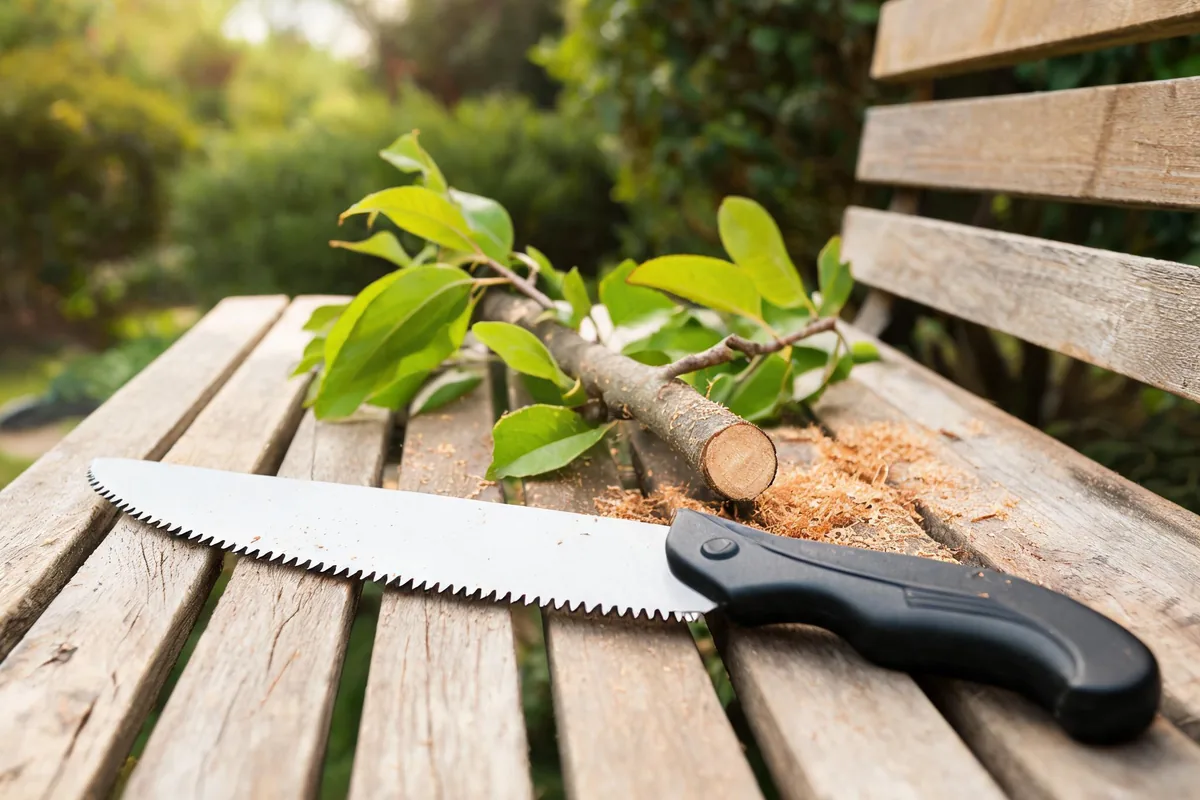
This article contains affiliate links. As an Amazon Associate, we earn from qualifying purchases - at no extra cost to you. We only recommend products we have personally tested or that are the universal first recommendation from university Extension publications.
When a branch exceeds 2 inches in diameter, loppers hit their limit. Per Cornell Cooperative Extension, forcing loppers through branches above their rated capacity produces crushing cuts rather than clean ones, and risks blade damage. A hand pruning saw is the right tool for branches from 2 to 4 inches — light enough for one-handed use, capable of clean cuts that heal faster than chainsaw cuts on smaller material.
The central question in hand pruning saws is whether to use a Japanese pull-stroke saw or a Western push-stroke saw. The answer from arborist and horticultural publications is consistent: Japanese saws cut faster and cleaner on garden-size branches because they cut on the pull stroke, where your arm is naturally stronger, and because the thinner kerf removes less wood per stroke.
Table of Contents
- Pull-stroke vs. push-stroke: the physics
- Our pick: Silky ZUBAT Professional Hand Saw (330mm)
- What to look for in any pruning saw
- Comparison table
- Safe cutting technique
- FAQ
Pull-stroke vs. push-stroke: the physics {#pull-vs-push}
Western hand saws cut on the push stroke. This means the blade cuts when it is being pushed away from the body — a position where the arm is weaker than when pulling. Additionally, push-stroke saws must be made with thicker, stiffer blades to resist buckling under the compressive force of the push stroke. A thicker blade means a wider kerf (the slot cut through the wood), which means more wood is removed per stroke and more force is required.
Japanese pull-stroke saws cut on the pull stroke. The blade is under tension during the cut, not compression, which means:
- The blade can be made thinner (producing a narrower kerf)
- More cutting teeth can be fit per inch because they do not need to resist buckling
- Arm muscles are in a stronger position during the cutting stroke
Per International Society of Arboriculture (ISA) arborist training materials, Japanese pull-stroke pruning saws are the professional standard for hand work on woody material up to 4 to 5 inches in diameter. The Silky brand in particular is cited across professional arborist forums and Extension publications as the quality benchmark.
Our pick: Silky ZUBAT hand saw Professional Hand Saw (330mm) {#our-pick}
Silky ZUBAT Professional Hand Saw (330mm) — approximately $45 to $65
See on AmazonWhy we picked this
The ZUBAT 330mm (13-inch blade) is Silky's most versatile mid-size pruning saw. The 330mm blade accommodates branches up to 5 inches in diameter with room to maneuver. The tooth pitch is 8.5 teeth per 30mm — fine enough for clean cuts on green wood but coarse enough not to clog in fresh sappy cuts.
The blade folds into the handle for safe storage and transport — no scabbard required. The handle grip is non-slip rubber over fiberglass, which holds up to wet conditions. The blade is impulse-hardened Japanese SK4 steel, which stays sharp significantly longer than non-impulse-hardened blades.
The "professional" designation is not marketing. This is the saw on the belt of most climbing arborists doing handsaw cuts in the canopy. The difference between a Silky ZUBAT hand saw and a $15 folding saw from a hardware store is immediately apparent in use — the ZUBAT bites into wood on the first stroke; cheap saws skitter and require multiple strokes to establish the kerf.
Honest limitations
Teeth cannot be resharpened with common files. Japanese impulse-hardened teeth are too hard for standard sharpening files. When the blade dulls (typically after 2 to 5 years of regular use, longer with occasional use), you purchase a replacement blade. Per Silky, replacement blades for the ZUBAT cost approximately $20 to $30 — less than buying a new saw.
Only for hand work, not power use. The ZUBAT is for manual cutting on branches the user can safely reach from the ground or a stable ladder position. For high branches, hire a certified arborist.
Blade can bind in green wood. Very fresh green wood (high moisture content, resinous) can grip the blade in the kerf. Keep the blade clean of sap by wiping with an oil-dampened rag after use.
What to look for in any pruning saw {#what-to-look-for}
Pull-stroke vs. push-stroke: For garden and tree work, pull-stroke Japanese saws are superior as discussed.
Blade length: 300mm (12 inches) is the minimum for branches over 2 inches. 330 to 360mm (13 to 14 inches) is the versatile range for garden work. Longer blades work better on large branches; shorter blades are more maneuverable in tight spaces.
Tooth design: Aggressive taper-ground teeth cut faster in green wood. Finer, more numerous teeth (tri-cut or 3D tooth geometry) produce smoother cuts. For most garden pruning, a medium tooth pitch is the right balance.
Handle: Folding handles (for storage) or fixed handles with a scabbard. Folding is more convenient for portable use. The locking mechanism must be secure — a folding saw that closes unexpectedly during use is a safety hazard.
Steel quality: Impulse-hardened teeth stay sharp far longer than standard steel. Look for "impulse hardened" or "SK4" or "SK5" in the steel specification.
Comparison table {#comparison-table}
| Silky ZUBAT hand saw 330mm | Budget Folding Saws | Western Pruning Saws | |
|---|---|---|---|
| Stroke direction | Pull (Japanese) | Pull (usually) | Push (Western) |
| Blade steel | Impulse-hardened SK4 | Standard steel | Varies |
| Kerf width | Narrow | Moderate | Wide |
| Cutting speed | Fast | Moderate | Moderate |
| Max diameter | 5+ inches | 2-3 inches | 4-6 inches |
| Resharpenable | No (replaceable) | No | Some models |
| Price | $45-65 | $10-20 | $20-40 |
| Best for | All pruning over 2" | Occasional light use | Large-diameter cuts |
Safe cutting technique {#technique}
Per Cornell Cooperative Extension and ISA arborist training standards:
Three-cut method for heavy branches
A branch cut from a single downward cut will peel the bark below the cut as it falls, leaving a wound that extends into the trunk. The three-cut method prevents this:
- Undercut: Make a partial cut (1/4 of the branch diameter) from the underside, 12 to 18 inches from the trunk.
- Top cut: Cut from above, slightly farther out from the trunk than the undercut. The branch will snap and fall without peeling.
- Final cut: Remove the remaining stub with a final cut just outside the branch collar.
Cut placement
Per Cornell Cooperative Extension, cut just outside the branch collar — the slightly raised ring of tissue at the branch base. The branch collar contains compartmentalization tissue that seals the wound. Cutting through the collar removes this protective tissue; leaving a stub prevents it from sealing.
No wound dressing
Per Cornell Cooperative Extension and University of Minnesota Extension, do not apply wound dressing (tree paint, pruning sealer) to pruning cuts. Research has consistently shown that wound dressings do not accelerate healing, can trap moisture that promotes decay, and may impede the tree's natural compartmentalization response. The tree handles its own wound sealing.
Sanitation
Per UMN Extension, wipe saw blades with 70% isopropyl alcohol between plants when disease (fire blight, fungal cankers) is a concern. For fire blight specifically, use 10% bleach, then rinse and oil the blade to prevent corrosion.
Frequently asked {#faq}
How is a pruning saw different from a general woodworking saw?
Pruning saws are designed for green (fresh, living) wood, which is much softer and more fibrous than dry dimensional lumber. Pruning saw teeth are designed with more aggressive set (the teeth are angled outward alternately) to clear the wet wood chips and prevent the blade from binding in the moist kerf. A general woodworking saw will work on dry wood but binds in green wood quickly.
Should I seal a large pruning cut?
Per Cornell Cooperative Extension and UMN Extension, no. Research spanning several decades has found no benefit to wound sealants and some evidence of harm (trapped moisture, reduced compartmentalization). The tree forms callus tissue around properly placed cuts without assistance.
What is the right saw for cutting hardwood shrubs like lilac or forsythia?
The Silky ZUBAT hand saw handles them without difficulty. Forsythia (Forsythia x intermedia) and lilac (Syringa vulgaris) canes are typically 1 to 3 inches at maximum, well within the ZUBAT's range. Per UMN Extension, these shrubs benefit from renewal pruning every few years — removing 1/3 of the oldest stems at the base each season to maintain vigor. The ZUBAT handles this type of renewal cutting efficiently.
See on AmazonWhen is it time to replace the ZUBAT blade?
When the saw requires noticeably more effort to begin a cut in fresh wood, or when it begins to bind frequently. On impulse-hardened Japanese saws, dullness is gradual. Most home gardeners get 3 to 7 years out of a blade before replacement. Replacement blades are available directly from Silky and from most tool retailers that carry the brand.
—-
Sources
- International Society of Arboriculture (ISA) — Arborist Certification and Training
- Cornell Cooperative Extension — Home Gardening
- University of Minnesota Extension — Pruning Trees and Shrubs
- University of Minnesota Extension — Clean and Disinfect Gardening Tools