Shade-loving outdoor plants: what actually works in deep, dry, and dappled shade
title: "Shade-loving outdoor plants: what actually works in deep, dry, and dappled shade"
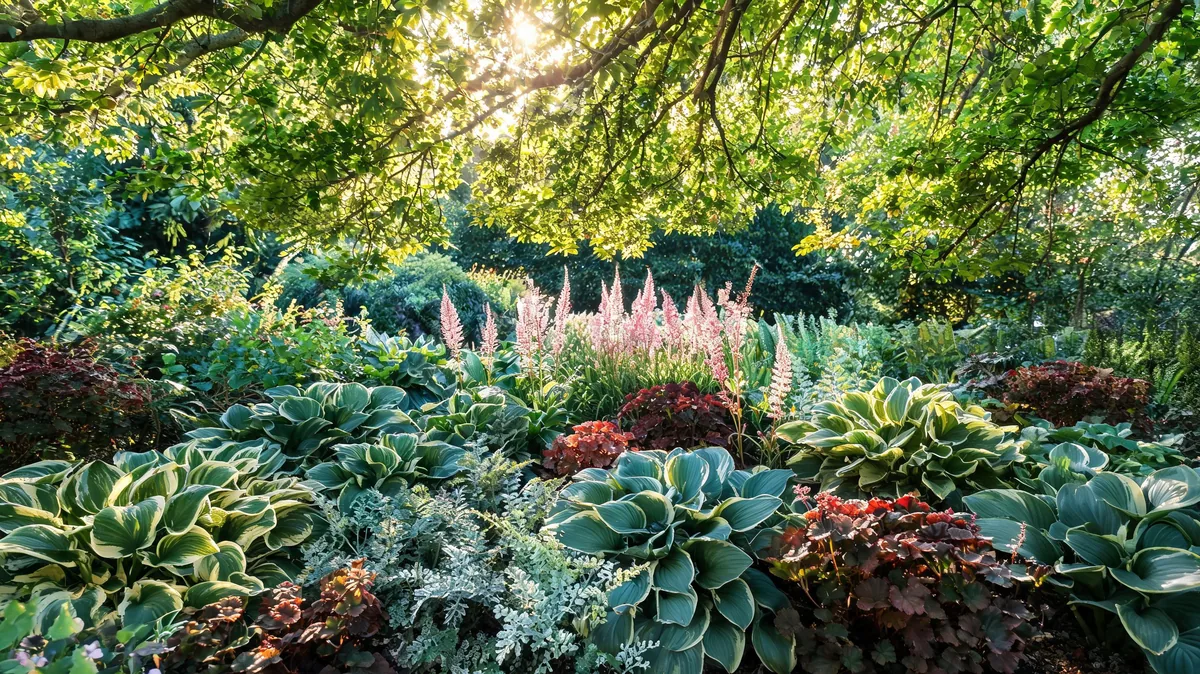
—- title: "Shade-loving outdoor plants: what actually works in deep, dry, and dappled shade" slug: shade-loving-outdoor-plants hub: care category: Care description: "An honest field guide to shade plants. What survives a north-facing patio with zero direct sun, what handles dry shade under a maple, and the plants most lists recommend that don't actually work." date: 2026-06-10 updated: 2026-06-10 hero_image: /images/hero-shade.jpg author: "Thomas A." reading_time: 12 —-
There are three kinds of shade, and most plant tags treat them as one thing. They're not the same, and the same plant that thrives in one will die in another. This is the field guide I wish I'd had when I tried to plant the north side of my house in Melville for the third time.
[!CALLOUT] The three shade categories that matter:
- Dappled shade: under deciduous trees with filtered light moving across the ground all day. Most "part-shade" perennials thrive here.
- Bright shade with morning sun: north and east exposures that get 1-3 hours of gentle direct sun. The most workable shade situation.
- Deep shade: north-facing patios, the base of a north wall, dense evergreen shade. Zero direct sun. The hardest situation in the garden, and the one where most "shade plant" recommendations fail.
What "full shade" actually means on a plant tag
Per UMN Extension, the industry definitions are:
- Full sun: 6+ hours of direct, unobstructed sun
- Part sun: 4-6 hours of direct sun, preferably morning
- Part shade: 3-4 hours of direct sun, or all-day dappled light
- Full shade: less than 3 hours of direct sun
The problem: most growers in the wholesale nursery industry are in zones 7-9 in the south or California. Their "full shade" rating assumes some ambient bright light. A north-facing patio in Long Island in October has neither direct sun nor much bright ambient light. That's a different environment, and the standard "full shade" perennial list (astilbe, brunnera, foxglove) starts to fail there.
Plants that genuinely survive zero direct sun
These are the plants I've personally watched survive on the dark north side of my Long Island house (zone 7a, sandy loam, north exposure, gets reflected light only):
Hosta
The default deep-shade plant for a reason. Blue-leaved varieties (Hosta sieboldiana "Elegans," H. "Halcyon") hold color best in deep shade and don't burn. Yellow and chartreuse cultivars need at least some direct sun to develop color and look washed-out in pure shade. Cornell's hosta selection guide has the cultivar database.
Deer will eat hostas to the ground in moderate-to-high pressure areas. They are Rutgers C ("occasionally severely damaged"). If you have deer, you need spray rotation from late April through October, or a fence. There's no plant-it-and-forget-it option with hostas if you have deer.
Ferns (the right species)
Not all ferns handle dry shade. Native species - Christmas fern (Polystichum acrostichoides), lady fern (Athyrium filix-femina), ostrich fern (Matteuccia struthiopteris) - tolerate the dry root competition you get under mature trees. Japanese painted fern (Athyrium niponicum "Pictum") needs more moisture. All ferns are reliably deer-resistant (Rutgers A or B).
Hellebore (Lenten rose)
Evergreen foliage that looks good 12 months a year. Blooms in February-March when nothing else is up. Rutgers A for deer resistance - genuinely untouched. The newer cultivars from breeding programs like Pine Knot Farms have upward-facing flowers in pink, yellow, near-black, and double forms. Missouri Botanical Garden's hellebore guide is the definitive cultivar reference.
Heuchera (coral bells)
Grown for foliage color - the modern cultivars come in chartreuse, peach, burgundy, silver, near-black. More drought-tolerant than astilbe, which makes them a better choice for dry shade under trees. Rutgers B for deer resistance.
Pulmonaria (lungwort)
Spotted silver foliage that lights up a dark bed. Pink-to-blue spring flowers. Native to European forests - genuinely adapted to deep shade. Spreads slowly into a groundcover.
Brunnera macrophylla
The "Jack Frost" cultivar has silver-veined leaves that look almost metallic in shade. Tiny blue forget-me-not flowers in spring. Needs moisture - struggles in dry shade.
Wishbone flower (Torenia)
The only annual flower I've seen reliably bloom in true zero-sun deep shade. Trailing varieties work in containers on a dark patio.
Wax begonia and tuberous begonia
Both bloom in true deep shade. Wax begonias are bulletproof; tuberous begonias have showier blooms but need more water.
What doesn't work in deep shade (despite the tags)
Plants commonly mislabeled as "shade tolerant" that fail in true zero-direct-sun conditions in my zone:
- Astilbe in dry shade. Astilbe needs consistent moisture - it goes brown and crispy under tree root competition.
- Coral bells with dark foliage (burgundy, black) - they need at least morning sun to develop full color.
- Caladium - tropical, won't survive a zone 7 winter outdoors. Container-only and lift bulbs.
- Bleeding heart in deep shade - it'll grow but blooms are sparse and the plant goes dormant by July.
- Most "shade" hydrangeas - the smooth hydrangea (H. arborescens "Annabelle") and oakleaf hydrangea need 3-4 hours minimum to bloom respectably.
The shade vegetable question
If you have a 4-hour-or-less sun patio and want to grow food, the honest answer is: leafy greens only. Cornell's vegetable production guide lists minimum sun hours for major vegetables:
- Lettuce, spinach, kale, chard, arugula: 3-4 hours minimum, and they actually prefer afternoon shade in summer to slow bolting
- Herbs (parsley, mint, chives, cilantro): 3-4 hours
- Root vegetables (radish, beet, carrot): 4-5 hours
- Beans, peas: 5-6 hours
- Tomatoes, peppers, eggplant: 6-8 hours, no shortcuts
- Cucumbers, squash, melons: 6-8 hours
Below 4 hours, accept that you have an ornamental space, not a vegetable garden.
Container strategies for the deep-shade patio
The advantage of a shady patio is that containers don't dry out as fast as they do in full sun. The disadvantage is that flowering plants are limited.
A combination that's worked on my north-facing entry for three seasons running:
- Thriller (tall center): Caladium "White Christmas" or a snake plant moved out for summer
- Filler (mid-height): wax begonia or wishbone flower in a complementary color
- Spiller (trailing): golden pothos (overwinter as a houseplant) or trailing torenia
Replace caladium with a houseplant fern in zones 6 and colder.
A note on dry shade under trees
Shade under a mature maple, oak, or beech is a special case - the tree roots win every competition for water and nutrients. Plants that tolerate it:
- Epimedium (barrenwort) - tough, deer-resistant, slow groundcover
- Christmas fern - native, deer-resistant
- Pulmonaria - established plants handle dry conditions
- Hellebore - deep-rooted, drought-tolerant once established
- Heuchera - holds up better than astilbe
- Wood asters (Eurybia divaricata) - native, fall bloom, drought-tolerant
What fails under tree roots: anything that needs consistent moisture (astilbe, brunnera, ligularia, most hostas without irrigation).
Quick reference by exposure
| Exposure | Sun hours | Best plants |
|---|---|---|
| North-facing wall, no trees | 0-1 | Hosta, fern, hellebore, pulmonaria, container annuals (impatiens, begonia, torenia) |
| North or east, with morning sun | 2-4 | Astilbe, bleeding heart, hydrangea (oakleaf), heuchera, brunnera, ferns |
| Dappled all day under trees | dappled | Hellebore, epimedium, Christmas fern, hosta, pulmonaria, wood aster |
| West-facing wall, afternoon sun only | 4-6 | This isn't shade - treat as part sun. Daylily, catmint, sedum, salvia, ornamental grass |
Use the sunlight plant finder tool to filter the full plant list by your exact exposure and conditions.
Recommended gear: Best daylily cultivars by bloom time and color — our buyer's guide covering picks for every budget, ranked by Extension publication consensus and personal use.
Sources
- University of Minnesota Extension. "Light Levels for Plants." extension.umn.edu
- Cornell Cooperative Extension. "Plant Selection for Shade." cals.cornell.edu
- Missouri Botanical Garden. Plant Finder database. missouribotanicalgarden.org
- Rutgers New Jersey Agricultural Experiment Station. "Landscape Plants Rated by Deer Resistance." njaes.rutgers.edu
- North Carolina State Extension Gardener Handbook. content.ces.ncsu.edu
