How-to guide

How to Divide Perennials: When and How by Root Type

How to divide perennials — when to divide, which species can and can't be divided, technique by root type (fibrous, rhizome, taproot, crown), and how to revitalize an overgrown bed.
Gardener dividing a large hosta clump with a spade in a shaded garden bed in early spring
Original brand image — Outdoor Plant Care

When to do this

The timing depends on when the plant blooms, not on the calendar alone. Per Penn State Extension, "divide spring and early summer bloomers in fall (August–September), and divide late-summer and fall bloomers in spring (March–April)." This timing ensures that the plant has just finished its primary growing effort and can recover before the next bloom season. Avoid dividing in the heat of summer when stress is highest, and avoid dividing in late fall after the first frosts when soils are too cold for quick root establishment.

Practical exception: many perennials are flexible about timing if kept well-watered through the establishment period after division. Hostas can be divided in spring (my preference on Long Island), summer, or early fall. What matters more than precise timing is keeping divisions moist and shaded for the first two weeks after planting.

What you need

Technique by root type

Fibrous-rooted clumps (hostas, daylilies, ornamental grasses, black-eyed Susans, asters)

These are the easiest to divide. The clump has no single dominant root structure — just a mass of fibrous roots attached to multiple growing crowns.

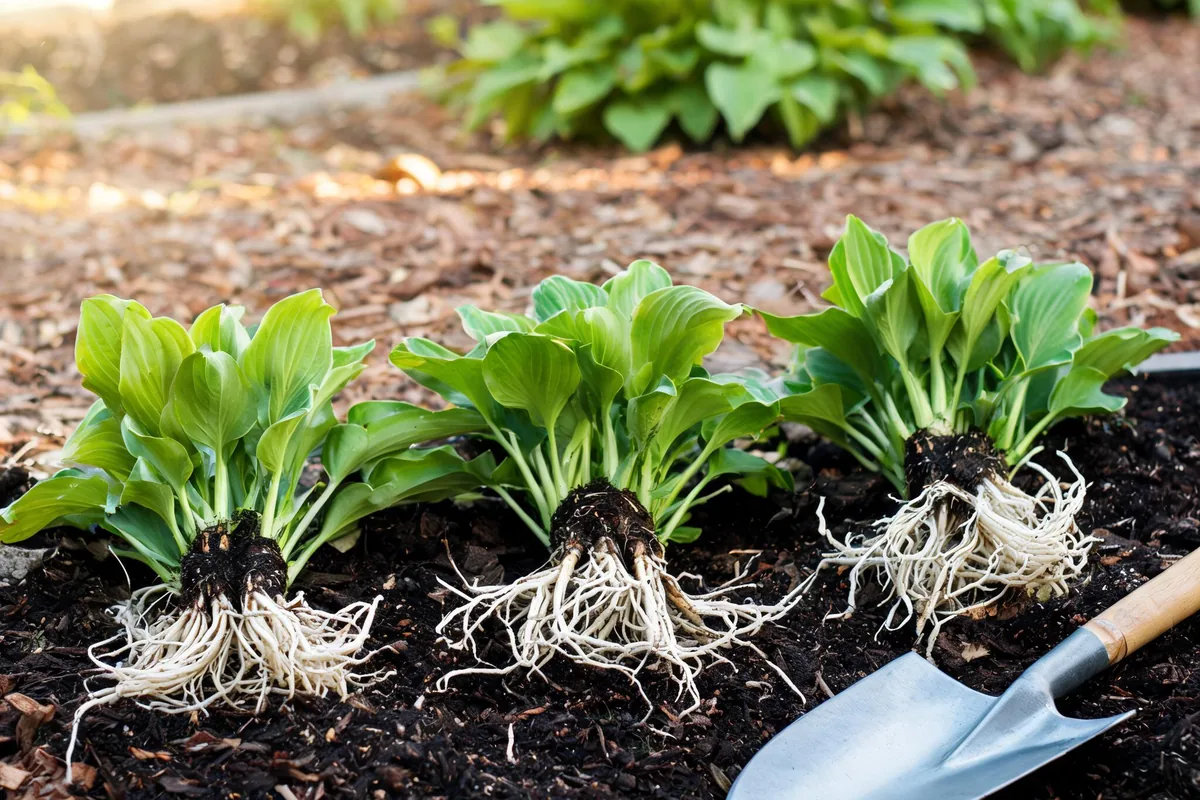
Dig the entire clump out of the ground first (easier to work with above ground than in the hole). Use a garden fork to loosen the soil at the perimeter, then lever upward to lift the whole root ball. Lay the clump on the ground, then divide into sections using a sharp spade thrust directly through the center. For large clumps, the "two-fork method" works well: insert two garden forks back-to-back through the center of the clump and push the handles apart — the tines pry the roots apart cleanly without as much cutting damage as a spade. Each section needs both roots and at least one healthy growing bud (eye). Per University of Minnesota Extension, "sections with 3–5 eyes or growing points will reestablish most quickly."

Crown divisions (peonies, hostas, daylilies)

Crowns are where stems meet roots at or just below the soil surface. Each division needs a piece of crown with attached roots and at least one eye. Use a sharp knife — clean cuts heal faster than torn tissue. Peony divisions that include at least 3 eyes will bloom in 2–3 years; divisions with only 1 eye may take 4–5 years to first bloom. Per Penn State Extension, "plant peony divisions with eyes no more than 1 to 2 inches below the soil surface" — planting too deep is the most common reason divided peonies fail to rebloom.

Rhizome divisions (Siberian iris, bearded iris, canna)

Rhizomes are horizontal underground stems that run at or just below the soil surface. Dig up the clump; it will come up as a mass of interconnected rhizomes. Cut apart individual rhizomes with a sharp clean knife, discarding old, woody central rhizomes and keeping the fresh outer growth. Each division needs: a section of plump, firm rhizome, a fan of foliage or growing tip, and attached roots. Per Penn State Extension, bearded iris should be replanted with the top of the rhizome at or just above the soil surface — "planting too deep prevents blooming and encourages rot." For Siberian iris, full division can be done less frequently (every 5–8 years) and plants can be split more roughly with a sharp spade without precise eye counting.

Tap-rooted plants (can't be divided this way)

Baptisia, coneflowers (Echinacea), butterfly weed (Asclepias tuberosa), bleeding heart (Dicentra), and gas plant (Dictamnus) have deep, brittle taproots and do not tolerate division — they may never recover. Leave these plants undisturbed; they're long-lived and don't need division. Propagate by seed or stem cuttings instead. Per University of Minnesota Extension, "attempting to divide tap-rooted perennials usually kills the plant."

Species I divide on Long Island

Hostas are my most divided perennial — the large clumps under the Norway spruce benefit from division every 4–5 years, and I always have neighbors and friends who will take the extra plants. I divide mine in early April as soon as the tips are 2 inches above the soil — they're easy to see and the cool, wet spring conditions in zone 7a are ideal for establishment. My Siberian iris on the fence line had become congested and was declining in bloom; dividing it in August a few years ago (immediately after bloom) produced noticeably more flowers the following spring. My catmint gets a hard shearing (not technically division, but similar regeneration) immediately after its main June bloom and rebounds with a second flush in August.

Common mistakes

Dividing in the heat of summer (July–August in zones 6–7): the stress of division on top of heat and water demand is usually fatal to small divisions. Wait for cooler conditions. Not watering enough after division: divided plants with reduced root systems need consistent moisture for 3–4 weeks. In my experience, the combination of dividing hostas on dry days without immediately watering in the new divisions is the most common division failure — a desiccated 2-hour window is enough to kill a small hosta division.

Sources